










Shilpa revenue and EBITDA reach records across four segments
Key highlights
- Shilpa reported record Q2 FY27 revenue of Rs 538 crore, up 35% year on year.
- Shilpa’s Q2 FY27 EBITDA reached a record Rs 151 crore, up 37% year on year, with a 28% margin.
- Shilpa’s biologics revenue rose 150% year on year to Rs 65 crore in Q2 FY27.
- Shilpa spent Rs 252 crore on capital expenditure in H1 FY27 while net debt stood at Rs 612 crore.
powered by IRIS
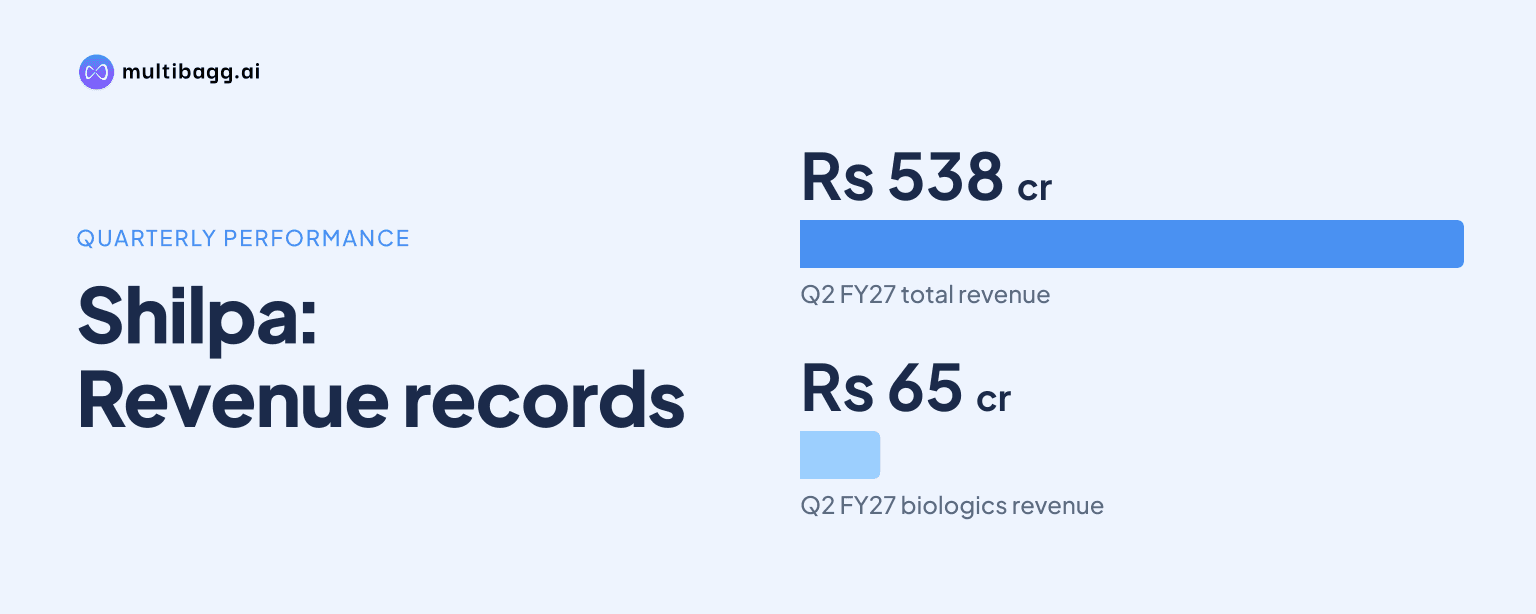
Shilpa Medicare Limited reported record revenue of Rs 538 crore in the second quarter of financial year 2027, up 35% year on year, and record earnings before interest, tax, depreciation and amortisation (EBITDA) of Rs 151 crore, up 37%, as management said active pharmaceutical ingredients (API), formulations, biologics and contract development and manufacturing organisation (CDMO) operations all grew.
Know Shilpa Medicare inside out
Results, valuation, peers and who's buying, in one view.
How did Shilpa perform in Q2 FY27?
Shilpa delivered its highest quarterly revenue and EBITDA in Q2 FY27, with revenue of Rs 538 crore and EBITDA of Rs 151 crore. Revenue rose 35% year on year, while EBITDA increased 37%, producing an EBITDA margin of 28%. Management described the quarter as the company’s best financial performance to date.
For the first half of FY27, or H1 FY27, revenue reached Rs 1,007 crore, up 44% year on year and above Rs 1,000 crore for the first time in a half-year period. H1 EBITDA was Rs 290 crore, up 40%, with a 29% margin. Operating profit before tax, excluding profit from joint ventures and associates and exceptional items, was Rs 104 crore in Q2 FY27 and Rs 202 crore in H1 FY27, while profit after tax was Rs 79 crore and Rs 180 crore, respectively.
Shilpa spent Rs 252 crore on capital expenditure in H1 FY27, primarily from internal accruals, while net debt stood at Rs 612 crore. Management said operating leverage from earlier capacity investment supported results and that return on capital employed improved to 13.3% from 9% in FY25; adjusted return on capital employed was 18.3%.
Which Shilpa businesses drove revenue growth?
Shilpa’s biologics business recorded the fastest reported growth, with quarterly revenue rising 150% year on year to Rs 65 crore in Q2 FY27. Formulation revenue exceeded 50% growth to Rs 210 crore, while non-captive API revenue increased 24% to Rs 255 crore. Management said all four operating engines, including CDMO, contributed to the record quarter, although it did not disclose standalone CDMO revenue.
Formulations grew faster than non-captive APIs in both reported periods. H1 FY27 formulation revenue rose 70% to Rs 407 crore, compared with 20% growth to Rs 470 crore for non-captive APIs. Shilpa said formulation base-business revenue, excluding licensing income, increased 87% in Q2 FY27, led by complex finished-dose products in Europe and supported by the United States and rest-of-world markets.
Shilpa attributed API growth to better uptake of products from newly expanded capacity and steady specialty CDMO performance. It attributed biologics growth to licensing and partnership deal momentum as well as CDMO activity. Biologics represented 12% of revenue, according to management, compared with Rs 65 crore of quarterly segment revenue.
Why did Shilpa’s gross margin decline despite record EBITDA?
Shilpa said the gross-margin decline reflected product mix, because the strong API contribution carried lower gross margins than formulations. An analyst said gross margin had fallen by about 700 basis points sequentially and year on year. Management termed the movement a small decline resulting from API performance being particularly strong in the quarter.
The mix effect occurred alongside a 37% year-on-year increase in EBITDA to Rs 151 crore. The Q2 FY27 EBITDA margin of 28% was one percentage point below the 29% margin reported for H1 FY27, although Shilpa did not disclose the prior-year quarterly EBITDA margin on the call. Management did not quantify raw-material cost changes or price pass-through in its response.
Management instead linked possible further improvement in return ratios to business mix and operating leverage as capacity utilisation rises. It said major investments in CDMO, biologics and new biological entities remain under monetisation, and return on capital employed should improve as plant capacity is filled. No target or timetable for that ratio was provided.
Got a follow-up? Ask IRIS
What launches and capacity plans could affect Shilpa’s growth?
Shilpa plans to commission an integrated peptide manufacturing expansion by the end of FY27, adding two lines to its existing four lines. Management said the facility is designed for tonne-scale annual peptide output and will serve a mix of CDMO, glucagon-like peptide-1 products and high-potency API opportunities.
Management clarified that customer indications, rather than secured orders, informed its peptide capacity plan. It said it expects clearer visibility on actual orders and business in the second half of next year. Separately, Shilpa has more than 25 new chemical entity CDMO client programmes and expects four partners’ programmes to commercialise within 18 to 24 months.
In formulations, Shilpa remains on track to complete more than 15 new oncology generic products in FY27. Three complex 505(b)(2) products are commercialised, while more than five are at advanced development stages. Enzalutamide, Abraxane and the Rotigotine patch are planned for FY28 launches, and the company completed exhibit batches for a semaglutide injectable during Q2 FY27 ahead of planned filings in Europe and rest-of-world markets.
What are Shilpa’s next biologics milestones?
Shilpa said biologics is now a business focus rather than an asset awaiting monetisation, with seven active biosimilars in its portfolio. Management expects two biosimilars to enter human studies for Europe and rest-of-world markets in FY27. It also said CDMO would remain one of the division’s fastest-growing activities.
In India, Shilpa already markets an Adalimumab biosimilar and expects Aflibercept to enter the market in FY27. Management identified Nivolumab as its first planned export-market biosimilar and said it plans to file the product in Europe next year. The company also expects Phase I supplies for three client biologics CDMO programmes in FY27 and plans for its first antibody-drug conjugate biosimilar to enter human studies in FY28.
Shilpa’s recombinant human albumin programme received approval for its global Phase III protocol from the Central Drugs Standard Control Organisation and the European Medicines Agency. Management is targeting an investigational medicinal product dossier submission in Europe in the second half of FY27. It declined to provide revenue guidance for albumin when asked by an analyst.
Conclusion
Shilpa’s Q2 FY27 result combined record revenue of Rs 538 crore with record EBITDA of Rs 151 crore, while reported segment data showed the fastest growth in biologics and formulations. The company’s API business remained its largest disclosed quarterly segment at Rs 255 crore, but management said that mix also contributed to lower gross margin relative to formulations.
The next disclosed checkpoints are peptide-capacity commissioning by the end of FY27, Aflibercept’s planned India entry in FY27 and the recombinant albumin dossier submission in Europe during the second half of FY27. Management’s expected update on whether customer indications convert into peptide orders, as well as commercialisation progress among four partner CDMO programmes over 18 to 24 months, will also be material to its capacity-monetisation plan.