










Shri Ahimsa Naturals Limited targets up to 3x manufacturing capacity
Key highlights
- SANL expects installation of its greenfield facility to be completed by March 2027.
- The greenfield facility is expected to enable up to three times manufacturing capacity.
- H1FY27 revenue rose 32% year on year to Rs 80 crore, while EBITDA rose 23% to Rs 22 crore.
- SANL reported consolidated net debt of Rs 30 crore, including Rs 13 crore for new-plant capital expenditure.
powered by IRIS
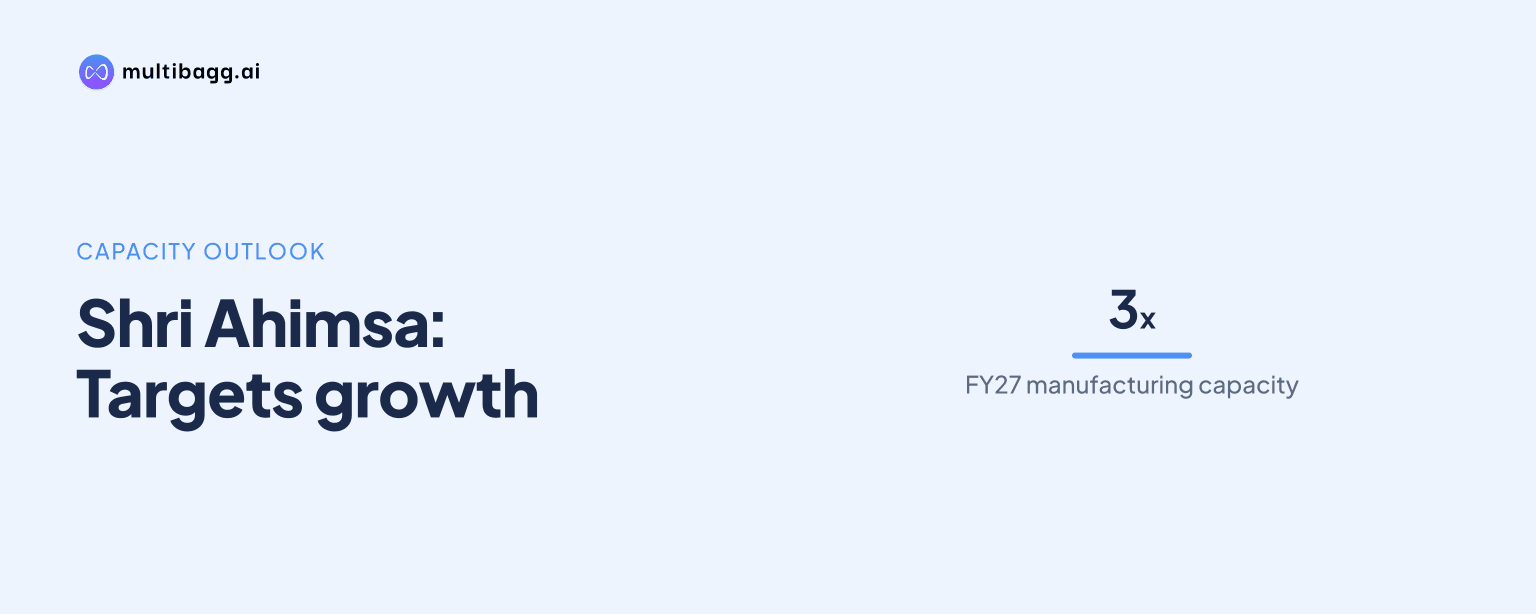
Shri Ahimsa Naturals Limited said its integrated greenfield manufacturing facility could enable up to threefold manufacturing capacity, with installation expected to be completed by March 2027. The project is designed to deepen backward integration through increased crude-caffeine processing and tea-waste sourcing after H1FY27 revenue rose 32% year on year to Rs 80 crore.
Know Shri Ahimsa Naturals inside out
Results, valuation, peers and who's buying, in one view.
What capacity expansion is SANL targeting?
SANL is targeting up to threefold manufacturing capacity through its greenfield facility. The company disclosed the target in its November 6, 2026 release alongside financial results for the half year ended September 30, 2026, and positioned the project as part of its next growth phase. The announcement does not state existing capacity, added capacity in tonnes, the facility location or the project's capital cost.
The planned expansion relates to SANL's natural caffeine and green coffee bean extract operations. SANL operates manufacturing facilities in Bagru, Rajasthan, and exports to more than 14 countries. It identifies natural caffeine anhydrous as a food-grade material for food and beverages, nutraceuticals and cosmetics, while green coffee bean extract is used mainly in nutraceuticals.
The capacity target follows H1FY27 volume growth in both Green Coffee Extract, or GCE, and Natural Caffeine. SANL reported approximately 25% volume growth despite supply-chain disruption associated with the West Asia war. GCE and herbal extracts accounted for about 18% of overall sales, a proportion the company said was consistent during the period.
When will SANL complete the greenfield plant installation?
SANL expects installation of the integrated greenfield manufacturing facility to be completed by March 2027. This is the specific project milestone in the November 6, 2026 announcement, which does not give a separate commissioning date, commercial-production date, ramp-up schedule or revenue forecast for the facility.
The project is partly funded through long-term borrowing at a subsidiary. SANL reported Rs 13 crore of net debt from a long-term loan taken for capital expenditure on the new plant under its subsidiary company. This was in addition to Rs 17 crore of standalone net debt, comprising short-term loans for working capital, taking consolidated net debt to Rs 30 crore in the H1FY27 update.
SANL said working-capital requirements increased as it sought to secure business growth amid logistics disruption. One import container remained stranded in the Strait of Hormuz, although overall shipment disruption was limited because most shipments used alternative routes. Longer lead times deferred some sales into H2FY27, while higher freight costs increased raw-material costs.
SANL said it was progressively passing freight-related cost increases to customers. EBITDA contribution per kilogram increased to Rs 2,149 in H1FY27 from Rs 1,966 in H1FY26, an increase of Rs 183 per kg, despite elevated logistics and ancillary expenses linked to geopolitical disruption.
Got a follow-up? Ask IRIS
How will SANL secure inputs for the expanded plant?
SANL is securing higher quantities of crude caffeine and tea-waste sourcing arrangements to support operations at the new facility in the next year. The company identifies crude-caffeine processing and tea-waste sourcing as parts of the project's backward-integration plan, intended to strengthen raw-material security as manufacturing capacity expands.
The November 6, 2026 release does not name suppliers, disclose committed volumes, specify contract durations or provide procurement prices for crude caffeine or tea waste. It therefore confirms that SANL is arranging additional supply for the facility, but does not establish how much material is contracted or whether all arrangements are complete.
The sourcing plan follows H1FY27 freight conditions that affected both input costs and delivery schedules. SANL said elevated freight charges increased raw-material costs and one import container was stranded in the Strait of Hormuz. Its response included alternative shipping routes for most consignments and progressive customer pass-throughs, while the project is intended to strengthen backward integration.
SANL reported a consolidated debt-to-equity, or D/E, ratio of 0.1 times in H1FY27. The company defines D/E as consolidated net debt divided by net worth. It also reported core return on capital employed, or core ROCE, of 29.3%, calculated using capital employed adjusted for cash, cash equivalents and subsidiary investment for the new plant, with earnings before interest and tax annualised.
What financial performance is SANL expanding from?
SANL is expanding after reporting H1FY27 revenue of Rs 80 crore, up 32% year on year, and EBITDA of Rs 22 crore, up 23%. PAT rose 9% to Rs 16 crore, a slower increase than EBITDA because the corresponding prior-year period had a higher base of other income, according to the company.
The release attributes revenue growth to volumes in both GCE and Natural Caffeine, while GCE and herbal extracts remained at about 18% of total sales. This means SANL did not describe the 32% revenue increase as being generated by only one of its principal product streams. It did not disclose separate revenue, volume or profitability figures for GCE, Natural Caffeine or herbal extracts.
Management cited rising global demand for natural ingredients in food, beverages and nutraceuticals, along with increasing use cases, as a structural opportunity. These are management's demand considerations rather than a quantified market forecast. The release does not provide a market-size estimate, market growth rate or forecast market share for SANL after the March 2027 installation milestone.
SANL said enhanced capacity and backward integration are expected to support its historical long-term growth trajectory of 35% compound annual growth rate, or CAGR, while improving cost efficiencies and operational performance. This is management's expectation linked to the greenfield project, and the release states that forward-looking statements are not guarantees of future performance.
Conclusion
SANL's disclosed project combines an up-to-threefold capacity target with increased crude-caffeine processing and tea-waste sourcing. The plan follows H1FY27 revenue growth of 32% to Rs 80 crore, approximately 25% volume growth and a Rs 183 per kg increase in EBITDA contribution, despite higher freight costs and sales deferred by longer shipment lead times.
The next disclosed milestone is completion of installation by March 2027, followed by SANL's effort to secure greater crude-caffeine and tea-waste quantities for operations in the next year. Matters to watch include the completion of sourcing arrangements, the timing of commercial production, the development of the Rs 13 crore long-term plant loan and whether deferred sales materialise in H2FY27.