










Shri Ahimsa Naturals Limited H1 revenue rises 32% to ₹80 crore
Key highlights
- SANL reported H1 FY27 revenue of ₹80 crore, up 32% year on year.
- EBITDA rose 23% to ₹22 crore, while PAT increased 9% to ₹16 crore.
- SANL reported approximately 25% volume growth despite West Asia logistics disruption.
- Consolidated net debt was ₹30 crore, including ₹13 crore for the new plant.
powered by IRIS
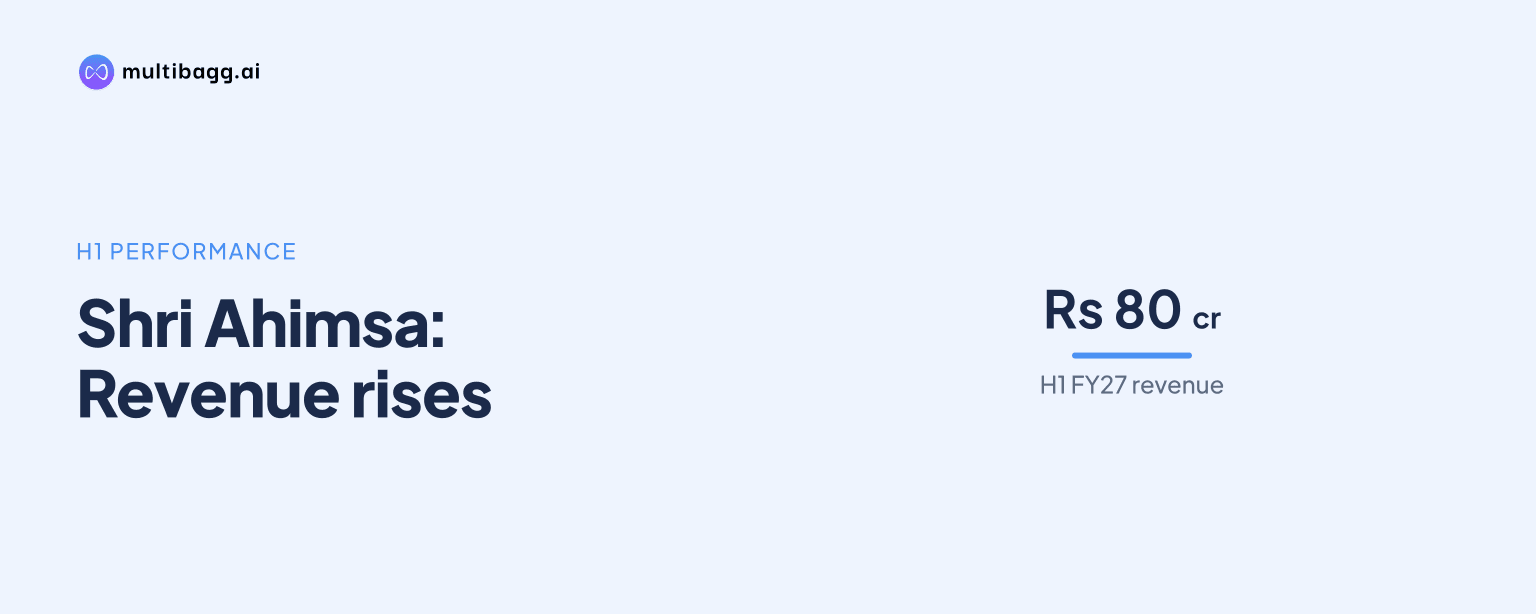
Shri Ahimsa Naturals Limited reported H1 FY27 revenue of ₹80 crore, up 32% year on year for the half year ended September 30, 2026, as approximately 25% volume growth in Green Coffee Extract and Natural Caffeine offset West Asia-related freight inflation, longer transit times and some deferred sales. SANL reported earnings before interest, tax, depreciation and amortisation (EBITDA) of ₹22 crore and profit after tax (PAT) of ₹16 crore.
Know Shri Ahimsa Naturals inside out
Results, valuation, peers and who's buying, in one view.
How did SANL perform in H1 FY27?
SANL increased revenue by 32% year on year to ₹80 crore in H1 FY27, while EBITDA rose 23% to ₹22 crore and PAT increased 9% to ₹16 crore. Its November 6, 2026 release also reported an EBITDA margin of 27.6% and core return on capital employed (ROCE) of 29.3%.
The difference between EBITDA growth of 23% and PAT growth of 9% reflected the prior-period comparison identified by SANL. Management said PAT growth was affected primarily by a higher base of other income in the corresponding period last year, despite growth in operating profit during H1 FY27.
Revenue growth was driven by volume growth in both Green Coffee Extract (GCE) and Natural Caffeine, according to SANL. GCE and Herbal Extracts together contributed about 18% of overall sales in H1 FY27, a share that SANL said remained consistent even as revenue reached ₹80 crore.
What was the effect of West Asia shipping disruption?
SANL said the West Asia war led to elevated freight costs, longer lead times and deferment of some sales into H2 FY27, although overall shipment disruption remained limited. Most shipments were routed through alternative routes, but one import container remained stranded in the Strait of Hormuz as of the November 6, 2026 announcement.
The company reported approximately 25% volume growth despite the logistics disruption. That volume result supported H1 FY27 revenue of ₹80 crore, while increased transit times meant that some sales were deferred rather than booked in the half year ended September 30, 2026.
Higher freight costs increased raw-material costs, SANL said, and the company was progressively passing the impact on to customers. It also said working-capital requirements increased to secure business growth and that it expected conditions to normalise as the war and its effects subside, without providing a timetable for the stranded container's release.
Did SANL raise operating contribution per kilogram?
SANL raised EBITDA contribution per kilogram to ₹2,149 in H1 FY27 from ₹1,966 in H1 FY26, an increase of ₹183 per kg despite higher logistics and ancillary expenses. The company linked those cost pressures to geopolitical disruption while reporting total EBITDA of ₹22 crore, up 23% year on year.
The per-kilogram comparison measures EBITDA contribution against volume and is separate from SANL's reported EBITDA margin of 27.6%. SANL did not disclose EBITDA by GCE, Herbal Extracts or Natural Caffeine, but said healthy volume growth in GCE and Natural Caffeine drove the 32% increase in H1 FY27 revenue.
The improvement in EBITDA contribution per kg occurred alongside freight inflation and higher ancillary costs. At the net-profit level, however, PAT growth of 9% lagged EBITDA growth of 23%, which SANL attributed to the higher other-income base in H1 FY26.
Got a follow-up? Ask IRIS
What debt and working-capital position did SANL report?
SANL reported consolidated net debt of ₹30 crore in H1 FY27, comprising ₹17 crore of standalone net debt for working-capital requirements and ₹13 crore of long-term debt for a new plant under its subsidiary. The company reported a debt-to-equity ratio of 0.1 times, calculated as consolidated net debt divided by net worth.
The ₹17 crore of standalone net debt consisted entirely of short-term loans, according to SANL. The company connected the working-capital requirement to securing business growth amid the logistics disruption, which included elevated freight costs, longer lead times and one container stranded in the Strait of Hormuz.
The ₹13 crore of long-term debt was availed for capital expenditure on the subsidiary's new plant. SANL defined its 29.3% core ROCE as annualised earnings before interest and tax on capital employed, adjusted for cash, cash equivalents and investment in the subsidiary towards the new plant.
When is SANL's new manufacturing facility expected to be ready?
SANL expects installation at its integrated greenfield manufacturing facility to be completed by March 2027, and management said the project could enable up to three times manufacturing capacity. The company is also securing higher quantities of crude caffeine and tea-waste sourcing arrangements for the facility's operations next year.
Management said the facility is intended to augment manufacturing capacity, strengthen backward integration and help SANL address rising demand. Its disclosed backward-integration plan includes increased crude-caffeine processing and tea-waste sourcing to strengthen raw-material security.
SANL said enhanced capacity and backward integration are expected to support its historical long-term growth trajectory of 35% compound annual growth rate (CAGR), while improving cost efficiencies and operational performance. This is management's outlook rather than an H1 FY27 forecast, and it depends on the planned March 2027 installation completion and sourcing arrangements for the new facility.
Conclusion
SANL combined 32% H1 FY27 revenue growth to ₹80 crore with approximately 25% volume growth and a ₹183-per-kg increase in EBITDA contribution. The result was reported despite higher freight and ancillary costs, longer transit times, deferred sales and one import container stranded in the Strait of Hormuz.
The next disclosed milestone is completion of installation at the greenfield facility by March 2027, alongside higher crude-caffeine and tea-waste sourcing for operations next year. The company has also identified sales deferred to H2 FY27, the stranded container and its ₹30 crore consolidated net debt as unresolved matters to monitor as working-capital needs and plant spending continue.