










Sical opens Chennai MMLP, plans Bengaluru rail terminal
Key highlights
- Sical commercialised its 82-acre Chennai MMLP in December 2025.
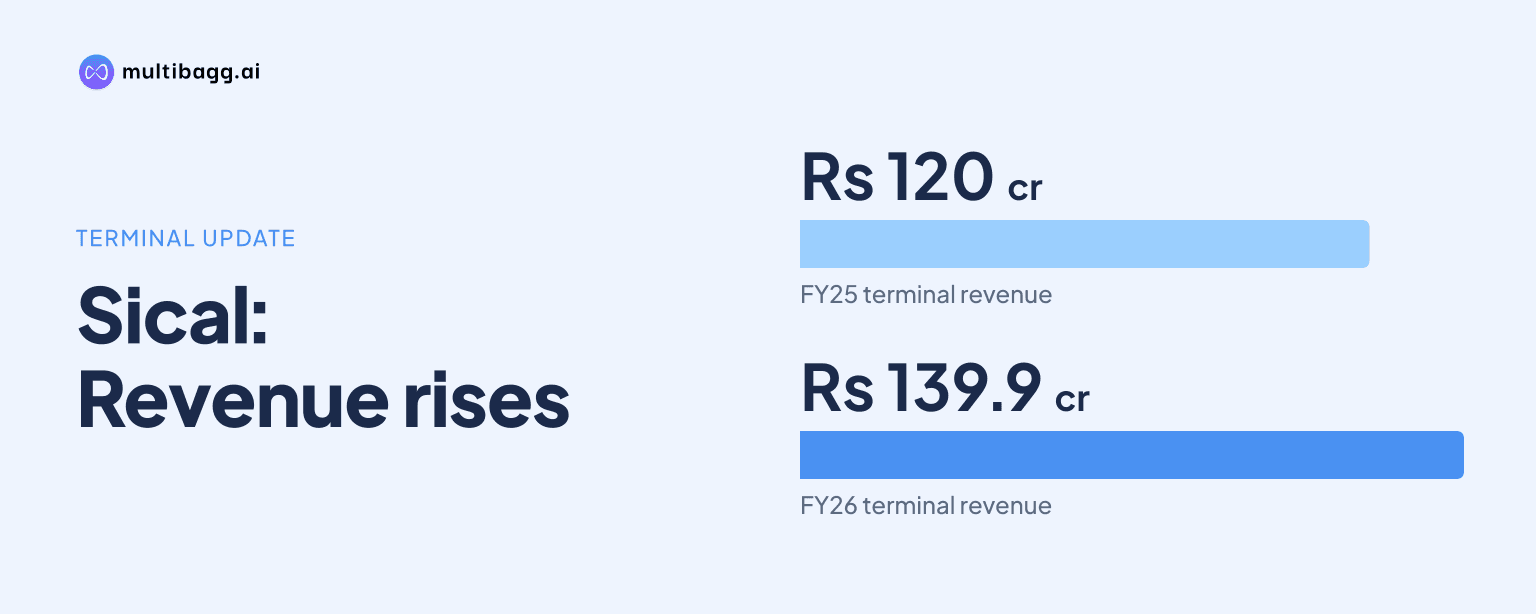
- Terminal revenue rose 17% to Rs 139.9 crore in FY26 from Rs 120 crore in FY25.
- Sical plans a rail-linked logistics terminal on 65-plus acres in Bengaluru.
- Chennai CFS handled 1,48,192 TEUs in FY26, up 14% year on year.
powered by IRIS
Sical Logistics Limited commercialised its 82-acre, rail-linked Chennai multi-modal logistics park in December 2025, establishing what it calls Chennai’s first private rail-linked logistics park, while planning a 65-plus-acre Bengaluru terminal. The move accompanied 17% growth in total terminal revenue to Rs 139.9 crore in FY26.
Know Sical Logistics inside out
Results, valuation, peers and who's buying, in one view.
What did Sical launch in Chennai?
Sical began commercial operations at its Chennai multi-modal logistics park, or MMLP, in December 2025. The 82-acre facility is described as Chennai’s first private rail-linked logistics park and marks Sical’s entry into the MMLP business. Its infrastructure includes a rail siding, container yards and truck parking, allowing cargo to move between rail and road within the same site.
The Chennai MMLP is located about 25 km from Ennore Port, 26 km from Kattupalli Port and 37 km from Chennai Port. It is also about 2.5 km from Ponneri Railway Station and 10 km from National Highway 16. Those links position the park near three ports, the rail network and a national highway, rather than as a standalone warehouse or container storage operation.
An MMLP integrates road, rail, inland waterways and air logistics modes at one location, according to the presentation. Sical says this model can lower logistics costs, improve freight efficiency and reduce the need for multiple handling points for customers. The disclosed Chennai equipment, particularly rail siding and container yards, identifies rail-road cargo transfer as a core operating mechanism at the 82-acre site.
How has Sical’s terminal business grown?
Sical’s total terminal revenue increased 17% to Rs 139.9 crore in FY26 from Rs 120 crore in FY25. The company defines terminal revenue as the combined result of its container freight stations, or CFSs, and its MMLP operations. Since the Chennai MMLP commenced only in December 2025, the FY26 total covers both established CFS activity and the newly commercialised park, rather than disclosing MMLP revenue separately.
Sical’s Chennai CFS handled 1,48,192 twenty-foot equivalent units, or TEUs, in FY26, up 14% year on year. That was larger than the 27,492 TEUs handled by Tuticorin, where volume fell 10%, and the 24,362 TEUs at Vizag, where volume rose 31%. Chennai CFS has about 55 acres of total area, compared with about 16.6 acres at Tuticorin and 10.2 acres at Vizag.
The Chennai CFS also has 2,08,095 square feet of warehouse area and 1,745 ground slots for 20-foot containers. Sical says it has more than 10% market share in Chennai and identifies the CFS as its largest by size and volume. Separately, NICCD Logistics Data Services recognised Chennai CFS as the southern region’s top-performing CFS in FY23, FY24, FY25 and FY26, a four-year sequence cited in the presentation.
Got a follow-up? Ask IRIS
What rail traffic does Sical identify in Chennai and Bengaluru?
Sical identifies automobiles as the largest industry in the cited rake-traffic mix for both Chennai and Bengaluru. Automobiles account for 41% of Chennai rake traffic and 46% in Bengaluru, followed by iron and steel at 21% and 23%, respectively. Food grain represents 22% of Chennai traffic, compared with 14% in Bengaluru, indicating a different disclosed mix between the two southern logistics markets.
The presentation states that the Chennai ranges include inward and outward container traffic. It lists cement at 8%, petroleum, oil and lubricants at 4%, ores at 3% and miscellaneous cargo at 2% of Chennai rake traffic. In Bengaluru, empty haulage is a separately identified 12% of rake traffic, while fertilisers account for 3% and miscellaneous cargo for 2%.
These figures are presented as market traffic and infrastructure context rather than reported throughput at Sical’s own sites. The comparison shows higher cited ranges in Bengaluru, at 100-140 container rakes and 180-200 non-container rakes per month, against Chennai’s 50-70 and 90-100 ranges. Sical also describes Chennai as having one inland container depot serving the region, while Bengaluru has only one major inland container depot handling regional traffic.
What is Sical planning in Bengaluru?
Sical plans to develop a rail-linked terminal on a land parcel of more than 65 acres in Kacharakanahalli Village, Bengaluru. The company says the project is intended to capture logistics demand currently moving by road because rail-linked infrastructure is limited. Unlike the Chennai MMLP, which began commercial operations in December 2025, the Bengaluru terminal remains an upcoming development in the presentation.
The planned Bengaluru site is to include rail siding, warehousing, a container yard, a customs-clearance facility and value-added logistics zones. Those proposed elements would combine rail handling, cargo storage, customs processes and related services on the same 65-plus-acre parcel. Sical does not disclose a commissioning date, capital expenditure figure or expected revenue contribution for the Bengaluru development in the presentation.
The company’s comparison of the two markets frames Bengaluru as the larger cited rail-traffic opportunity, with container traffic of 100-140 rakes per month versus 50-70 in Chennai. Bengaluru’s automobile share is also 5 percentage points above Chennai’s 41%, while its iron and steel share is 2 percentage points above Chennai’s 21%. These are industry-report figures cited by Sical, not forecasts of volumes that its proposed terminal will handle.
Conclusion
Sical has added an operating 82-acre MMLP to its terminal platform while retaining a larger existing CFS network led by Chennai’s 1,48,192 TEUs in FY26. Terminal revenue rose by Rs 19.9 crore between FY25 and FY26, but the presentation does not separate the revenue produced by the Chennai MMLP from CFS revenue. The available evidence therefore establishes a new operating asset and a growing terminal segment, without quantifying the new park’s standalone financial contribution.
The next disclosed expansion point is the 65-plus-acre Bengaluru land parcel, where Sical plans rail siding, warehousing, a container yard and customs facilities. Investors will need to watch for development timing, project spending and the eventual operating metrics for Bengaluru, as none is specified in the presentation. Chennai MMLP utilisation and any separately reported MMLP revenue would also clarify how the December 2025 commercial start affects the terminal business.