










Sical EBITDA rose 7.8 times and margin reached 20% in FY26
Key highlights
- Sical’s FY26 revenue was Rs 385.7 crore, up from Rs 221.1 crore in FY24.
- Sical’s FY26 EBITDA excluding other income reached Rs 78.3 crore, versus Rs 10.1 crore in FY24.
- Sical’s EBITDA margin increased from 5% in FY24 to 20% in FY26.
- Sical reported a mining order book above Rs 4,200 crore as of 30 September 2026.
powered by IRIS
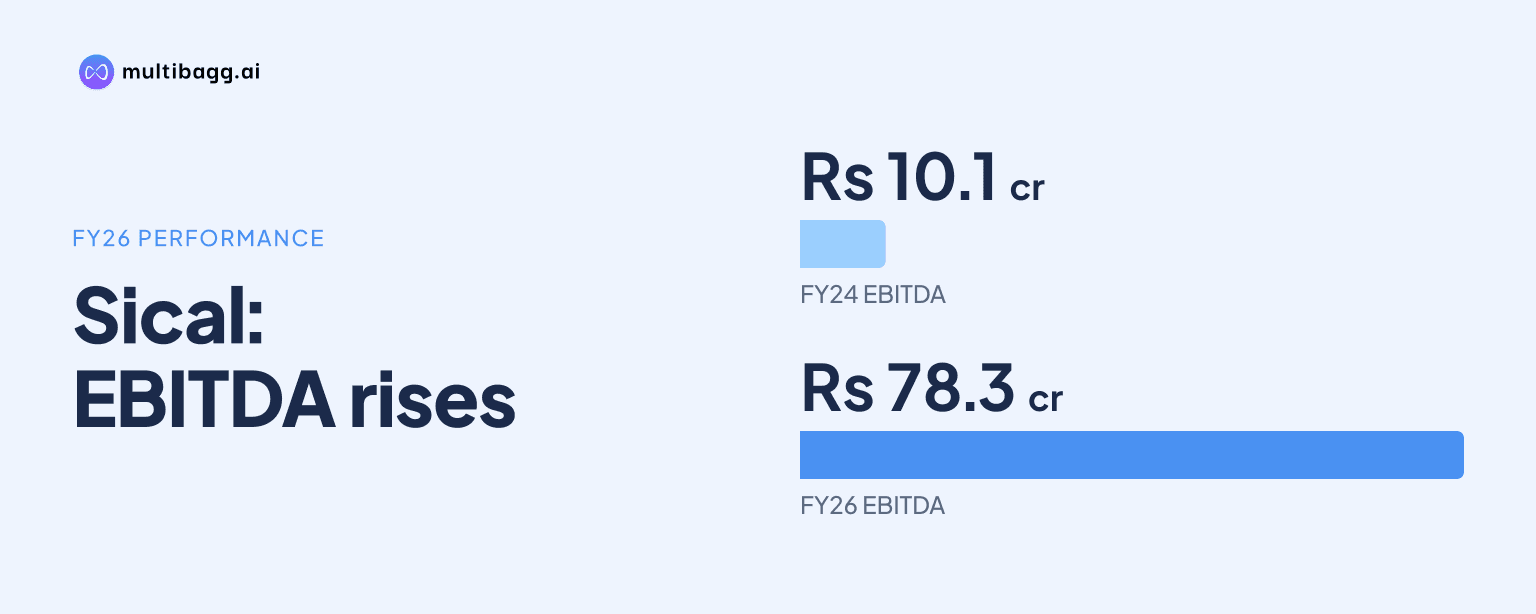
Sical Logistics Limited lifted EBITDA 7.8 times from Rs 10.1 crore in FY24 to Rs 78.3 crore in FY26, while revenue rose 1.7 times to Rs 385.7 crore and EBITDA margin increased from 5% to 20%. The audited consolidated figures exclude other income and cover the turnaround following Pristine Group’s January 2023 acquisition.
Know Sical Logistics inside out
Results, valuation, peers and who's buying, in one view.
How did Sical's FY24-to-FY26 earnings change?
Sical’s reported operating profitability increased faster than revenue between FY24 and FY26. Earnings before interest, tax, depreciation and amortisation, or EBITDA, excluding other income, rose from Rs 10.1 crore in FY24 to Rs 21.5 crore in FY25 and Rs 78.3 crore in FY26. The presentation reports a 178% compound annual growth rate, or CAGR, for EBITDA across FY24 to FY26.
Revenue was broadly unchanged in the first year of that period before accelerating in FY26. It moved from Rs 221.1 crore in FY24 to Rs 221.8 crore in FY25, then rose to Rs 385.7 crore in FY26. That FY24-to-FY26 increase equates to the 1.7-times growth stated by Sical, with a reported revenue CAGR of 32%.
The change in margin was as significant as the change in absolute EBITDA. Sical reported a rise of 1,500 basis points, or 15 percentage points, from 5% in FY24 to 20% in FY26. Because the FY26 EBITDA figure excludes other income, the presentation frames the improvement as operating rather than as a contribution from other income.
What caused Sical's disruption and subsequent revival?
Sical attributes its FY19-to-FY23 disruption to liquidity pressure, high debt servicing and declining coal and iron-ore volumes. The company says capital-intensive expansion increased debt servicing and depreciation, while regulatory changes, a mining slowdown and Covid-19 reduced volumes. It entered insolvency in March 2021 amid a group-wide liquidity crisis and recorded asset write-downs during FY21 through FY23.
The contrast with its earlier scale is shown by the FY18 figures in the presentation. Sical reported revenue of Rs 1,355 crore and profit after tax of Rs 34 crore in FY18, after developing mining and allied logistics, port operations, container freight stations, rail logistics and warehousing. Coffee Day Group had acquired a majority stake in 2011, according to the company’s timeline.
Pristine Group acquired Sical in January 2023 to expand in southern India, beginning the period that the presentation labels as re-establishment and turnaround. Management says the post-acquisition focus has been governance, financial discipline, capital backing, execution scale and operating strength, alongside stabilising cargo volumes and logistics services. In FY26, Sical also raised Rs 93.03 crore through an 11:5 rights issue to meet the 25% minimum public-shareholding requirement.
Got a follow-up? Ask IRIS
Which operations supported Sical's turnaround?
Sical’s turnaround rests on a mix of mining logistics, terminals, and warehousing and third-party logistics, or 3PL. Mining logistics includes dredging income and covers mineral and overburden handling and transportation. The company also operates container freight stations, or CFS, multi-modal logistics parks, or MMLP, and warehousing and 3PL facilities.
Mining logistics expanded sharply during FY26. Segment revenue rose from Rs 40.2 crore in FY25 to Rs 164.8 crore in FY26, a 4.1-times increase stated in the presentation. As of 30 September 2026, Sical reported a mining order book of more than Rs 4,200 crore and said it had executed seven projects since 2014.
Terminals and logistics infrastructure provide the other operating platforms. Sical reports CFS locations in Chennai, Tuticorin and Visakhapatnam, as well as what it describes as Chennai’s first and only private rail-linked terminal. Its infrastructure includes more than 4,50,000 twenty-foot equivalent units, or TEU, of CFS yard area, 20 warehouses with more than 1.2 million square feet of cumulative space, and an 82-acre Chennai MMLP.
What do Sical's FY27 updates show?
Sical’s first-half FY27 segment results show terminals and warehousing growing while mining logistics EBITDA declined from the preceding-year period. Total EBITDA excluding other income was Rs 34.52 crore in H1 FY27, down 15.8% from Rs 41.05 crore in H1 FY26. In Q2 FY27, total EBITDA was Rs 9.57 crore, down 47.2% from Rs 18.11 crore a year earlier.
Mining logistics was the main source of the decline. Its H1 FY27 EBITDA was Rs 14.4 crore, 38.4% below Rs 23.39 crore in H1 FY26, while Q2 EBITDA fell 96.2% to Rs 0.4 crore. Sical says the segment faced margin pressure because monsoon-season production fell short.
The other two reported segments moved in the opposite direction. Terminals EBITDA rose 12.5% year on year to Rs 17.92 crore in H1 FY27 and 16.6% to Rs 8.18 crore in Q2 FY27. Warehousing and 3PL EBITDA increased 29.3% to Rs 2.23 crore in H1 FY27 and 29.4% to Rs 0.99 crore in Q2 FY27.
Sical has also disclosed new capacity and financing actions during Q2 FY27. It received a five-year letter of award from Central Coalfields Limited for overburden removal and coal extraction at the Dhori-area SDOC mine, with an order value of Rs 534.7 crore including 18% goods and services tax. To support mobilisation of new mining projects, it added Rs 13.7 crore of owned assets and Rs 64.2 crore of leased equipment, largely dumpers, for total fleet additions of Rs 77.9 crore.
Conclusion
Sical’s FY24-to-FY26 recovery combined a 15-percentage-point EBITDA-margin expansion with revenue growth after the March 2021 insolvency period. Mining logistics accounted for a substantial FY26 revenue increase, while terminals and warehousing and 3PL added separate operating lines whose H1 FY27 EBITDA continued to rise despite the mining shortfall.
The next disclosed operating point is mobilisation and execution of the five-year Dhori mining contract, supported by Rs 77.9 crore of Q2 FY27 fleet additions. The presentation also leaves the monsoon-related mining production shortfall unresolved, making the segment’s recovery relative to H1 FY27 EBITDA of Rs 14.4 crore a key reported operating measure to follow.