








Siemens Energy India backlog rises 25.6% to Rs 20,360 crore
MAX Plan at ₹4,999/yr

Find your next multibaggerBe a Pro Investor
Research stocks and track your picks on the go. Download the app.
Key highlights
- SEIL's FY26 order backlog was Rs 20,360 crore, up 25.6% from Rs 16,210 crore in FY25.
- SEIL's FY26 order entry was Rs 14,580 crore, up 11.2% from Rs 13,110 crore in FY25.
- SEIL won 3 of 6 STATCOM projects ordered in FY26 and 2 large 765-kilovolt substation projects in Q4.
- SEIL disclosed Rs 740 crore of ongoing expansions and a Rs 2,060 crore Ujjain transformer-factory investment.
powered by IRIS
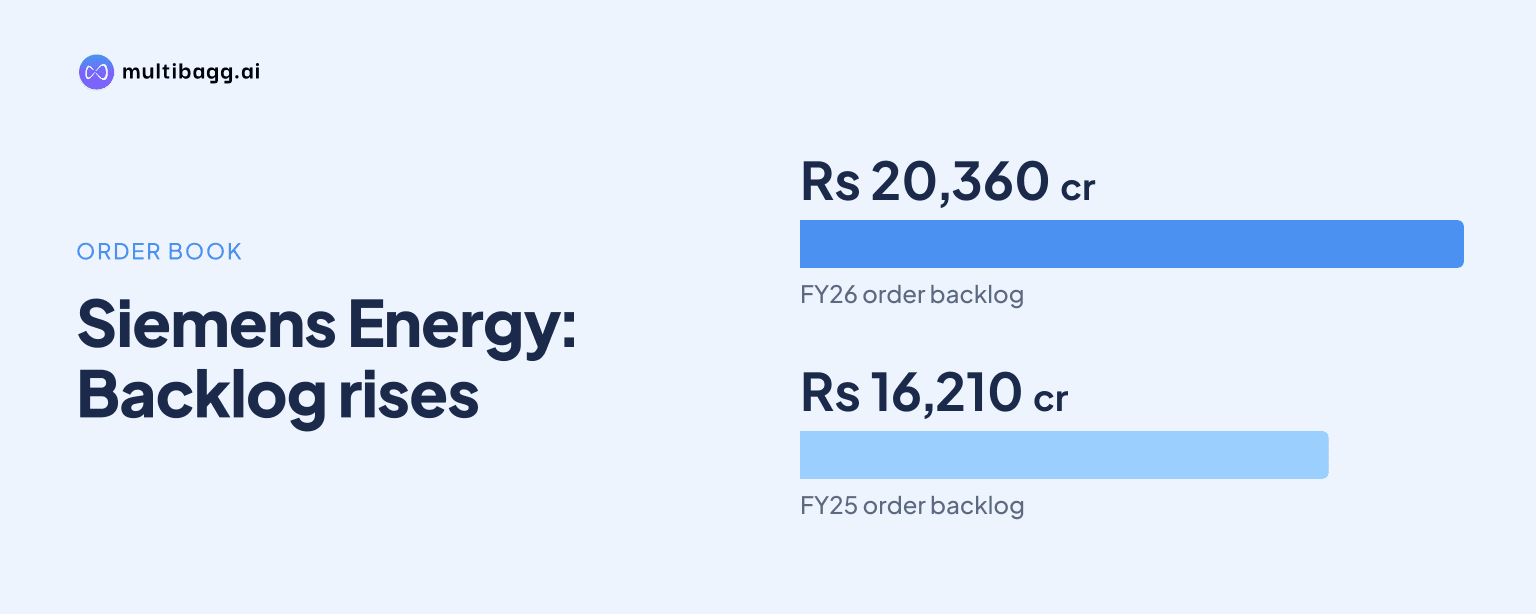
For FY26, Siemens Energy India reported an order backlog of Rs 20,360 crore, up 25.6% from Rs 16,210 crore in FY25, following an order mix that included three of six grid-stability projects, two large 765-kilovolt substation wins in Q4 and generation, industrial and export work.
Know Siemens Energy India inside out
Results, valuation, peers and who's buying, in one view.
How did SEIL's order book change in FY26?
SEIL's order backlog increased by Rs 4,150 crore in FY26 to Rs 20,360 crore, from Rs 16,210 crore in FY25. Its FY26 order entry was Rs 14,580 crore, up 11.2% from Rs 13,110 crore a year earlier, while the presentation describes the backlog as providing revenue visibility.
The backlog growth rate of 25.6% exceeded the 11.2% increase in order entry. In absolute terms, backlog rose Rs 4,150 crore while order entry rose Rs 1,470 crore year on year. SEIL presented the FY26 figures in November 2026, and separately listed its backlog metric as of September 30, 2026.
Which transmission orders contributed to SEIL's FY26 backlog?
SEIL said transmission orders included three of the six STATCOM, or static synchronous compensator, projects ordered during FY26. The presentation identifies their purpose as grid stability for renewable-energy integration, although it does not disclose the value of SEIL's three projects.
SEIL also won two large 765-kilovolt air-insulated substation projects in the fourth quarter of FY26, marking its return to that voltage class. The presentation says these projects are intended to enhance grid capacity, but gives neither customer names nor order values.
The transmission order list also included transformer and reactor exports for a large European Union renewable-energy generator. SEIL's broader transmission portfolio covers transformers, switchgear, substations, grid stabilisation, services and digital solutions, providing the product categories through which the disclosed FY26 orders entered its book.
What generation and industrial work did SEIL win in FY26?
SEIL's disclosed generation work included a services and upgrade order from India's largest thermal utility, a 2x180-megawatt steam-turbine order for a metals company, and compressor electrification for oil-and-gas operations. The presentation links the thermal-services order to upkeep of critical power infrastructure.
The steam-turbine order represents 360 megawatts across two 180-megawatt units and is described as supporting a base industry. SEIL characterises compressor electrification as enabling decarbonisation and energy security, but does not provide contract values or a backlog split between generation, transmission and industrial work.
SEIL placed these orders against a demand backdrop in which peak electricity demand rose to 250 gigawatts in calendar year 2024 from 216 gigawatts in calendar year 2022, a 16% increase. Its presentation shows 270 gigawatts for calendar year 2026, a further 8% increase from the 2024 level, using Central Electricity Authority demand data.
Got a follow-up? Ask IRIS
What has SEIL delivered, and how is it expanding capacity?
SEIL delivered a 220-kilovolt gas-insulated substation for a data centre in Maharashtra and another 220-kilovolt gas-insulated installation for a captive facility in Gujarat. The presentation describes the first as supporting always-on power and the second as supporting uninterrupted supply for an energy-intensive industry.
For the grid, SEIL completed refurbishment of a 387-megavolt-ampere, 400-kilovolt high-voltage direct-current converter transformer in Odisha. Its other disclosed deliveries included a 200-megavolt-ampere transformer for a US energy company and extra-high-voltage circuit breakers for Nigeria's 330-kilovolt transmission network, alongside an SF6-free Blue circuit-breaker retrofit in Goa.
SEIL has Rs 740 crore of ongoing expansion investment at Kalwa and CSN, where transformer and switchgear capacity, respectively, is described as doubling. It also announced Rs 2,060 crore for a new transformer factory in Ujjain, with capacity described as 2x; the presentation frames these projects as supporting backlog conversion and readiness for new opportunities, without giving commissioning dates.
The company separately reported about Rs 3,000 crore of capital expenditure committed for expansions and factory modernisation. SEIL had 5,091 employees as of September 30, 2026, up 12%, while the presentation identifies utilities, industries and infrastructure as the customer areas served by its portfolio.
Conclusion
SEIL's Rs 20,360 crore FY26 backlog was supported by orders across transmission, generation, industry and exports rather than one disclosed contract category. Backlog growth of 25.6% was more than twice the 11.2% order-entry growth rate, while the order list included grid-stability projects, 765-kilovolt substations, thermal-utility services and a 360-megawatt industrial turbine configuration.
The next disclosed development to watch is execution of the Rs 740 crore Kalwa and CSN expansions and the Rs 2,060 crore Ujjain transformer-factory investment. SEIL says the projects will double specified capacities, but the presentation does not provide commissioning dates, segment-level backlog values or a schedule for converting the Rs 20,360 crore order book.

