








Siemens Energy India Maps Rs 50 Lakh Crore Power Build-Out
MAX Plan at ₹4,999/yr

Find your next multibaggerBe a Pro Investor
Research stocks and track your picks on the go. Download the app.
Key highlights
- SEIL estimates more than Rs 50 lakh crore of generation, transmission and storage investment from 2026-27 to 2035-36.
- India’s peak power demand is projected to rise from 270 GW in 2026 to 459 GW in FY36.
- Transmission planning includes 828 GVA of additions and about Rs 8 lakh crore of investment.
- SEIL Power Transmission revenue rose 43.4% to Rs 6,010 crore in FY26.
powered by IRIS
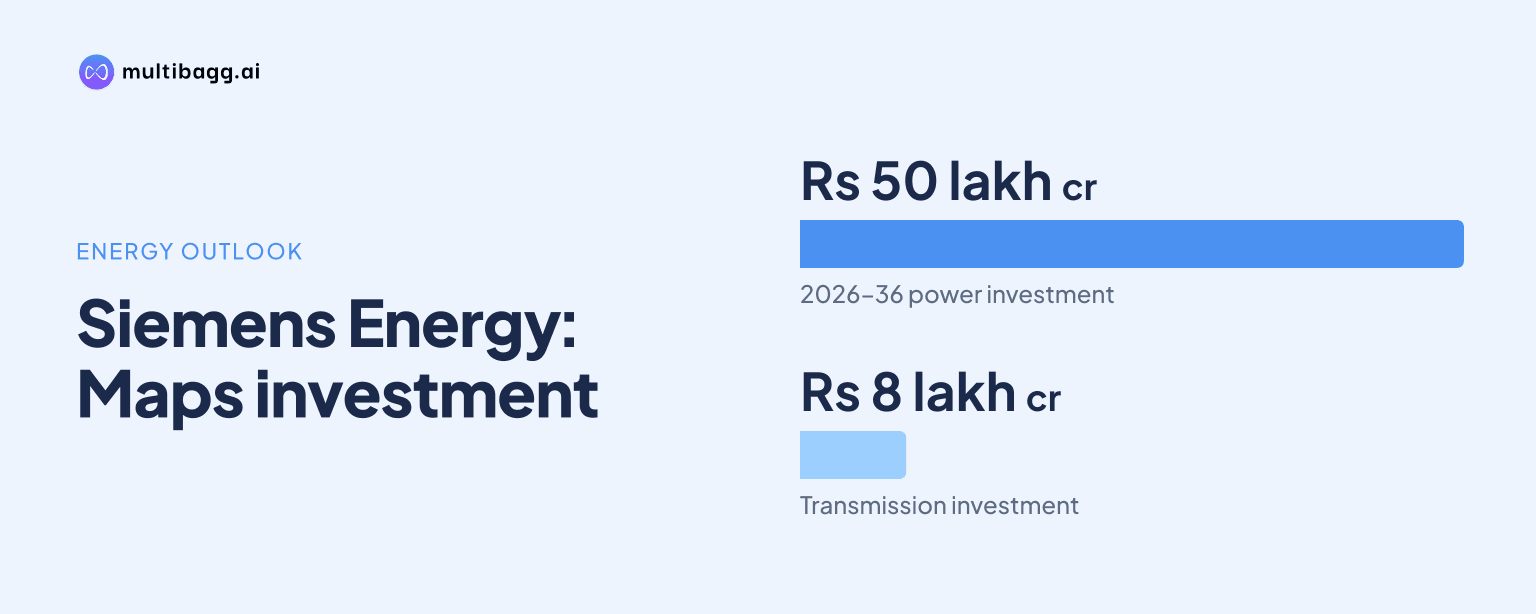
Siemens Energy India says India’s generation, transmission and storage build-out could require more than Rs 50 lakh crore from 2026-27 to 2035-36, as peak electricity demand is projected to reach 459 GW in FY36. SEIL links this market-wide investment cycle to rising electrification, renewable integration and the need for firm power.
Know Siemens Energy India inside out
Results, valuation, peers and who's buying, in one view.
What investment cycle is SEIL targeting?
SEIL is targeting a power-system expansion estimated at more than Rs 50 lakh crore between 2026-27 and 2035-36 across generation, transmission and storage. The estimate is a market opportunity, not a company order, revenue or capital-expenditure target, and the presentation identifies it as partly based on SEIL’s internal estimate.
Generation capacity is projected to rise from 533 GW to 1,121 GW by FY36, requiring 588 GW of additions. Non-fossil sources account for 503 GW of the planned increase, while battery energy storage systems and pumped hydro are shown at 174 GW and 888 gigawatt-hours, respectively. These additions require both equipment for new capacity and systems to balance variable renewable generation.
Transmission is a separately identified part of the build-out, with an estimated investment of about Rs 8 lakh crore. The plan envisages advanced grid planning for evacuation of 900 GW of non-fossil capacity and an addition of 828 gigavolt-amperes of transformation capacity at 220 kilovolts and above. That scope places transmission equipment, grid stability and renewable-power transfer alongside generation in the stated opportunity.
Why is India’s peak power demand expected to reach 459 GW?
SEIL projects peak electricity demand to increase from 270 GW in 2026 to 459 GW in FY36, a compound annual growth rate of 5.58%. It also forecasts energy requirement of 3,365 terawatt-hours by FY36, growing at a 6.41% compound annual rate, which is faster than the projected peak-demand growth rate.
The presentation identifies economic growth above 7%, urbanisation and a cooling surge as demand drivers. Air-conditioner penetration is about 10% currently, according to SEIL, while data-centre load is expected to increase from 1.5 GW to 8-9 GW by 2030. Electric-vehicle charging and green hydrogen are also included among the new high-density electricity loads.
SEIL also frames electrification as an energy-security measure. India imports more than 85% of crude oil and about 50% of liquefied natural gas, and the presentation cites rail, freight and industrial process heat as areas where electrification could reduce that exposure. Electricity’s share of final energy is projected to rise from 19% in 2025 to about 25% by 2035, at 2.25 times the growth rate of total energy.
The demand case is paired with policy and decarbonisation assumptions, including 60% non-fossil capacity by 2035 and a 47% reduction in gross domestic product emissions intensity from 2005 levels. The planned 503 GW non-fossil capacity addition is therefore linked to the need for the 174 GW of storage and the 828 GVA of additional transmission transformation capacity cited by SEIL.
Got a follow-up? Ask IRIS
How does SEIL plan to address generation and grid demand?
SEIL plans to address the opportunity through its generation and transmission portfolio, with services, localisation, manufacturing expansion and digital offerings listed as execution priorities. In generation, the company identifies upkeep of existing assets, demand from base industries and domestic oil-and-gas growth as drivers of equipment and service needs.
The presentation cites 5-7% growth in metals, cement and paper, alongside a projected threefold increase in industrial electricity consumption by 2035. It also refers to a shift in baseload supply from coal to nuclear, with 100 GW of nuclear capacity cited for 2047. These are sector and policy drivers identified by management rather than quantified financial targets for SEIL.
For transmission, SEIL highlights building grids ahead of generation additions, stabilising networks with large renewable-energy penetration and transferring bulk renewable power from generation centres to load centres. The technologies named include high-voltage direct-current voltage-source converters and 1,200 kilovolt high-voltage alternating-current systems, as well as digital and secure-grid capabilities.
The company’s stated actions include generating service value from its installed base, localising for India, expanding manufacturing facilities and improving productivity through automation and digitalisation. SEIL also plans to use India for global products, research and development, and engineering, while expanding Digital Grid offerings through Noedra. The presentation does not disclose a spending amount, revenue target or timetable for these initiatives.
What does FY26 performance show about SEIL’s exposure?
SEIL’s FY26 results show faster growth in Power Transmission than in Power Generation, matching the company’s emphasis on grid investment. Power Transmission revenue increased 43.4% to Rs 6,010 crore from Rs 4,190 crore in FY25, while its order backlog rose 37.3% to Rs 14,610 crore from Rs 10,640 crore.
Power Generation revenue grew 16.4% to Rs 4,230 crore in FY26, but its order backlog increased 3.4% to Rs 5,750 crore. Power Transmission order inflow rose to Rs 10,030 crore from Rs 8,430 crore, whereas Power Generation order inflow fell to Rs 4,550 crore from Rs 4,680 crore. The comparison shows a materially larger FY26 backlog expansion in the transmission segment.
Reported profit from operations in Power Transmission rose by 220 basis points to 21.4%, while Power Generation improved by 530 basis points to 22.0%. Excluding foreign-exchange effects, commodity gains and one-time items, the respective margins were 19.9% and 20.5%, versus 17.4% and 16.5% in FY25. SEIL attributes the transmission improvement to backlog and project execution, and the generation improvement to utility and industrial demand plus operating leverage.
Conclusion
SEIL’s presentation places its growth plan within a projected Rs 50 lakh crore-plus Indian power investment cycle, rather than presenting that amount as its own addressable revenue. Peak demand rising to 459 GW, generation capacity reaching 1,121 GW and the planned addition of 828 GVA of transformation capacity together explain why the company is positioning across generation, services and grid equipment. FY26 performance provides a current indicator of that positioning, with Power Transmission revenue growing 43.4%, compared with 16.4% in Power Generation.
What to watch next is execution of SEIL’s stated plan to localise, expand manufacturing, automate operations and develop Digital Grid offerings through Noedra. The presentation also makes future demand contingent on grid build-out keeping pace with renewable additions, including the plan to evacuate 900 GW of non-fossil capacity and deploy 174 GW of storage through FY36.

