








Siemens Energy India FY26 revenue rose 30.9% to Rs 10,240 crore
MAX Plan at ₹4,999/yr

Find your next multibaggerBe a Pro Investor
Research stocks and track your picks on the go. Download the app.
Key highlights
- SEIL FY26 revenue increased 30.9% to Rs 10,240 crore from Rs 7,830 crore.
- SEIL FY26 profit from operations rose 57.3% to Rs 2,220 crore and reported margin reached 21.7%.
- SEIL Q4 FY26 reported operating margin was 22.6%, up 570 basis points year on year.
- SEIL's FY26 closing order backlog increased 25.6% to Rs 20,360 crore.
powered by IRIS
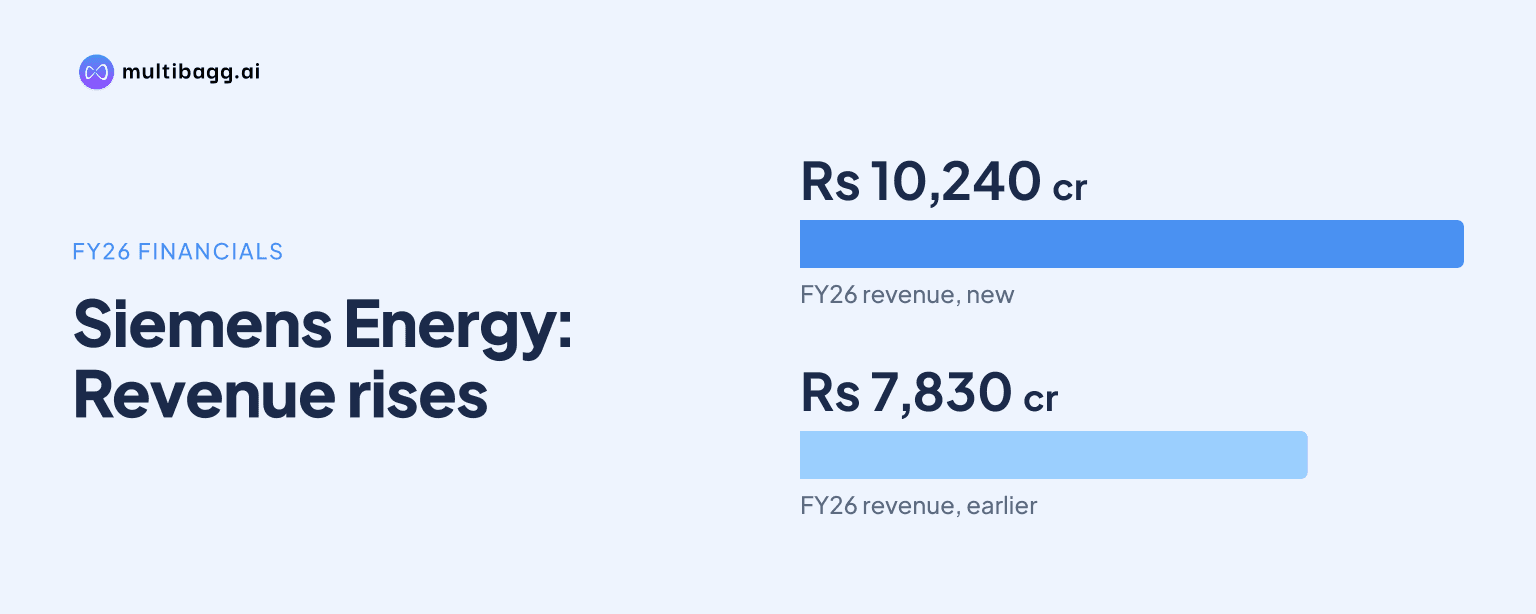
Siemens Energy India reported FY26 revenue of Rs 10,240 crore, up 30.9% from FY25, while profit from operations rose 57.3% to Rs 2,220 crore and reported margin expanded 370 basis points to 21.7%. SEIL also ended FY26 with a Rs 20,360 crore order backlog, 25.6% higher year on year.
Know Siemens Energy India inside out
Results, valuation, peers and who's buying, in one view.
How did SEIL perform in FY26?
SEIL delivered faster profit growth than revenue growth in FY26. Revenue increased from Rs 7,830 crore in FY25 to Rs 10,240 crore in FY26, while profit from operations rose from Rs 1,410 crore to Rs 2,220 crore. Profit after tax, or PAT, increased 61.9% to Rs 1,780 crore from Rs 1,100 crore.
SEIL's reported profit-from-operations margin reached 21.7% in FY26, compared with 18.0% in FY25. That is an expansion of 370 basis points, where one basis point is one-hundredth of a percentage point. Excluding foreign-exchange, commodity gains and one-time items, the margin rose 350 basis points to 20.2% from 16.7%.
SEIL recorded Rs 14,580 crore of FY26 order inflow, up 11.2% from Rs 13,110 crore in FY25. Order inflow exceeded FY26 revenue by Rs 4,340 crore, and the year-end backlog of Rs 20,360 crore was about 1.99 times annual revenue. The presentation attributes revenue growth to a healthy order backlog and disciplined project execution.
What drove SEIL's margin and revenue mix changes?
SEIL attributed its FY26 margin expansion to better operating leverage and a higher export contribution. Profit from operations increased by Rs 810 crore, compared with a Rs 2,410 crore increase in revenue, resulting in profit-from-operations growth of 57.3% against revenue growth of 30.9%.
The revenue mix moved towards Power Transmission, or PT, which accounted for 58.7% of FY26 revenue compared with 53.5% in FY25. Power Generation, or PG, represented 41.3%, down from 46.5%. This was a change in mix rather than a fall in PG revenue, which increased 16.4% to Rs 4,230 crore.
Exports contributed 30.0% of FY26 revenue, compared with 23.0% in FY25, while the domestic share declined to 70.0% from 77.0%. Products represented 35.9% of revenue, up from 31.7%; solutions accounted for 41.7%, down from 42.4%; and services fell to 22.4% from 25.9%.
The presentation links higher export contribution with the overall margin improvement, but does not disclose export revenue in rupees or profitability by geography. It also does not provide revenue amounts for products, solutions or services, limiting the disclosed evidence to the percentage changes in the FY25 and FY26 business mix.
Got a follow-up? Ask IRIS
Which SEIL segment grew faster in FY26?
SEIL's PT segment grew faster than PG in FY26. PT revenue rose 43.4% to Rs 6,010 crore from Rs 4,190 crore, while PG revenue increased 16.4% to Rs 4,230 crore from Rs 3,640 crore. PT also increased its share of SEIL revenue by 5.2 percentage points to 58.7%.
PT backlog rose 37.3% to Rs 14,610 crore, and order inflow rose to Rs 10,030 crore from Rs 8,430 crore. The presentation attributes PT's revenue and margin movement to healthy backlog and disciplined project execution. Its reported profit-from-operations margin increased 220 basis points to 21.4% from 19.2%.
PG backlog increased 3.4% to Rs 5,750 crore from Rs 5,560 crore, while order inflow declined to Rs 4,550 crore from Rs 4,680 crore. Even so, PG's reported profit-from-operations margin expanded 530 basis points to 22.0% from 16.7%, the larger margin increase between the two segments.
PG's margin excluding foreign-exchange, commodity gains and one-time items rose to 20.5% in FY26 from 16.5% in FY25. SEIL cited steady demand from utilities and industries, along with better operating leverage, for PG's FY26 revenue and profitability development.
How did SEIL exit FY26 and what is its stated plan?
SEIL's Q4 FY26 revenue rose 30.4% to Rs 3,450 crore from Rs 2,650 crore in Q4 FY25, while profit from operations increased 74.4% to Rs 780 crore from Rs 450 crore. Reported quarterly margin reached 22.6%, up 570 basis points from 16.9% and 90 basis points above the FY26 full-year margin of 21.7%.
Q4 FY26 PAT increased 81.5% to Rs 650 crore from Rs 360 crore, and quarterly order inflow rose 92.1% to Rs 4,510 crore from Rs 2,350 crore. The Q4 order backlog was Rs 20,360 crore, unchanged from the FY26 closing backlog because both figures refer to the same period-end position.
SEIL's stated strategies across generation and transmission include expanding manufacturing facilities, localising for India, improving productivity through automation and digitalisation, and generating service value from its installed base. It also plans to use India for global products, research and development, and engineering, while expanding Digital Grid offerings including Noedra.
The presentation frames these plans against a projected Indian power-investment cycle. It cites peak demand rising from 270 gigawatts in 2026 to 459 gigawatts by FY36 and estimates investment of more than Rs 50 lakh crore across generation, transmission and storage during 2026-27 to 2035-36; the investment figure is identified as a SEIL internal estimate.
Conclusion
SEIL's FY26 results combined 30.9% revenue growth to Rs 10,240 crore with 57.3% growth in profit from operations and a 370-basis-point reported-margin expansion. PT produced the faster revenue and backlog growth, while PG delivered the larger reported margin increase, and exports increased their revenue share to 30.0%.
The next measure is whether SEIL converts its Rs 20,360 crore closing backlog into revenue while sustaining the 22.6% Q4 FY26 reported margin. Management's disclosed plan centres on manufacturing expansion, localisation, services, productivity initiatives, global engineering activity and Digital Grid offerings, against the cited 2026-to-FY36 electricity-demand expansion.

