










Signpost India Limited H1 profit rose 11% after depreciation change
Key highlights
- Signpost India reported H1 FY27 net profit of Rs 34.5 crore, up 11% from Rs 31.0 crore.
- The straight-line depreciation change reduced H1 FY27 depreciation expense by Rs 12.9 crore.
- H1 FY27 operating EBITDA fell 5% to Rs 62.8 crore and EBITDA margin declined to 21.9%.
- Q2 FY27 Digital OOH contributed 34% of revenue, up from 25% a year earlier.
powered by IRIS
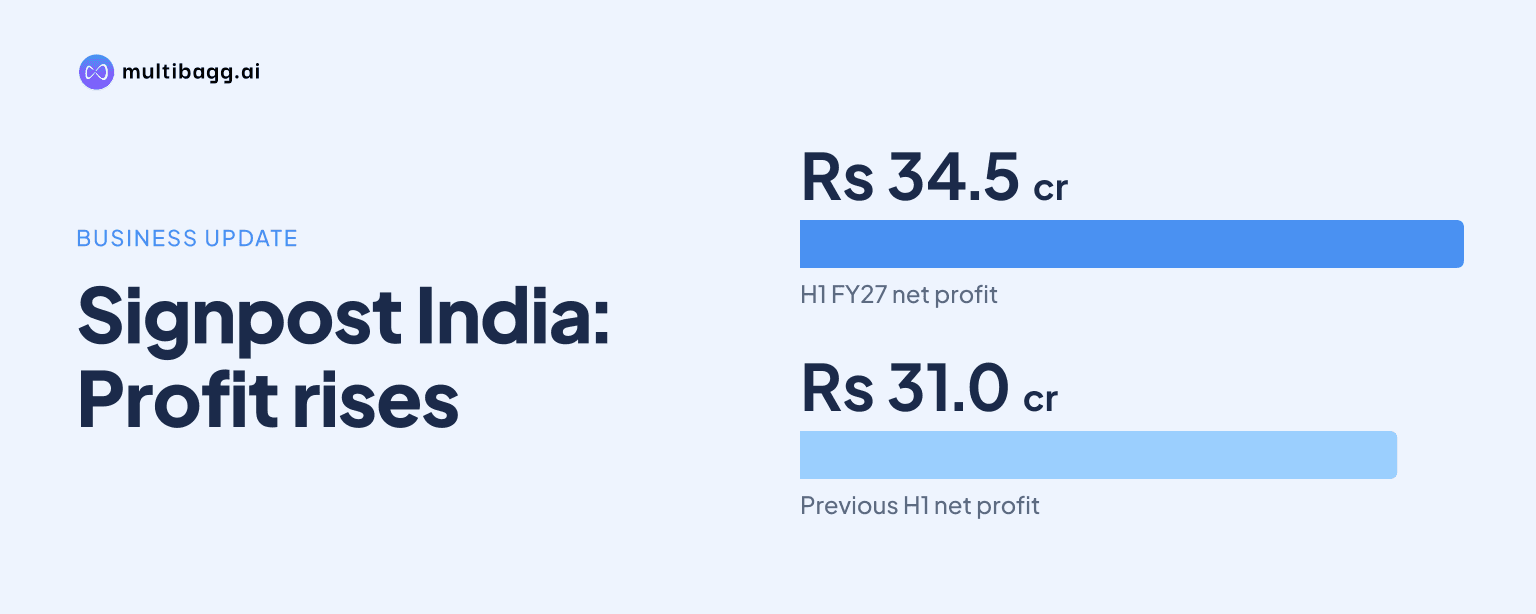
Signpost India Limited reported H1 FY27 net profit of Rs 34.5 crore, up 11% from Rs 31.0 crore, after its April 1, 2026 move to straight-line depreciation reduced the half-year charge by Rs 12.9 crore; operating EBITDA fell 5% to Rs 62.8 crore.
Know Signpost India inside out
Results, valuation, peers and who's buying, in one view.
How much did the depreciation-method change affect Signpost India’s H1 profit?
The depreciation-method change reduced Signpost India’s H1 FY27 depreciation expense by Rs 12.9 crore, while reported net profit increased by Rs 3.5 crore from H1 FY26. Effective April 1, 2026, Signpost India changed depreciation for property, plant and equipment, or PPE, from the written-down value, or WDV, method to the straight-line method, or SLM, using the remaining useful lives prescribed under the Companies Act, 2013. The presentation says the change reduced the charge in the statement of profit and loss, but does not disclose the related tax effect or adjusted net profit.
The same mechanism reduced Q2 FY27 depreciation by Rs 6.9 crore, with the reported depreciation charge at Rs 6.1 crore versus Rs 9.8 crore in Q2 FY26. Despite the lower non-cash charge, earnings before interest and tax, or EBIT, fell 8% to Rs 23.7 crore and profit before tax declined 13% to Rs 19.7 crore. Net profit was nearly unchanged at Rs 15.8 crore, compared with Rs 15.7 crore a year earlier, while operating earnings before interest, tax, depreciation and amortisation, or EBITDA, fell before the depreciation change affected reported profit.
What changed in Signpost India’s underlying operating performance?
Signpost India’s H1 FY27 operating performance declined at the EBITDA level even as revenue increased 6%, because gross-profit growth did not keep pace with sales. Revenue from operations rose to Rs 286.8 crore from Rs 271.7 crore, while gross profit increased 2% to Rs 110.4 crore from Rs 108.2 crore. Gross margin declined to 38.5% from 39.8%, and operating EBITDA decreased to Rs 62.8 crore from Rs 66.2 crore, reducing the EBITDA margin to 21.9% from 24.4%.
The Q2 FY27 comparison was more pronounced: revenue was broadly unchanged at Rs 134.5 crore against Rs 134.0 crore, but gross profit declined 7% to Rs 51.6 crore and EBITDA fell 17% to Rs 28.4 crore. Cost of services increased to Rs 83.0 crore from Rs 78.5 crore, while employee expenses rose to Rs 13.9 crore from Rs 11.2 crore. Management attributed the employee-cost increase to annual increments and hiring for the next phase of growth, and said largely fixed long-term media-rights costs did not flex with quarterly billing.
Got a follow-up? Ask IRIS
Why did Signpost India’s second-quarter revenue and margins weaken?
Signpost India said Q2 FY27 was affected by a later festive calendar and cautious large-corporate budgets, with Navratri beginning nearly three weeks later than in the prior year. Management said a large share of festive campaigns shifted into Q3 FY27. With Q2 revenue nearly flat, gross margin narrowed to 38.3% from 41.4% and EBITDA margin fell to 21.1% from 25.7%, reflecting the timing mismatch between billing and fixed media-rights costs.
The Q2 FY27 revenue mix nevertheless shifted towards digital out-of-home, or Digital OOH, and direct business. Digital OOH represented 34% of revenue, up from 25% in Q2 FY26, while transit media represented 48%, down from 58%; conventional out-of-home and static media remained at 18%. Direct business accounted for 73% of Q2 FY27 revenue versus 51% a year earlier, while third-party aligned business declined to 27% from 49%.
Contract vintage also changed during Q2 FY27, although the presentation does not provide profitability by contract type. Legacy contracts generated 63% of revenue, up from 60% in Q2 FY26, and new acquisitions contributed 21%, compared with 14%. Emerging contracts accounted for 16%, down from 26%, so the disclosed mix data do not establish whether any one format, contract group or geography caused the consolidated margin decline.
What did cash flow and the balance sheet show at September 2026?
Signpost India’s H1 FY27 net cash from operating activities rose to Rs 58.1 crore from Rs 13.6 crore in the comparable prior-year period. Cash generated from operations was Rs 61.4 crore, compared with Rs 20.1 crore, as working-capital changes were positive by Rs 0.1 crore versus a Rs 47.0 crore outflow in September 2025. Profit before tax increased to Rs 45.3 crore from Rs 42.9 crore, while operating profit before working-capital changes declined to Rs 61.5 crore from Rs 67.1 crore.
At September 2026, trade receivables were Rs 273.1 crore, down from Rs 317.3 crore at March 2026, while cash and cash equivalents were Rs 20.2 crore versus Rs 20.1 crore. Current borrowings increased to Rs 125.2 crore from Rs 113.4 crore, whereas non-current borrowings declined to Rs 69.8 crore from Rs 82.7 crore. Net cash used in investing activities was Rs 48.0 crore in H1 FY27, compared with Rs 42.5 crore in the prior-year period.
Conclusion
Signpost India’s H1 FY27 results show a divergence between reported profit and operating performance: net profit increased by Rs 3.5 crore to Rs 34.5 crore, while operating EBITDA declined by Rs 3.4 crore to Rs 62.8 crore and EBITDA margin fell to 21.9%. The Rs 12.9 crore reduction in depreciation was material to the path from EBITDA to reported profit, while revenue and gross-margin data show lower operating profitability during the half year.
The next disclosed items to watch are the full festive season in Q3 FY27, the ramp-up of Bengaluru Metro, the Mumbai premium bus fleet and Kolkata Streetscape, and Nashik event-led projects from February that are expected to continue into Q1 FY28. Management has maintained its expectation of double-digit revenue growth in FY27 and a stronger second half in revenue and profitability, making delivery against those projects and the seasonal campaign recovery the next reported tests.