










Signpost India operating cash flow hits Rs 58.1 crore in H1FY27
Key highlights
- Signpost India generated Rs 58.1 crore of net operating cash flow in H1FY27, versus Rs 13.6 crore a year earlier.
- Working-capital changes moved from negative Rs 47.0 crore in Sep-25 to Rs 0.1 crore in Sep-26.
- Signpost India used Rs 48.0 crore in investing activities and Rs 10.0 crore in financing activities in Sep-26.
- Plant and property equipment increased to Rs 237.3 crore at Sep-26 from Rs 205.8 crore at Mar-26.
powered by IRIS
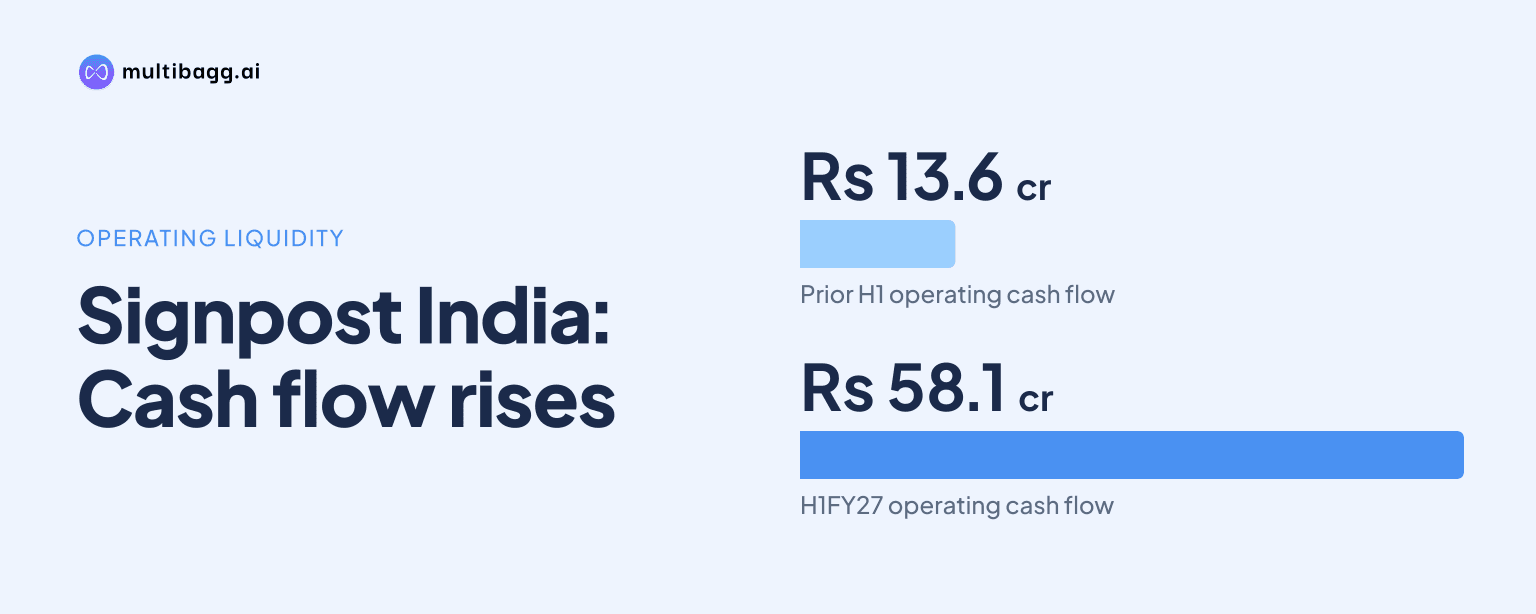
Signpost India Limited generated Rs 58.1 crore of net cash from operating activities in H1FY27, more than four times Rs 13.6 crore in the comparable prior-year period, as changes in working capital moved from a Rs 47.0 crore outflow to a Rs 0.1 crore movement.
Know Signpost India inside out
Results, valuation, peers and who's buying, in one view.
Why did Signpost India’s operating cash flow rise in H1FY27?
Signpost India’s operating cash flow rose because the prior-year working-capital outflow was largely absent, rather than because operating profit before working-capital changes increased. That pre-working-capital measure fell to Rs 61.5 crore in Sep-26 from Rs 67.1 crore in Sep-25, while net cash from operating activities increased by Rs 44.5 crore to Rs 58.1 crore.
The working-capital line was Rs 0.1 crore in Sep-26, compared with negative Rs 47.0 crore in Sep-25. As a result, cash generated from operations rose to Rs 61.4 crore from Rs 20.1 crore, despite the lower operating-profit figure before working-capital movements.
Direct taxes paid, net of refunds, also declined to Rs 3.3 crore from Rs 6.4 crore. That Rs 3.1 crore reduction added to the increase in net operating cash flow, although the principal year-on-year movement was the Rs 47.1 crore change in the working-capital line.
Profit before tax increased to Rs 45.3 crore in H1FY27 from Rs 42.9 crore in H1FY26, while adjustments for non-cash items and other investment or financial items declined to Rs 16.2 crore from Rs 24.2 crore. The Rs 2.4 crore increase in profit before tax was substantially smaller than the Rs 44.5 crore rise in operating cash flow.
What changed in Signpost India’s working-capital balances?
Signpost India’s trade receivables declined to Rs 273.1 crore at Sep-26 from Rs 317.3 crore at Mar-26, while trade payables declined to Rs 98.8 crore from Rs 145.7 crore. These movements occurred during the half year in which the company reported a Rs 0.1 crore working-capital change, but the presentation does not provide a line-by-line reconciliation of that cash-flow item.
Other current assets rose to Rs 73.2 crore at Sep-26 from Rs 43.1 crore at Mar-26. On the liabilities side, other current liabilities increased to Rs 30.8 crore from Rs 3.7 crore, and current tax liabilities rose to Rs 20.2 crore from Rs 4.1 crore.
Those offsetting balance-sheet changes mean the near-neutral reported working-capital cash movement cannot be attributed to receivables alone. Total current assets edged down to Rs 381.9 crore from Rs 384.9 crore, even as total assets rose to Rs 719.2 crore from Rs 687.7 crore.
Cash and cash equivalents were broadly unchanged at Rs 20.2 crore at Sep-26 from Rs 20.1 crore at Mar-26. Bank balances other than cash equivalents, however, increased to Rs 15.1 crore from Rs 3.9 crore over the same period.
How was Signpost India’s operating cash deployed?
Signpost India deployed most of its operating inflow in investing activities, reporting net cash used in investing of Rs 48.0 crore in Sep-26 versus Rs 42.5 crore in Sep-25. Net cash from financing activities was also an outflow of Rs 10.0 crore, compared with an inflow of Rs 28.0 crore a year earlier.
Plant and property equipment increased to Rs 237.3 crore at Sep-26 from Rs 205.8 crore at Mar-26, a Rs 31.5 crore increase. Capital work-in-progress declined to Rs 19.2 crore from Rs 20.2 crore, and right-of-use assets fell to Rs 5.7 crore from Rs 6.7 crore.
Non-current assets increased to Rs 337.3 crore from Rs 302.8 crore. The cash-flow statement does not provide a project-level split of the Rs 48.0 crore investing outflow, so the increase in plant and property equipment should not be treated as a direct equivalent of the investing-cash figure.
Other non-current changes included current tax assets rising to Rs 16.4 crore from Rs 8.5 crore and other financial assets rising to Rs 38.8 crore from Rs 37.3 crore. Other non-current assets declined to Rs 8.9 crore from Rs 13.9 crore during the same period.
Got a follow-up? Ask IRIS
Did Signpost India’s cash balance increase?
Signpost India’s cash and cash equivalents ended Sep-26 at Rs 20.2 crore, compared with Rs 20.1 crore at the start of the period, because Rs 58.1 crore of operating inflow was offset by Rs 48.0 crore of investing outflow and Rs 10.0 crore of financing outflow. The company reported a net increase in cash and cash equivalents of Rs 0.2 crore, with the small difference from the opening-to-closing balance reflecting rounded presentation.
In the comparable Sep-25 period, cash and cash equivalents declined by Rs 0.8 crore to Rs 1.4 crore from Rs 2.2 crore. The year-on-year change in financing was material, with the Sep-26 Rs 10.0 crore outflow replacing the Sep-25 Rs 28.0 crore inflow.
Current borrowings rose to Rs 125.2 crore at Sep-26 from Rs 113.4 crore at Mar-26, while non-current borrowings declined to Rs 69.8 crore from Rs 82.7 crore. Total equity increased to Rs 325.0 crore from Rs 291.0 crore, but the presentation does not identify the individual transactions behind the financing cash-flow line.
How did earnings and depreciation affect the cash-flow comparison?
Signpost India’s H1FY27 revenue increased 6% to Rs 286.8 crore from Rs 271.7 crore, but operating earnings before interest, tax, depreciation and amortisation, or EBITDA, declined 5% to Rs 62.8 crore from Rs 66.2 crore. EBITDA margin decreased to 21.9% from 24.4%, showing that the cash-flow increase did not mirror the operating-profit trend.
The company changed its depreciation method from written-down value to straight-line method effective April 1, 2026. Signpost India said this reduced depreciation charged to profit and loss by Rs 12.9 crore in H1FY27; reported depreciation was Rs 11.6 crore, compared with Rs 19.1 crore in H1FY26.
Reported net profit increased to Rs 34.5 crore from Rs 31.0 crore, while earnings before interest and tax rose to Rs 53.3 crore from Rs 49.5 crore. The presentation lists Rs 16.2 crore of non-cash and other investment or financial adjustments in the cash-flow statement, but does not quantify the exact cash-flow reconciliation effect of the depreciation-method change.
Conclusion
The H1FY27 cash-flow result reflects a significant change in cash conversion: operating profit before working-capital changes declined, but the previous period’s Rs 47.0 crore working-capital outflow did not recur. Investing and financing outflows then absorbed almost all of the operating inflow, leaving cash and cash equivalents broadly stable at Rs 20.2 crore.
The next disclosure should clarify whether the near-neutral working-capital movement can be sustained and how the Rs 48.0 crore investing outflow was allocated. The presentation also leaves unresolved the detailed reconciliation of receivables, payables and other current accounts to working-capital cash flow, as well as the project-level use of investment cash.