










Simca Advertising Wins ₹41.30 Crore Central Railway Rights
Key highlights
- Simca Advertising secured a ₹41.30 crore, five-year Central Railway advertising rights contract.
- The mandate covers development of 15,000 sq. ft. of new hoardings across seven Mumbai railway corridors.
- The contract will operate from August 14, 2027 to August 13, 2032.
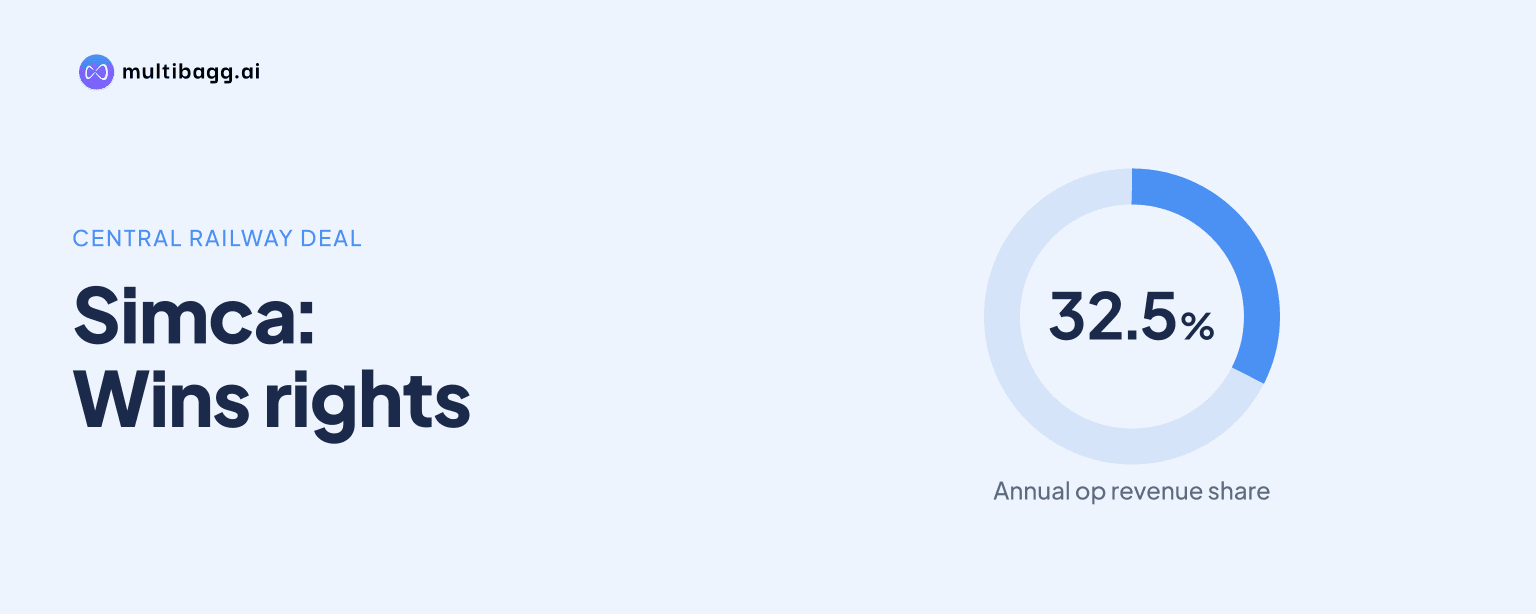
- The ₹41.30 crore deal is stated to represent about 32.5% of Simca Advertising's annual operating revenue.
powered by IRIS
Simca Advertising Limited has secured ₹41.30 crore of advertising rights from Central Railway's Mumbai CST Division to develop 15,000 sq. ft. of new hoardings across seven Mumbai railway corridors for five years from August 14, 2027. The mandate expands the company's exposure to transit advertising but requires it to build the advertising inventory itself.
Know Simca Advertising inside out
Results, valuation, peers and who's buying, in one view.
What contract has Simca Advertising secured from Central Railway?
Simca Advertising has secured a five-year leave-and-license advertising rights contract valued at ₹41.30 crore from the Mumbai CST Division of Central Railway. The award was made through an e-auction conducted on the Indian Railways E-Procurement System, or IREPS, and was disclosed by the company on November 20, 2026.
The agreement covers the development and operation of 15,000 sq. ft. of advertising hoardings across railway premises in Mumbai. It is not a contract to sell advertising on pre-existing structures. Simca Advertising must create a new network of sites and hoardings before the inventory can be offered to advertisers.
The company accepted the award on November 19, according to the reported disclosure. Fahim Batliwala, chairman, managing director and promoter of Simca Advertising, said the mandate supports the company's strategy of building a scalable media infrastructure platform and expands its presence in premium transit environments.
Where will the new railway advertising network be located?
The new network will be developed across seven railway corridors in the Mumbai division, subject to site feasibility and required approvals. The identified routes cover Mumbai CSMT-Mulund, Mumbai CSMT-Sanapada, Belapur or Nerul-Uran, Diva-Vasai, Diva-Panvel, Karjat-Khopoli, and Panvel-Karjat.
These corridors span suburban and connecting rail routes in the Mumbai region. The contract gives Simca Advertising the right to develop advertising infrastructure at approved railway locations, rather than providing a fixed list of completed hoardings from the outset.
What work must Simca Advertising complete under the agreement?
Simca Advertising must identify suitable sites, conduct feasibility assessments, obtain approvals, and construct new advertising hoarding structures across railway premises. The company will therefore have execution responsibilities before it can operate the full advertising network.
The scope makes approvals and site feasibility central to implementation. The 15,000 sq. ft. figure represents the planned advertising area under the mandate, while individual locations must still be assessed and cleared in line with railway requirements.
The agreement starts on August 14, 2027, giving Simca Advertising time before the operating period begins. The supplied information does not specify construction expenditure, a site-wise rollout schedule, advertiser commitments, or the timing of revenue recognition during the five-year term.
Got a follow-up? Ask IRIS
Why is the Central Railway contract important for Simca Advertising?
The contract is important because its ₹41.30 crore value is stated to equal about 32.5% of Simca Advertising's annual operating revenue. It also adds a long-tenure transit advertising mandate to a business that has primarily operated a broader outdoor media portfolio.
Simca Advertising currently operates 222 media assets, comprising 80 static hoardings and 142 digital out-of-home slots, across more than 235 towns. The Central Railway mandate would add new inventory in Mumbai, where railway premises can provide recurring commuter visibility once the proposed structures are developed and operational.
The railway award follows Simca Advertising's recent acquisition of advertising rights at Shirdi Airport from Maharashtra Airport Development Company. Together, the two mandates indicate the company's effort to add transit-focused advertising locations alongside its existing roadside and outdoor media assets.
How does the contract affect investors and the outdoor advertising business?
For investors, the key financial point is the ₹41.30 crore total contract value and its five-year tenure, but the operating contribution cannot be assessed solely from that headline figure. Revenue generation depends on the completion of sites, approvals, construction, and subsequent sale of the advertising inventory to customers.
The delayed commencement date also matters. The contract period begins in August 2027 and ends in August 2032, so the award does not establish immediate operating revenue from the railway network. Investors will need to track further disclosures on approvals, completed structures, capital deployment, occupancy, and advertising sales.
For the outdoor media sector, the mandate illustrates the use of public transit premises for new-format and conventional advertising infrastructure. But unlike an acquisition of existing inventory, this project involves development risk as well as the opportunity to create a fresh set of advertising locations.
Conclusion
Simca Advertising's Central Railway award provides rights to develop 15,000 sq. ft. of new advertising hoardings across seven Mumbai corridors under a ₹41.30 crore agreement. Its significance lies in the size of the mandate relative to the company's reported annual operating revenue and in its expansion into railway-based transit media.
The next disclosed milestone is the start of the five-year contract on August 14, 2027. Before then, the main matters to watch are site identification, feasibility findings, regulatory approvals, construction progress, and any company disclosure on the costs and commercial rollout of the new network.