










Australian Premium Solar reports 45% H1 FY27 income growth
Key highlights
- Australian Premium Solar reported H1 FY27 total income of ₹439.4 crore, up 45% year-on-year.
- H1 FY27 EBITDA rose 21.1% to ₹52.4 crore, while PAT increased 15.8% to ₹33.1 crore.
- APS commissioned a 400 MW TOPCon module line in October 2026, raising total capacity to 1.2 GW.
- The company disclosed a ₹250 crore confirmed order book, primarily in solar pumps.
powered by IRIS
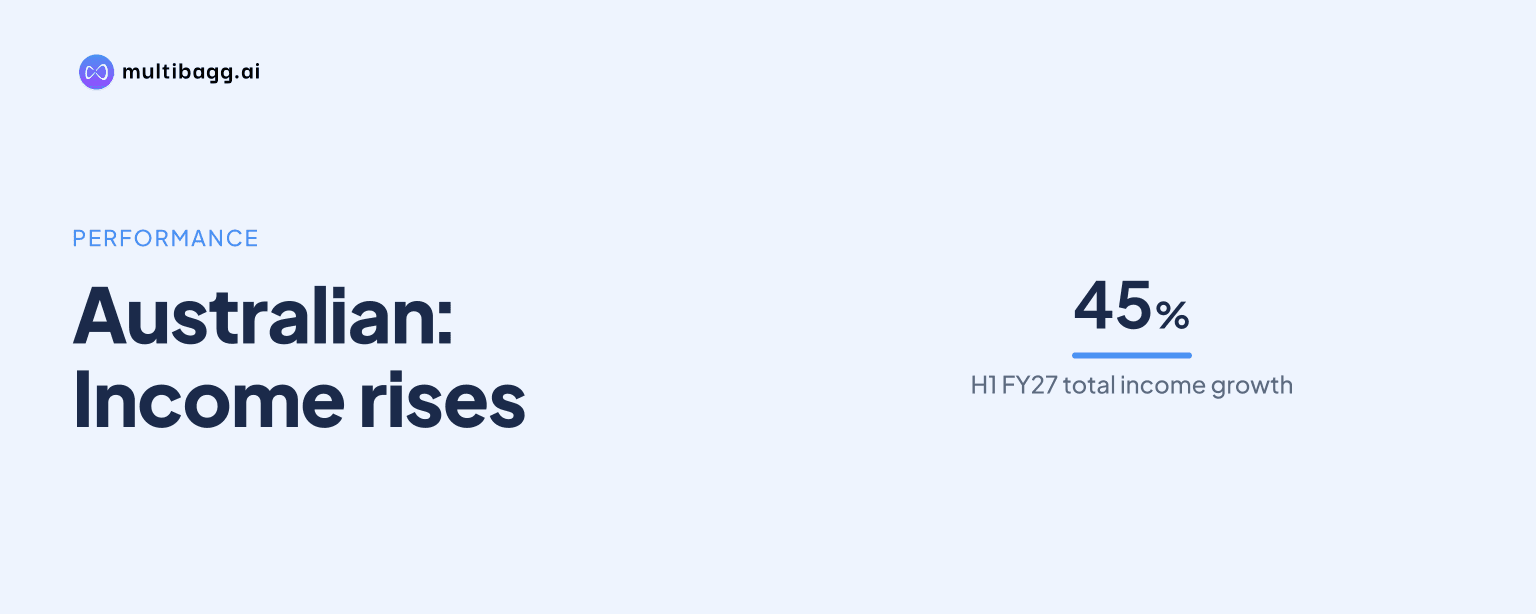
Australian Premium Solar (India) Ltd reported 45% year-on-year growth in H1 FY27 total income to ₹439.4 crore, while EBITDA rose 21.1% to ₹52.4 crore and profit after tax increased 15.8% to ₹33.1 crore. The results show continued demand-led sales growth, although management indicated that margins may remain below some market expectations.
Know Australian Premium Solar (India) inside out
Results, valuation, peers and who's buying, in one view.
What did Australian Premium Solar report for H1 FY27?
Australian Premium Solar (India) Ltd, referred to as APS, reported higher income and profit for the first half of FY27, with revenue expansion exceeding the growth rate in operating profit. Total income was ₹439.4 crore in H1 FY27, compared with ₹302.9 crore in the corresponding previous-year period. Revenue from operations was reported at ₹438.6 crore.
EBITDA rose to ₹52.4 crore, up 21.1% year-on-year, while PAT increased to ₹33.1 crore, up 15.8%. This difference between income growth and profit growth reflects the pressure on operating margins during the period. Management said operating margins were around 12%, with costs related to entry into new geographies affecting profitability.
The H1 FY27 update was discussed in APS's earnings call held on 19 November 2026. The company linked revenue growth to solar pump and retail business demand, while also pointing to the expansion of its module manufacturing operations. The available material does not provide a reliable quarter-by-quarter comparison because three prior-call transcripts were marked as unavailable.
Why did APS's margins grow slower than income?
APS's profitability grew more slowly than its total income because of margin pressure associated with geographic expansion and the cost of building new markets. Management did not support analyst expectations of 15-16% EBITDA margins and instead indicated that margins could settle in the 11-12% range.
At ₹52.4 crore, EBITDA represented roughly 12% of H1 FY27 total income, consistent with the operating margin figure discussed by management. PAT growth of 15.8% also remained below the 45% rise in income. The earnings call therefore presented a mixed operating picture: substantial top-line expansion alongside a lower margin profile than some investors had anticipated.
Management described the revenue outlook as supported by scale and demand visibility, but it also highlighted execution needs. Solar pumps were identified as an important contributor, and the confirmed order book stood at ₹250 crore, primarily related to solar pumps. The company cited the PM-KUSUM scheme as one source of demand visibility for this business.
The company also referred to battery energy storage systems, or BESS, as an opportunity rather than an established contributor. Management said progress in that area would depend on policy developments, battery prices and broader market development. No financial contribution from BESS was disclosed for H1 FY27.
Got a follow-up? Ask IRIS
How has APS expanded its manufacturing capacity?
APS commissioned a 400 MW TOPCon module line in October 2026, taking its total module manufacturing capacity to 1.2 GW. The new line is located in Sabarkantha and has started commercial production, according to the company's investor presentation and related disclosures.
The capacity addition forms part of APS's broader effort to expand its presence across solar modules, inverters and pumps. The company describes itself as vertically integrated across these product categories. Greater module capacity could support sales growth if demand and execution remain aligned, but the earnings call did not provide a specific utilisation figure for the new line.
APS also acquired the remaining 49% stake in Aplus Solar Cell, making the entity a wholly owned subsidiary. The disclosure did not provide the transaction value or a detailed timetable for its operational or financial integration. Still, the change gives APS full ownership of the solar-cell business at a time when it is expanding module capacity.
What are APS's stated growth priorities and risks?
APS has stated a target of 20-25% revenue compound annual growth over three years, while aiming for solar pumps to contribute 35-40% of revenue by FY27. It also plans to pursue battery storage, expand engineering, procurement and construction activity, and develop exports.
These targets place solar pumps at the centre of the company's disclosed strategy. Demand visibility from PM-KUSUM was highlighted by management, and the ₹250 crore confirmed order book provides a recorded measure of near-term business activity. However, the materials do not disclose the order book's execution schedule, profitability or split between individual projects.
For investors, the main issue is the relationship between rising capacity and margins. APS has delivered 45% income growth, but EBITDA and PAT have expanded at a slower pace. Management's 11-12% margin indication provides a more cautious benchmark than the 15-16% EBITDA margin range raised by analysts on the call.
The lack of accessible prior-call transcripts also limits historical assessment. Earlier guidance, commitments and changes in management commentary cannot be checked reliably from the available record. As a result, the H1 FY27 disclosures offer a current operating snapshot but not a complete multi-quarter comparison of strategy execution.
Conclusion
APS's H1 FY27 performance shows strong growth in total income, supported by solar demand, solar pumps and a larger manufacturing base. Yet the gap between 45% income growth and the lower growth rates in EBITDA and PAT indicates that expansion costs and market-entry spending have constrained operating leverage.
The next areas to watch are the execution of the ₹250 crore order book, the use of the new 400 MW TOPCon line, and progress toward the company's stated 20-25% three-year revenue CAGR target. Investors will also monitor whether margins remain within management's indicated 11-12% range and whether BESS plans gain support from policy, battery pricing and market demand.