










APS presentation does not disclose solar-pump revenue target
Key highlights
- APS does not disclose a FY27 solar-pump revenue target or a FY23 solar-pump revenue contribution in the supplied pages.
- The cited Indian solar-pump market is forecast to grow at a 6.91% CAGR from 2026 to 2034.
- PM-KUSUM aims to install 20 lakh solar pumps, and the presentation cites subsidies of up to 30% or 50% of installation cost.
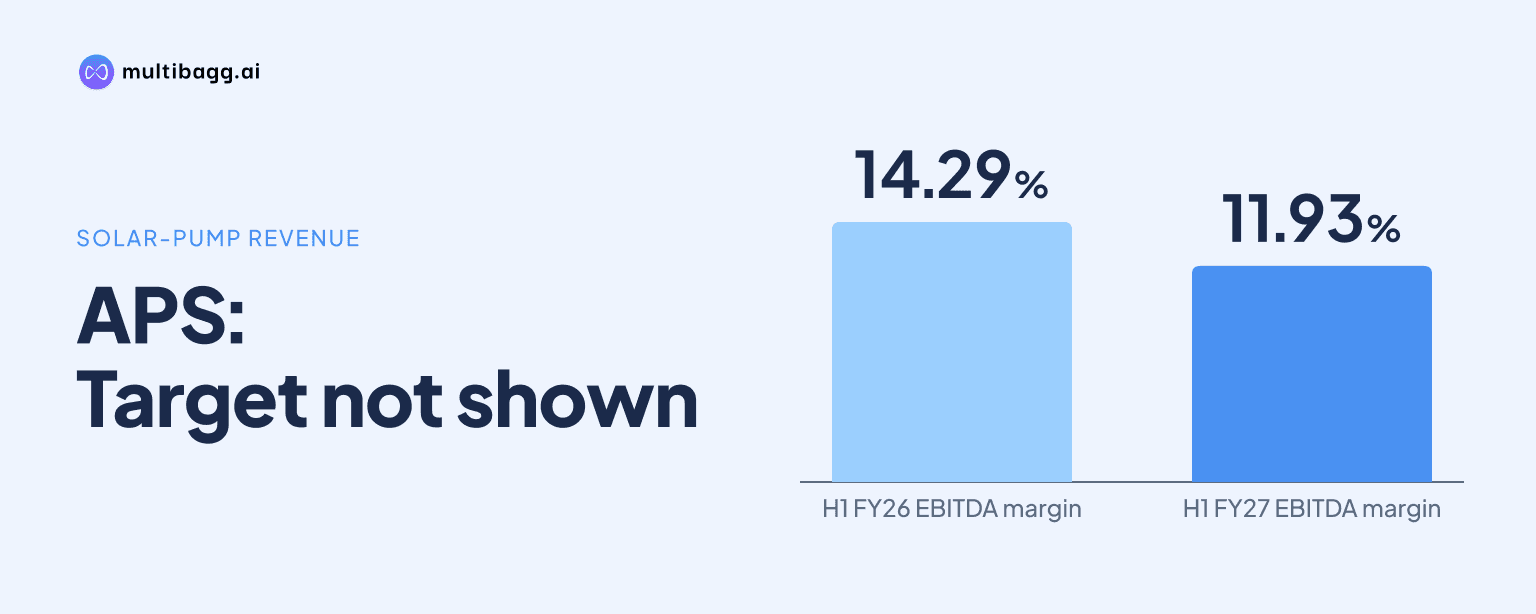
- APS reported H1FY27 net sales of Rs 438.57 crore and an EBITDA margin of 11.93%, versus 14.29% in H1FY26.
powered by IRIS
Australian Premium Solar does not disclose a FY27 solar-pump revenue target or a FY23 solar-pump revenue contribution in the supplied presentation pages. APS instead cites a 6.91% compound annual growth rate for India’s solar-pump market from 2026 to 2034 and highlights PM-KUSUM, which aims to install 20 lakh solar pumps.
Know Australian Premium Solar (India) inside out
Results, valuation, peers and who's buying, in one view.
Does APS disclose a FY27 solar-pump revenue target?
APS does not disclose a FY27 solar-pump revenue target, a FY23 pump-revenue contribution or a target share of group sales in the supplied material. The presentation’s solar-pump pages cover the Indian market outlook for 2025 to 2034, technology trends and government support, rather than APS-specific product revenue or guidance.
This distinction is material because the presentation does report consolidated H1FY27 net sales of Rs 438.57 crore, but does not divide that amount between solar pumps, solar modules, rooftop systems, inverters or other products. It also provides no pump sales volume, installations, order book, customer count, market share or tender pipeline for APS.
The cited Indian solar-pump market is expected to expand at a 6.91% CAGR between 2026 and 2034. That forecast describes the external market cited in APS’s presentation, not an APS forecast, and the company does not state how much of the projected market it intends to capture by FY27.
What policy support for solar pumps does APS cite?
APS cites the Pradhan Mantri Kisan Urja Suraksha evam Utthaan Mahabhiyan, or PM-KUSUM, as a government programme providing subsidies to farmers for solar irrigation pumps. The presentation says the central-government subsidy can be up to 30% or 50% of total installation cost for standalone solar pumps or for solarising existing grid-connected agricultural pumps.
The presentation also lists central financial assistance, or CFA, of 30% of the benchmark cost or tender cost, whichever is lower. It states that the procurement-based incentive, or PBI, is 40 paise per kilowatt-hour or Rs 6.60 lakh per megawatt per year, whichever is lower; these are programme mechanisms rather than APS-specific benefits.
PM-KUSUM aims to install 20 lakh solar pumps and generate 27,000 megawatts from barren lands, according to APS’s government-initiatives page. The same page says subsidies are supporting rooftop solar installations across sectors with a 40-gigawatt capacity target, placing agricultural pumping within a wider distributed-solar policy setting.
How does solar-pump growth compare with other markets cited by APS?
The solar-pump market has a lower cited growth rate than the solar-inverter and wider solar-photovoltaic markets presented by APS. The solar-pump market is forecast to grow at 6.91% from 2026 to 2034, compared with a 10.11% forecast CAGR for solar inverters from 2025 to 2031 and 37.82% for solar photovoltaic from 2026 to 2034.
India added 23.8 gigawatts of solar capacity in fiscal 2025, up 58.5% year on year, according to industry material reproduced in the presentation. Rooftop solar added 5,148 megawatts, up 72%, while off-grid and distributed installations reached 1,785 megawatts, three times the prior year’s additions; APS does not identify the portion related to irrigation pumps.
The presentation also identifies a 90% on-grid share in India’s rooftop market during 2025 and a 41% residential share. These figures concern rooftop solar rather than agricultural pumping, so they cannot establish APS’s solar-pump sales mix or demonstrate that a projected solar-pump contribution will reach any stated level by FY27.
Got a follow-up? Ask IRIS
Which solar-pump technologies does APS identify as demand factors?
APS identifies advances in efficiency, durability and reliability as solar-pump market trends, alongside a 6.91% market CAGR forecast for 2026 to 2034. The presentation says these advances are making solar pumping systems a viable alternative to diesel or electric pumps, but it does not provide APS product specifications or comparative operating-cost data.
Smart monitoring and control systems are another demand mechanism identified by APS. The presentation says they can optimise water use, enable remote performance tracking and improve operating efficiency, while Internet of Things, or IoT, tools and data analytics can provide farmers with real-time information for decisions.
APS also links solar pumps to agricultural productivity, energy efficiency and lower carbon emissions from agriculture. However, the supplied pages do not confirm whether APS sells IoT-enabled pumps, smart-monitoring equipment or standalone solar-pump systems, so those features should be treated as cited market developments rather than an APS product roadmap.
What do APS’s H1FY27 results show about the revenue base?
APS reported consolidated H1FY27 net sales of Rs 438.57 crore, up from Rs 302.47 crore in H1FY26, while total income increased 45.05% to Rs 439.41 crore. Earnings before interest, tax, depreciation and amortisation, or EBITDA, rose 21.08% to Rs 52.40 crore over the same comparison.
Profit after tax rose 15.81% to Rs 33.12 crore in H1FY27 from Rs 28.60 crore in H1FY26, and earnings per share increased 15.79% to Rs 16.43. Yet the income statement does not identify any revenue or profit contribution from solar pumps, leaving the reported growth unallocable by product category.
Margins declined despite higher sales. EBITDA margin was 11.93% in H1FY27 versus 14.29% in H1FY26, a decline of 2.36 percentage points, while net profit margin fell 1.90 percentage points to 7.54%; raw-material expense increased to Rs 346.55 crore from Rs 220.01 crore.
Conclusion
APS’s supplied presentation establishes a policy-supported backdrop for solar pumps, led by PM-KUSUM’s 20 lakh-pump installation aim and subsidies of up to 30% or 50% of installation cost. It also cites 6.91% market growth through 2034, but it does not support the claim that solar pumps will deliver 35% to 40% of FY27 revenue or that they represented a single-digit contribution in FY23.
The next issue to watch is whether APS discloses a product-level revenue split, pump orders, installations, tenders or a formal FY27 business-mix target. Until then, the available company evidence is consolidated: H1FY27 net sales rose to Rs 438.57 crore, while EBITDA margin decreased to 11.93% from 14.29% in H1FY26.