










APS reaches 1.2 GW, with conflicting commissioning timelines
Key highlights
- APS states current manufacturing capacity of 1.2 GW after adding 400 MW of machinery in October 2026.
- APS says a 400 MW TOPCon module line completed trial runs and began commercial production in 2025.
- APS reports H1FY27 revenue of Rs 439.41 crore, EBITDA of Rs 52.4 crore and PAT of Rs 33.12 crore.
- APS’s listed FY27 wholesale, pumps and retail revenue totals Rs 438.57 crore, Rs 0.84 crore below its H1FY27 revenue figure.
powered by IRIS
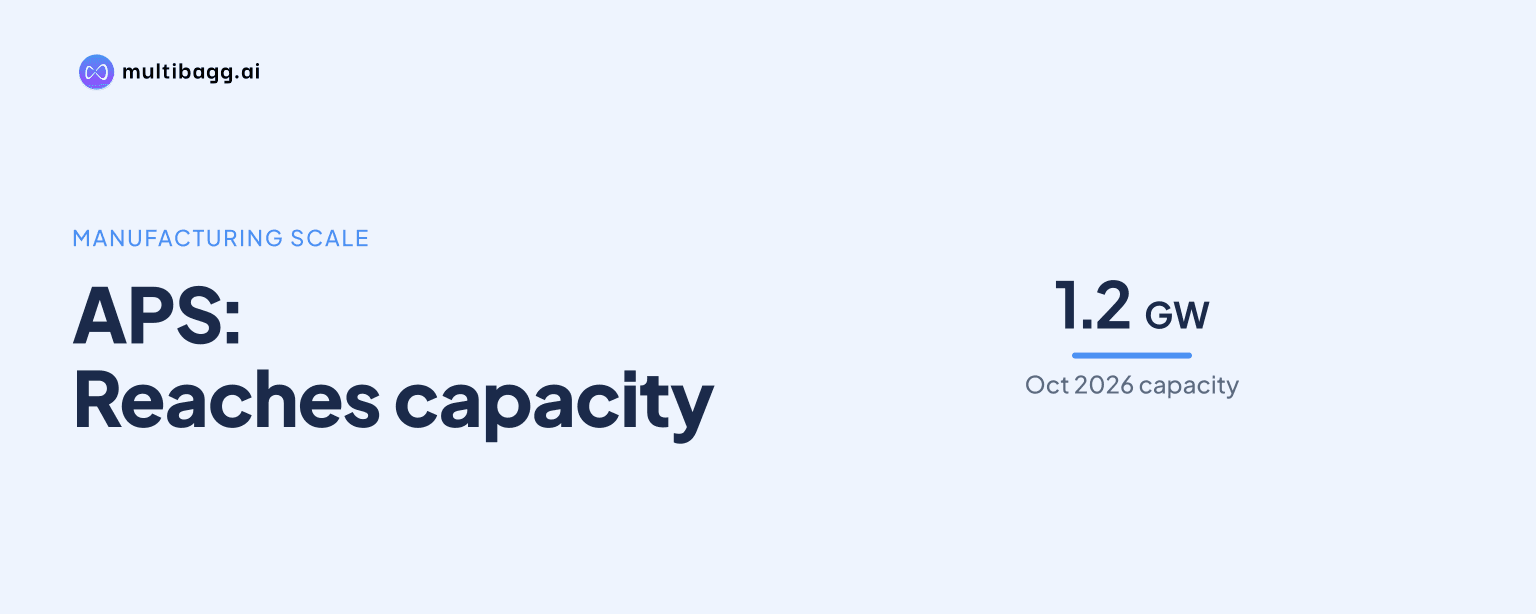
Australian Premium Solar (India) Limited says its module-manufacturing capacity reached 1.2 GW after an additional 400 MW machinery addition in October 2026, but the same presentation gives no year for November operations at an adjacent TOPCon expansion and does not say when the 2026 equipment began commercial production.
Know Australian Premium Solar (India) inside out
Results, valuation, peers and who's buying, in one view.
What is APS’s stated current manufacturing capacity?
APS states that its current manufacturing capacity is 1.2 GW. The figure appears on its key-metrics page alongside more than 20,000 successful installations, more than 600 team members, more than 25 stock keeping units and more than 15,000 agriculture solar water-pump projects.
APS’s October 2026 milestone says it added another 400 MW of module-manufacturing machinery, taking total installed capacity to 1.2 GW. This wording indicates that installed capacity was 800 MW before that addition, although APS does not separately present 800 MW as a reported capacity measure.
The 1.2 GW measure is manufacturing capacity rather than sales, installations or project capacity. APS describes its business as making monocrystalline and N-type TOPCon modules, providing engineering, procurement and construction, or EPC, services, and offering solar grid inverters and solar water pumps.
When did APS say its TOPCon capacity entered production?
APS says a new 400 MW TOPCon solar-module line completed a successful trial run and began commercial production in 2025. This is the presentation’s only statement that explicitly links a stated module capacity with both trial-run completion and commercial production.
The same 2025 entry says APS acquired adjacent land for TOPCon line expansion and “commenced operations from November.” APS does not state the year of that November date, the capacity involved, or whether the operations relate to the original 400 MW line, the adjacent expansion or another activity.
APS separately dates the next 400 MW machinery addition to October 2026, when total installed capacity reached 1.2 GW. Unlike the 2025 disclosure, the October 2026 entry does not state that trial runs were completed or that commercial production had started, leaving the commissioning date of that equipment undisclosed.
How did APS’s manufacturing base grow before 1.2 GW?
APS says it started setting up a 5 MW module-production line in Kathwada, Ahmedabad, in 2013, and increased Ahmedabad production-line capacity to 50 MW in 2017. The stated change over those four years was a 45 MW increase at the Ahmedabad operation.
In 2018, APS acquired 16,000 square metres of premises at Majra, Tajpur, Gujarat, for a new production line. Its 2021 milestone says capacity at the Majra unit expanded to “200 MV,” using MV rather than MW, so the presentation does not use a consistent capacity unit across all manufacturing milestones.
APS identifies Sabarkantha, Gujarat, as the location of the 400 MW TOPCon line disclosed for 2025. The October 2026 entry does not identify the site of its additional 400 MW machinery, and the presentation does not allocate the 1.2 GW total between Ahmedabad, Majra, Sabarkantha, monocrystalline modules or TOPCon modules.
APS also says it acquired the remaining 49% stake in Aplus Solar Cell Limited in 2026, making the company a wholly owned subsidiary. The presentation gives no manufacturing-capacity figure for Aplus Solar Cell Limited, so it does not show whether that subsidiary contributes to the stated 1.2 GW total.
Got a follow-up? Ask IRIS
What financial disclosures accompany APS’s expansion?
APS reports H1FY27 revenue of Rs 439.41 crore, earnings before interest, tax, depreciation and amortisation, or EBITDA, of Rs 52.4 crore, and profit after tax, or PAT, of Rs 33.12 crore. These figures appear on the same key-metrics page as the 1.2 GW capacity figure, but APS does not disclose capacity utilisation, TOPCon revenue or output from the newly added machinery.
A separate page headed FY27 Revenue Bifurcation lists wholesale revenue of Rs 264.64 crore, pumps revenue of Rs 120.61 crore and retail revenue of Rs 53.32 crore. Those listed categories total Rs 438.57 crore, which is Rs 0.84 crore below the separately stated H1FY27 revenue of Rs 439.41 crore; APS does not reconcile the differently labelled disclosures.
Wholesale is the largest listed FY27 channel at Rs 264.64 crore, ahead of pumps at Rs 120.61 crore and retail at Rs 53.32 crore. APS also states that 100% of sales are organic and lists distribution across 14 states, including Gujarat, Maharashtra, Rajasthan, Karnataka, Tamil Nadu and Telangana.
APS began a residential-rooftop retail division in Gujarat in 2018 and added APS solar water pumps to its range in 2019. That product and channel history is consistent with the presentation’s separate pumps, retail and wholesale categories, although it does not identify which channel sells TOPCon modules or monocrystalline panels.
What does the disclosure leave unresolved?
APS provides a clear installed-capacity endpoint of 1.2 GW in October 2026 and a clear 2025 commercial-production milestone for one 400 MW TOPCon line. The timeline is less complete for the adjacent expansion because its November operations date has no year or capacity, while the later 400 MW addition has no stated commercial-production date.
APS’s next relevant disclosure would need to identify the year and capacity behind the November TOPCon operations, the site and commercial commissioning date for the October 2026 machinery, and whether Aplus Solar Cell Limited contributes to the 1.2 GW figure. A reconciliation between the Rs 438.57 crore listed FY27 revenue bifurcation and Rs 439.41 crore H1FY27 revenue would also clarify the scope of those figures.
Conclusion
APS’s presentation describes a manufacturing expansion from a 5 MW line in 2013 to 1.2 GW of current capacity after an additional 400 MW machinery addition in October 2026. It also records commercial production at a separate 400 MW TOPCon line in 2025, while reporting H1FY27 revenue of Rs 439.41 crore.
What to watch next is APS’s disclosure on the adjacent TOPCon expansion that reportedly commenced operations from November, because the presentation does not provide its year or capacity. Investors can also watch for a stated commercial-production date for the October 2026 machinery and a reconciliation of the differently labelled Rs 438.57 crore and Rs 439.41 crore revenue disclosures.