










APS Sees Sales Growth as TOPCon Margin Moves to 11%-12%
Key highlights
- APS expects the new 400 MW TOPCon line to move EBITDA margin from 12% to 11%-12% as sales channels broaden.
- Management said the TOPCon line may need six to nine months for full operation and could add 25% of output within three months.
- APS cited Rs 121.61 crore of pump turnover within total turnover of Rs 439 crore.
- Finance cost increased from Rs 1.56 crore to Rs 3.2 crore in H1 FY27 after borrowing for expansion.
powered by IRIS
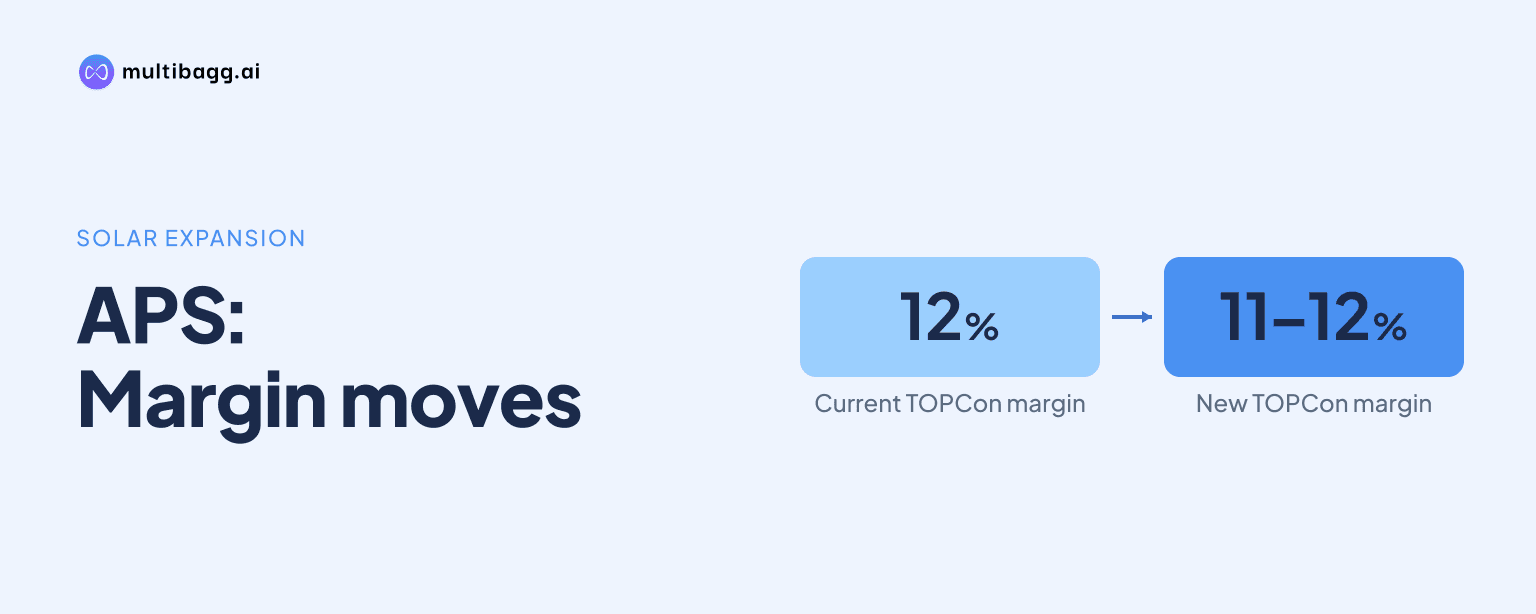
Australian Premium Solar (India) Limited (APS) expects its newly commissioned 400 MW TOPCon line to lift sales while earnings before interest, tax, depreciation and amortisation (EBITDA) margin moves from 12% to a management-estimated 11%-12%. Management linked the lower margin range to using the additional capacity for wholesale distribution and larger projects, rather than only pump and retail business.
Know Australian Premium Solar (India) inside out
Results, valuation, peers and who's buying, in one view.
How will APS use its new 400 MW TOPCon line?
APS plans to deploy the new 400 MW TOPCon line in wholesale distribution and bigger projects, two channels that management said carry lower EBITDA margins than its pump and retail operations. Kalpesh Vakharia said the existing production line is already being used for pumps and retail, making the new line the capacity source for the broader sales push.
The change matters because APS had previously not focused on much of the ground-mounting market. Nikunj Patel said India installs about 40-50 gigawatts of solar panels annually and that nearly 70% of installations are ground-mounted, but APS had not concentrated on this segment because its earlier capacity was sufficient only to meet existing demand.
Management said APS will also expand wholesale distribution rather than rely on larger projects alone. APS has divided its activities among wholesale distribution, mounting-project supply, government-tender pump business and retail engineering, procurement and construction, or EPC, work. The planned use of 400 MW of fresh capacity therefore adds volume through more than one channel, though management did not provide a revenue figure for the line.
Why does APS expect EBITDA margin to move lower?
APS expects EBITDA margin to be in the 11%-12% range, compared with management’s stated current level of 12%, because wholesale distribution and larger projects earn less than pump and retail business. Vakharia said sales, or top line, should increase as APS uses capacity to a greater extent, but the margin may come down modestly.
The margin outlook reflects sales mix rather than a stated change in production economics for the TOPCon equipment. Management specifically differentiated the new line’s expected project and wholesale output from the existing line’s pump and retail output. It did not provide separate EBITDA margins for the four business channels or a line-by-line profitability forecast for FY27, FY28 or FY29.
APS’s stated sales mix target gives context for retaining multiple channels. Management said pump business could account for 30%-35% of turnover, retail EPC for 10%-15%, and the balance primarily for wholesale distribution. APS said it generally seeks an approximate 50:50 split between wholesale distribution and the combined retail and pump businesses.
What is APS's timetable for ramping the new line?
APS said it may need six to nine months to bring the new line to full operation, while management expects it can add another 25% of output within three months. Nikunj Patel described the new line as about 50% more than the capacity APS had at that point, although the call did not quantify the resulting total module capacity in one reconciled figure.
The equipment was only recently operational at the time of the call. In discussing finance costs, management said the last machinery had entered operation in the preceding month after 12-14 months of expansion work involving a new building, machinery, an 800 MW utility addition and a 400 MW machine. Management did not state what percentage of the 400 MW line would be utilised in a specific quarter.
Management also said the second half of the financial year is usually better than the first half for APS, citing financial year-end activity, weather and execution conditions. That seasonal pattern is relevant to the ramp because APS expects execution to improve in H2, although it gave no specific H2 output forecast for the new line.
Got a follow-up? Ask IRIS
How is APS funding the capacity expansion?
APS said higher finance costs reflect borrowing for the new line, building and machinery. An analyst noted finance cost had increased from Rs 1.56 crore to Rs 3.2 crore in H1 FY27, and Vakharia attributed the change to long-term borrowing taken for the expansion completed over the prior 12-14 months.
Management said it does not currently need a preferential issue for future expansion through its Aplus Solar Cell subsidiary. Patel said APS intends to use recurring profit and the remainder of funding from long-term borrowing. That approach follows management’s comment that additional working capital is needed as sales rise, rather than a disclosed plan for an immediate equity raise.
Working-capital needs have increased alongside turnover. Inventory rose from Rs 57.2 crore in FY26 to Rs 87.6 crore in the first half, and management said solar operations typically require inventory equal to roughly one month of turnover. Patel said stock generally converts into sales within four to six weeks after order processing, payment and collection or delivery arrangements.
Which sales channels can support APS's capacity ramp?
APS identified wholesale distribution, ground-mounting project supply and solar pumps as core growth channels for the additional output. Management also cited potential future growth from battery energy storage systems, or BESS, while stating that the immediate plan is to use the new capacity across wholesale distribution and larger projects. APS stated an ambition to grow at a 20%-25% compound annual growth rate over the next three years.
Pump business remains a material part of current sales. Management cited Rs 121.61 crore of pump turnover within total turnover of Rs 439 crore and said pump business could reach 30%-35% of turnover in the next half. APS also reported a Rs 250 crore pipeline, of which Rs 200 crore was from the pump division, with activity mentioned in Maharashtra, Gujarat, Tripura, Karnataka, Bihar and Madhya Pradesh.
Geographic expansion is directed at India rather than exports for the next two to three years. APS said it had established operations in Maharashtra during the past six to nine months, was growing in Madhya Pradesh and had been established in Rajasthan for two to three years. Management said it was monitoring South and North Indian markets, while not considering exports at this stage.
Conclusion
APS’s disclosed plan is to trade some margin for higher sales by applying the new 400 MW TOPCon capacity to wholesale distribution and larger projects. Management’s 11%-12% EBITDA margin range, versus its stated current 12%, reflects the lower-margin channel mix, while pump and retail operations remain important contributors to APS’s sales structure.
The next indicators are the six-to-nine-month path to full operation, the expected 25% additional output within three months and the pace of wholesale and larger-project sales. Management also said that by next December, additional profit could be directed to further business expansion, including BESS and ground-mounting investments that sell electricity.