










Chetana targets fourfold stationery revenue after Rs 4 crore H1
Key highlights
- Chetana reported about Rs 4 crore of stationery revenue in H1 FY27.
- Chetana management confirmed an at-least-fourfold stationery revenue target, implying about Rs 16 crore from the H1 FY27 base.
- Chetana had delivered stationery orders to more than 100 schools by November 17, 2026.
- Chetana estimated stationery EBITDA margin at about 12%, versus a 26.6% consolidated H1 FY27 EBITDA margin.
powered by IRIS
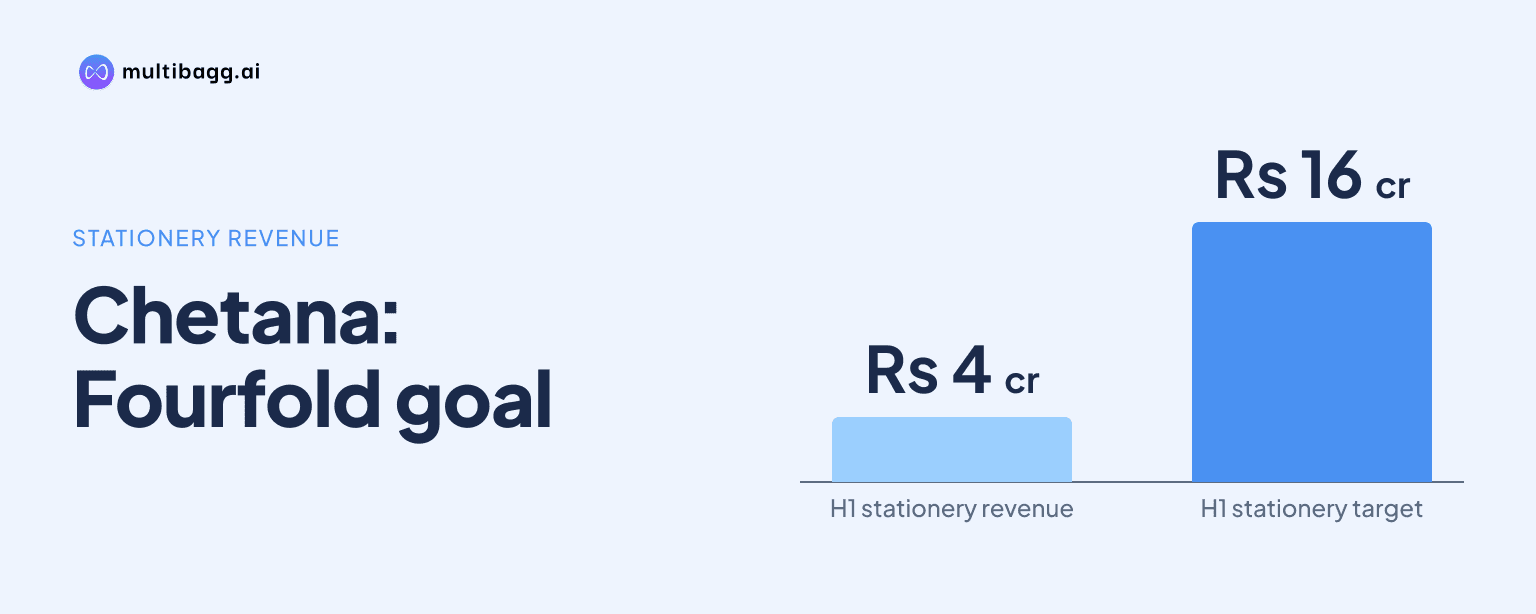
Chetana Education Limited is targeting at least fourfold growth in stationery revenue after recording about Rs 4 crore in H1 FY27, management said on November 17, 2026. The relaunched paper-stationery business had delivered orders to more than 100 schools, and management linked the next expansion to the FY27-28 academic year.
Know Chetana Education inside out
Results, valuation, peers and who's buying, in one view.
Why is Chetana targeting fourfold stationery revenue growth?
Chetana is targeting stationery revenue at least four times its H1 FY27 level of about Rs 4 crore. In response to an analyst who calculated that fourfold growth would equate to Rs 16 crore, management confirmed that expectation. Management had earlier described the potential as four to five times growth for the next academic year.
The target follows a relaunch of paper stationery in FY26-27, after the business had previously existed in 2019. The range includes notebooks, long books, A4-size books, foolscap paper and project paper. Management presented these as school-use products that can be sold alongside Chetana’s publishing relationships rather than as a consumer-retail initiative.
Chetana had already supplied more than 100 schools by the November 17 H1 FY27 call. Management said it aimed to add another 400 to 500 schools in academic year FY27-28, while separately saying it expected to deliver to at least 500 to 600 schools. The two statements indicate that the larger delivery count includes the initial 100-plus schools and planned additions.
What is Chetana’s stationery margin compared with other businesses?
Chetana estimates that stationery generates an earnings before interest, tax, depreciation and amortisation, or EBITDA, margin of about 12%, versus an average EBITDA margin of about 25% cited by management. Management said stationery margins are lower than those in publishing and the over-the-top, or OTT, platform business.
The margin contrast is relevant because Chetana reported a consolidated H1 FY27 EBITDA margin of 26.6%, up 310 basis points from 23.5% in H1 FY26. One basis point is one-hundredth of a percentage point. A larger stationery contribution would therefore add a division with a lower stated margin than the consolidated H1 result and the company average cited on the call.
Management attributed the H1 FY27 margin improvement to costing measures, a streamlined employee base and lower finance costs. It said Chetana bought paper about two months before the peak season, before paper prices rose by almost 15%. Management estimated that inventory carrying costs of 2% to 3% were offset by paper-purchase savings of about 7% to 8%.
How will Chetana add schools for stationery sales?
Chetana plans to build stationery sales through its existing school network and programmes designed to raise revenue per school. Management said the company operates in more than 20 states but does not intend to add a new education board for at least the next couple of years. Its stated focus is strengthening sales in existing territories, including South, West and North India.
Gold Circle is one mechanism for deepening school engagement. Pre-primary schools that buy only Chetana books can receive teacher support, student kits, assessment papers and access to the Dijaa OTT platform. Management said the programme seeks to move from the usual two or three titles a publisher may supply out of 10 subjects to a full curriculum of seven or eight subjects.
Chetana also enrolled about 60 schools in its Smart School Program during FY26-27. The programme provides an interactive flat panel, or IFP, free of cost and binds participating customers for three years. Management said it would modify the programme for the next academic year to reach more schools and improve sales and profitability, without giving a numerical FY27-28 target.
Got a follow-up? Ask IRIS
How does stationery fit into Chetana’s growth plan?
Chetana identified print and publishing, the NextGen Scholar Olympiad, OTT and stationery as its four principal revenue lines, excluding institutional tenders that management called unpredictable. Management expects both stationery and Olympiad to grow by four to five times from current levels. It described the wider effort as a way to create revenue beyond the business’s roughly six-month publishing cycle.
The NextGen Scholar Olympiad had reached more than 175 schools and distributed about 24,000 exam papers after its launch three months before the call. Each exam is priced at Rs 150, although management said only part of the associated revenue had been recognised. For the next academic year, management expects 750 to 1,000 schools to join, compared with the initial 175-plus schools.
OTT revenue from students had exceeded Rs 1 crore by the call date, while management estimated overall OTT revenue at about Rs 2.5 crore because subscriptions are spread through the year. Management estimated OTT EBITDA margins at 35% to 40%. It said the immediate objective is adoption, offering six months of free subscription after a nominal registration fee under the Smart School Program.
Can institutional orders support Chetana’s revenue target?
Chetana had won two government or institutional contracts scheduled for delivery in Q3 FY27, including an order worth Rs 4 crore due within one month of the November 17 call. Management estimated EBITDA margins of 18% to 20% for such work, below the approximately 25% company average it cited but above the approximately 12% stationery margin.
Management said it is pursuing education tenders across municipal corporations, Maharashtra and tribal divisions, including Gujarat opportunities. It did not disclose the combined value of the two Q3 contracts, saying tender opportunities are variable and some details are confidential. Management said the institutional initiative could support at least 15%-plus growth by the close of the coming financial year.
At the consolidated level, Chetana reported H1 FY27 turnover of Rs 65.63 crore, EBITDA of Rs 17.47 crore and profit after tax of Rs 12.07 crore. Turnover was about 12% higher year on year, while EBITDA margin increased to 26.6% from 23.5%. Management’s formal FY27 revenue-growth visibility was 18% to 20% over FY26.
Conclusion
Chetana’s stationery target represents a planned scale-up from about Rs 4 crore in H1 FY27 and more than 100 supplied schools to a substantially wider school base in FY27-28. The expansion would diversify revenue alongside publishing, Olympiad and OTT, but management has explicitly placed stationery’s approximately 12% EBITDA margin below its publishing, OTT and company-average margin levels.
The next disclosures to watch are delivery of the two Q3 FY27 institutional contracts, including the Rs 4 crore order due within one month of the call, and execution in the FY27-28 academic cycle. Management expects the effects of school additions, Smart School modifications and the stationery rollout to be reflected in the next financial year.