










E2E Rail says 20% contract retention defers cash receipts
Key highlights
- Indian Railways represented 70% of E2E Rail’s business and management said accepted invoices are generally paid in less than 30 days.
- E2E Rail said Indian Railways BOQ contracts initially pay about 80%, while roughly 20% is released after later project milestones.
- Private-siding work represented about 25% to 30% of E2E Rail’s business and typically provides about 95% initial collection.
- Management said project-level margins of roughly 17% to 18% could rise to 23% to 26% through product and business-mix changes.
powered by IRIS
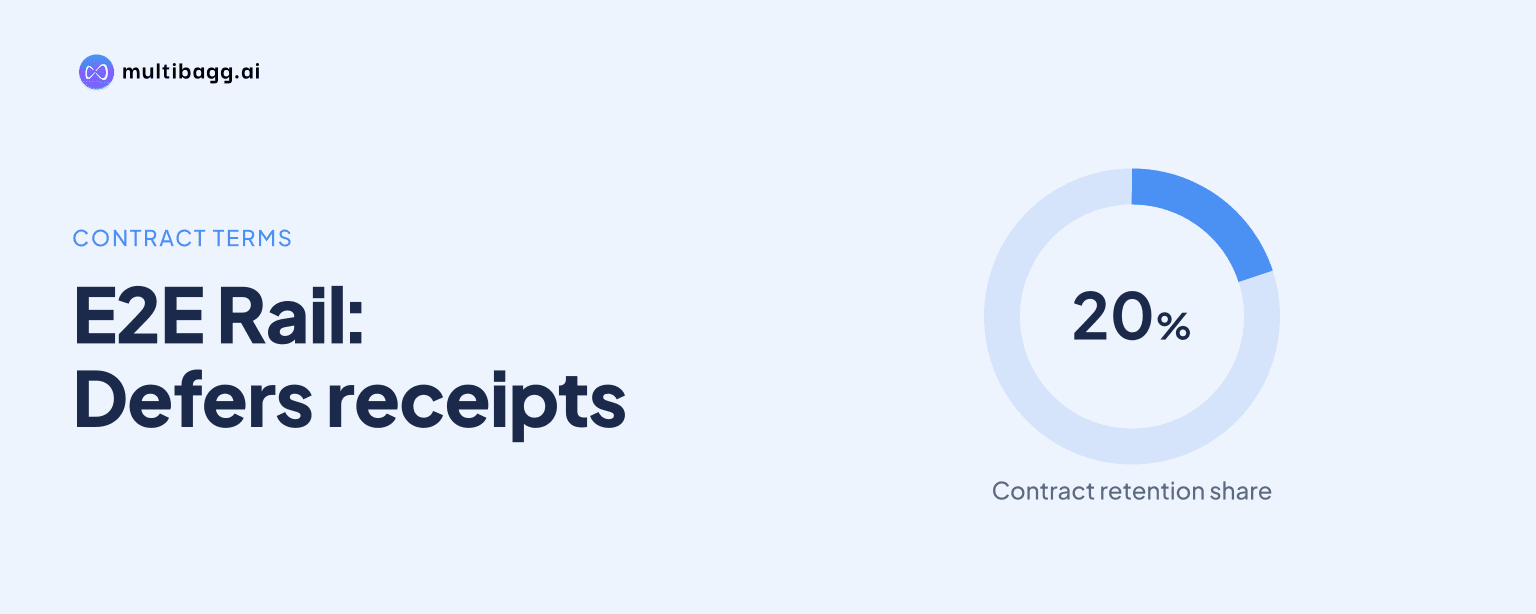
In its H1 earnings call, E2E Rail said Indian Railways contracts typically release about 80% of an item’s value at initial supply and defer roughly 20% until execution, commissioning and defect-liability milestones, causing unbilled revenue to build faster during the 45% to 50% growth rate it is pursuing.
Know E to E Transportation Infrastructure inside out
Results, valuation, peers and who's buying, in one view.
Why does E2E Rail defer about 20% of Indian Railways receipts?
E2E Rail said the deferred cash results from contract structure rather than delayed payment after invoice acceptance. Indian Railways represented 70% of its business at the time of the call, and management described it as a reliable payer once an invoice is accepted, with payment generally received in less than 30 days. The constraint is the bill of quantities, or BOQ, contract design, under which about 80% of an item’s sale value is paid against the initial supply invoice.
E2E Rail said the remaining amount is released when subsequent project milestones are completed, although there is no additional supply under the original invoice. Management described a 5% to 10% release after successful execution, another 5% after commissioning and a further 5% after the defect-liability period. It characterized the deferred component as roughly 20%, which remains in unbilled revenue until the relevant milestones are met.
The company said this model has operated over several years, with unbilled revenue from earlier projects returning to the business as projects are successfully commissioned. That means the balance is not presented by management as a permanent loss of cash. However, the timing gap becomes more significant when fresh order execution and supply expand faster than prior projects reach commissioning and defect-liability milestones.
How does E2E Rail’s growth rate affect operating cash flow?
E2E Rail said it can maintain neutral operating cash flow at a growth rate below the 45% to 50% pace currently under discussion, but it did not quantify that lower rate. At 45% to 50% growth, management said new unbilled revenue builds faster than deferred cash is recovered from prior years’ projects. This is why rapid revenue growth can coincide with negative operating cash flow under the Indian Railways contract model.
The collection mechanism differs between Indian Railways work and private-siding projects. E2E Rail said private-siding contracts typically permit 95% initial collection, compared with 80% for Indian Railways BOQ projects. Private sidings serve facilities such as ports, cement plants, steel plants and power-generation sites, linking them to the Indian Railways mainline.
E2E Rail said the 15-percentage-point difference in initial collection can increase cash available from private-siding work. The company began this activity in 2023 and said it now works with close to 19 private sidings across ports, cement and steel facilities. This business represented about 25% to 30% of overall activity at the time of the call, while Indian Railways still accounted for 70%.
Got a follow-up? Ask IRIS
How does E2E Rail plan to improve operating cash flow?
E2E Rail said it is addressing the cash-flow pattern through a larger private-siding mix and higher project margins. Management expects a greater contribution from contracts with 95% initial collection to improve the cash conversion of the business. It did not give a target date for private sidings to rise above their current 25% to 30% share, but said the segment was being continuously expanded.
The second measure is a targeted increase in project-level margins from roughly 17% to 18% to 23% to 26%. Management said higher margins would increase the cash generated within the existing 80%-initial-billing framework, even though the remaining amount would still be released only at later milestones. The 23% to 26% range is a management target, not a reported outcome.
E2E Rail linked the margin plan partly to NOVA, its wholly owned subsidiary established in 2025 to develop safety-critical railway products. Management said NOVA’s Kavach product was undergoing automatic train protection, or ATP, testing with the Research Designs and Standards Organisation, or RDSO. It indicated commercialisation could occur in the third quarter of the following year and identified electronic interlocking, axle counters and upgraded train-control systems as further planned NOVA RAKSHA platform products.
Will E2E Rail need equity funding for its current growth plan?
E2E Rail said it did not expect to require additional equity over the next two years to maintain its current growth plan. Management framed that view around a 40% to 45% compound annual growth rate, or CAGR, over the next couple of years. It said lenders including State Bank of India, ICICI Bank and HDFC Bank understood the milestone-based contract structure and were providing debt support for the current expansion pace.
That funding view is conditional. E2E Rail said it could consider equity if acquisitions or additional products beyond its current plans created non-linear growth. For Kavach, management said incremental working capital was already incorporated in its broader tendering and order-book assumptions, and it did not expect inventory to add significant pressure because stock would be built only a couple of months before field-trial approval.
E2E Rail said its H1 tender win rate exceeded 40%, which management cited as a reason not to slow growth despite the unbilled-revenue effect. The company also said it has gained credentials to bid for projects above Rs 200 crore. The trade-off described by management is that faster project wins and supply can increase deferred cash before the final 20% from earlier contracts is released.
Conclusion
E2E Rail attributes its negative operating cash flow primarily to the sequencing of Indian Railways BOQ contracts, not to payment delays on accepted invoices. With 70% of business tied to Indian Railways and roughly 20% of contract value dependent on later milestones, a 45% to 50% growth rate can expand unbilled revenue faster than older projects convert into cash. Management’s proposed offsets are a larger private-siding mix and higher project margins.
The next measures to watch are whether private sidings rise above their current 25% to 30% business share, whether project margins move from roughly 17% to 18% toward management’s 23% to 26% target, and whether Kavach reaches the commercialisation timetable indicated for the third quarter of the following year. Management also said no equity is expected for the next two years under its current plan, while leaving open the possibility of a raise for acquisitions or additional product opportunities.