










e2E Rail Targets January 2027 Kavach Order, FY28 Revenue
Key highlights
- e2E Rail targets its first Kavach order by January 2027, subject to approvals and customer decisions.
- Management plans to begin Kavach revenue recognition in FY28.
- More than 100 Nova and Tata Elxsi personnel are working on Kavach testing.
- e2E Rail reported an order book of around Rs 1,200 crore, including goods and services tax.
powered by IRIS
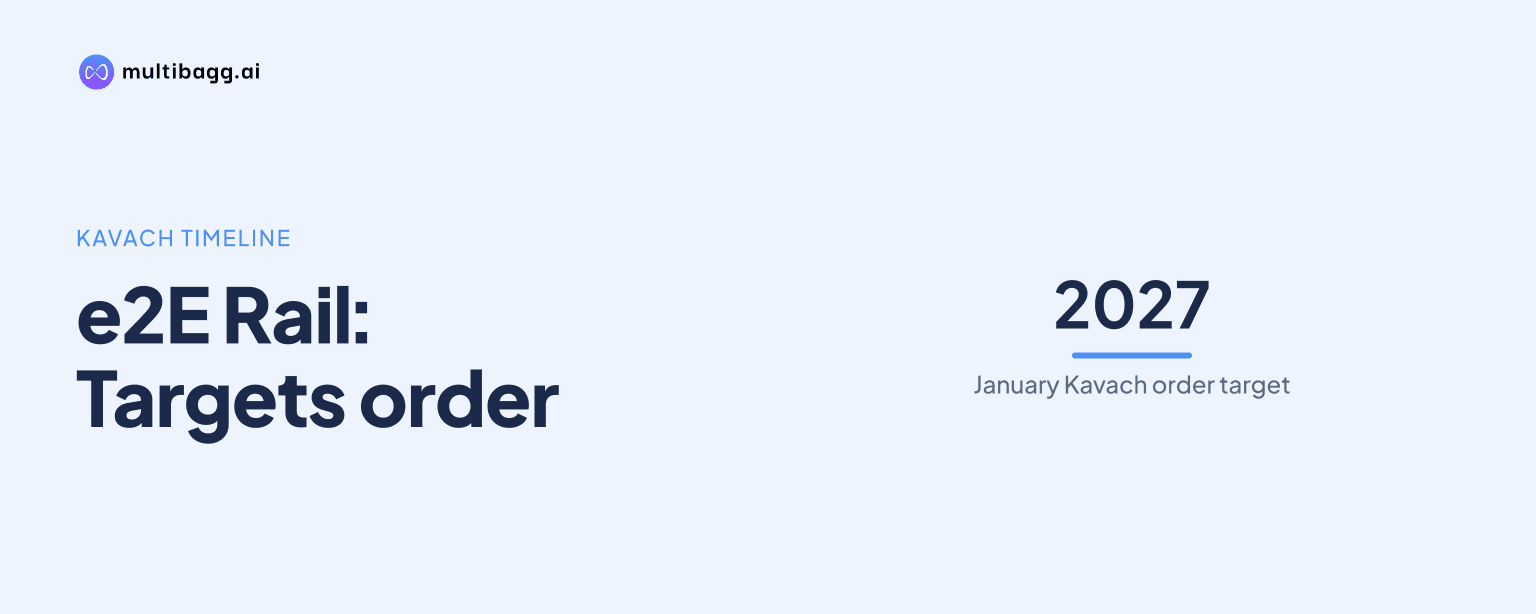
e2E Rail is targeting its first Kavach order by January 2027, subject to applicable approvals and customer decisions, and management’s roadmap places revenue recognition from the rail-safety product in FY28. The company said it received CCA approval in May, has Kavach hardware ready and has more than 100 Nova and Tata Elxsi personnel working on testing.
Know E to E Transportation Infrastructure inside out
Results, valuation, peers and who's buying, in one view.
When does e2E Rail expect its first Kavach order?
e2E Rail is targeting January 2027 for its first Kavach order, but this is a management target rather than a signed contract. Management disclosed the timetable on its November 16, 2026 H1 FY27 earnings call and said the outcome remains subject to applicable approvals and customer decisions.
Management said that meeting the January target would mean moving from CCA approval received in May to a first order in about eight months. It said this would be the fastest such progression for any Kavach vendor in India, but presented that comparison as conditional on attaining the target.
The company’s roadmap separates the prospective order from reported revenue. Management said testing and approvals will continue on their own schedules, while revenue recognition is slated to start in FY28. It did not disclose the potential customer, order value, route, tender scope or delivery schedule for the proposed first order.
What conditions could affect e2E Rail’s January 2027 target?
e2E Rail said applicable approvals and customer decisions are the two conditions that could determine whether the January 2027 order target is met. The company has not said that all testing, approvals or customer-selection processes have been completed, so the target does not represent booked revenue.
The current programme stage includes ready hardware and ATP, or automatic train protection, testing under way. More than 100 people across Nova and Tata Elxsi are working on the programme, according to management, which also said the product has been developed and tested by its teams.
Management described the first order as a commercial milestone rather than the end of the approval process. It said Nova’s products must move steadily through approval and into service, linking the timing of commercialisation to technical testing, regulatory processes and customer procurement decisions.
How does Kavach fit into e2E Rail’s existing business?
e2E Rail positions Kavach as an internally developed product that can supplement its system-integration operations. The company is executing 73 projects, including 54 business-to-government, or B2G, projects across 15 railway zones, and it has completed nine B2G projects during FY27 to date.
The existing projects are focused on milestones including commissioning, certification and billing, which management identified as the route from order book to reported results. Kavach is expected to add to that business only after a first order and the FY28 start of revenue recognition, rather than replacing the company’s current integration activity.
Management also described Nova Raksha as a safety platform for products including electronic interlocking and axle counters, systems e2E Rail already integrates. As those products obtain approvals and reach the market, management said e2E Rail could retain a greater share of project value and better coordinate product delivery with site schedules; this is management’s view, not a reported margin outcome.
The company said maintenance and support after commissioning could create recurring revenue over the life of equipment. No recurring-revenue figure was disclosed, and management’s FY29 revenue vision of Rs 1,000 crore depends on executing the existing order book and bringing Nova products through approvals and into service.
Got a follow-up? Ask IRIS
What financial and execution base supports the Kavach roadmap?
e2E Rail reported H1 FY27 revenue of Rs 161 crore, up 45.1% year on year from Rs 111 crore, while earnings before interest, tax, depreciation and amortisation, or EBITDA, moved to a Rs 5.09 crore profit from a Rs 1.46 crore loss. Staff and other expenses declined to about 31% of revenue from 37% a year earlier.
The company said the second half has accounted for around 70% of annual revenue over the past three years, making H2 FY27 commissioning and certification material to its full-year result. Management said it was confident of sustaining a similar year-on-year growth pace and keeping full-year profit-after-tax margin broadly in line with FY26, which is management guidance.
Reported FY27 order intake had exceeded Rs 700 crore at the time of the call, while the order book was around Rs 1,200 crore including goods and services tax. This compares with projects typically pursued a few years earlier in the Rs 20 crore to Rs 60 crore range; management said it now targets opportunities valued from Rs 50 crore to Rs 500 crore.
Cash conversion remains an execution issue alongside product development. e2E Rail began the year with Rs 228 crore of opening receivables and had collected Rs 199 crore by November 12, nearly 87%, while trade receivables at the September close were down 47% from March to Rs 121 crore. Operating cash flow was negative Rs 39 crore in the six months to September, compared with negative Rs 102 crore for the full year ended March.
Conclusion
e2E Rail has set out a defined but conditional Kavach commercialisation sequence: CCA approval in May, testing with more than 100 Nova and Tata Elxsi personnel, a first order targeted for January 2027 and revenue recognition from FY28. The plan sits alongside a larger integration operation, with 73 active projects and an order book of around Rs 1,200 crore including goods and services tax.
The next disclosed milestones are the January 2027 first-order target, continuing approvals and ATP testing, and H2 FY27 execution through commissioning, certification and billing. Management is also monitoring whether H1 FY27 revenue growth of 45.1% continues in the second half and whether negative operating cash flow can be reduced further from Rs 39 crore for the six months to September.