










e2E Rail expects Kavach revenue recognition in October 2027
Key highlights
- e2E Rail expects its first Kavach order in January 2027.
- e2E Rail expects Kavach revenue recognition to start in October 2027.
- e2E Rail targets Kavach commercialisation at steady state by March 2028.
- e2E Rail reports a NOVA and TEL Kavach team of more than 100 people.
powered by IRIS
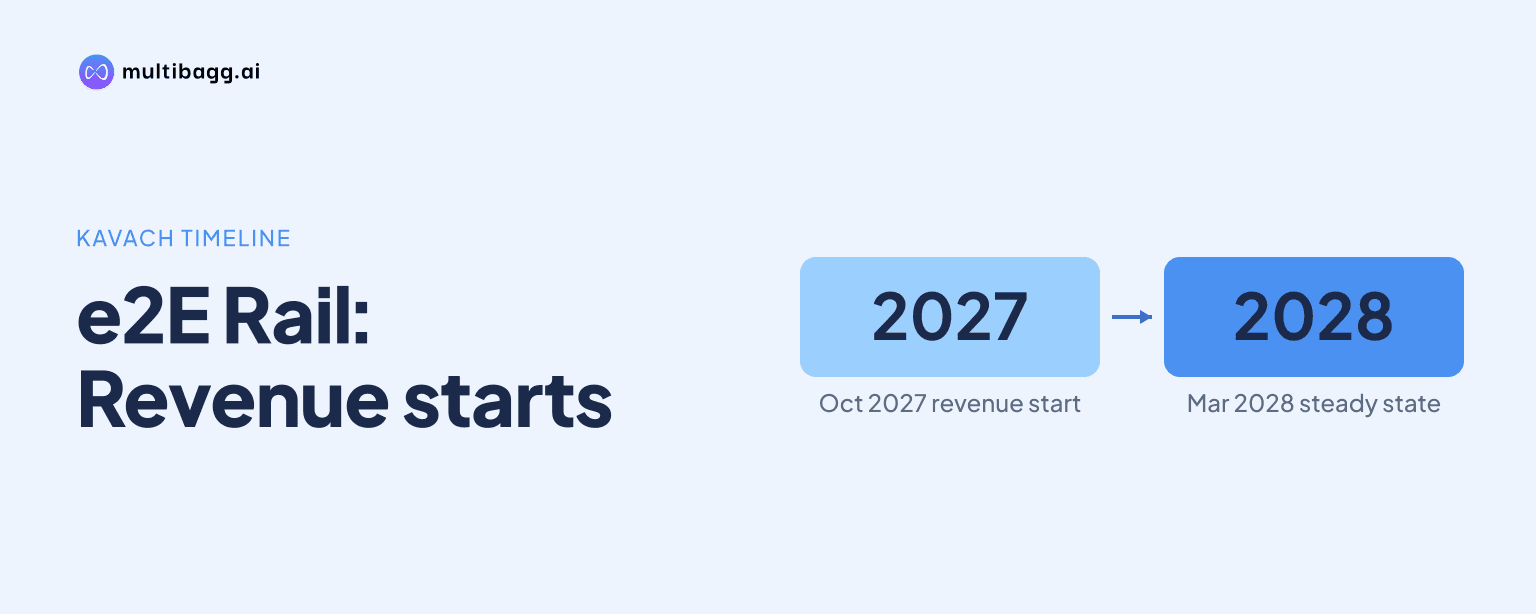
e2E Rail expects its first Kavach order in January 2027 and revenue recognition to start in October 2027, under a roadmap that targets final approval in December 2027 and steady-state commercialisation by March 2028. The presentation identifies the dates as expected timelines subject to client requirements and industry conditions.
Know E to E Transportation Infrastructure inside out
Results, valuation, peers and who's buying, in one view.
What is e2E Rail's Kavach commercial timetable?
e2E Rail expects a first Kavach order in January 2027, revenue recognition from October 2027 and steady-state commercialisation in March 2028. These are expected milestones in the company’s commercial roadmap, rather than disclosed orders, contracts or recognised revenue.
The roadmap places the expected revenue-recognition start nine months after the planned first order. It then puts steady-state commercialisation five months after revenue is expected to begin, indicating that Kavach is presented as a programme moving through approvals and execution rather than as current FY27 revenue.
The expected January 2027 order would precede the planned December 2027 final approval. e2E Rail does not disclose an order value, customer, route-kilometre scope or forecast Kavach revenue contribution, so the presentation supports the timing framework but not a quantified sales forecast.
Which Kavach approvals are still pending for e2E Rail?
e2E Rail’s approval roadmap shows that a May 2026 approval was achieved, while a November 2026 completion milestone remained in progress. The company also says its hardware was ready for the testing stage scheduled to begin in December 2026.
The plan schedules prototype approval for March 2027, followed by a 70% testing target in June 2027 and field trials from July 2027. These expected technical steps overlap with the company’s January 2027 first-order expectation, rather than being completed before that commercial date.
Final approval is expected in December 2027, two months after the planned October 2027 revenue-recognition start. e2E Rail states that the timeline can change according to client requirements and industry conditions, making testing progress, prototype approval and field trials the disclosed dependencies for the programme.
How does the NOVA platform support e2E Rail's Kavach plan?
e2E Rail positions NOVA as an integrated railway-safety platform spanning hardware and electronics, software and algorithms, system integration, and after-sales and annual maintenance contracts. The company says indigenous onboard and wayside-unit design is intended to reduce import dependency, while in-house products are intended to support complete signalling and safety solutions.
The Kavach programme has a NOVA and TEL team of more than 100 people, according to the presentation. e2E Rail does not disclose a separate research, development, certification or capital-expenditure figure for the programme.
NOVA Raksha is presented as the base for 11 safety-critical products across four categories. The train-protection category includes Kavach 4.0, Electronic Interlocking, Axle Counters and platform screen doors, while the wider product list includes train-control, intelligence and monitoring, and propulsion systems.
The 11-product portfolio places Kavach within e2E Rail’s broader technology roadmap rather than presenting it as a stand-alone offering. The company identifies long-term operations and maintenance contracts as a source of annual revenue streams, but gives no contract duration, margin or contract value specifically linked to Kavach.
Got a follow-up? Ask IRIS
What business scale provides context for e2E Rail's Kavach rollout?
e2E Rail reported an executable order book of ₹994 crore as of 11 November 2026, comprising ₹870 crore of business-to-government work and ₹124 crore of business-to-business work. Kavach is not separately identified in that order book, so the presentation does not establish that the expected January 2027 order is included in the reported total.
The company reported FY27 year-to-date orders of ₹724.04 crore, including 12 business-to-government orders worth ₹568.80 crore and seven business-to-business orders worth ₹155.24 crore. The secured orders cover capacity expansion, Mission Raftar, private sidings, signalling for new lines and signalling upgrades.
The company says its average business-to-government ticket size has shifted from ₹20 crore to ₹60 crore earlier to ₹50 crore to ₹500 crore now. It cites the Kalahasti order of more than ₹200 crore as an example and shows a ₹3,423.1 crore pipeline, including ₹664.4 crore of result-awaited bids, ₹173.7 crore of high-probability bids and ₹2,585 crore of third- and fourth-quarter bids.
Execution scale provides further context for a future technology rollout. e2E Rail reports 73 active projects across 15 zones and five sectors, comprising 54 Indian Railways projects and 19 private-siding projects, with nine business-to-government projects completed in FY27 so far.
What could change e2E Rail's Kavach dates?
e2E Rail says its Kavach dates are expected timelines that can change because of client requirements and industry conditions. The outstanding stages include the December 2026 testing start, March 2027 prototype approval, June 2027 testing target, July 2027 field-trial start and December 2027 final approval.
The roadmap’s sequence shows the operational dependencies between hardware readiness in December 2026 and the March 2028 steady-state commercialisation objective. A change in prototype approval, testing progress or field-trial timing could affect the expected October 2027 revenue-recognition date.
Cash conversion is another disclosed operating backdrop as e2E Rail expands project activity. Net cash outflow from operating activities was ₹39 crore in H1 FY27, compared with ₹65 crore in H2 FY26, while trade receivables fell by ₹108 crore since March and total cash collection reached ₹270 crore by 12 November 2026.
Management says the collection cycle for other current assets, including unbilled revenue and security deposits, is generally about two to 2.5 years because of contractual terms. It expects the current-asset load to reduce significantly by year-end as multiple projects approach commissioning and completion.
Conclusion
e2E Rail has set out a defined Kavach commercial sequence: a first order expected in January 2027, revenue recognition from October 2027 and steady-state commercialisation by March 2028. The programme is supported by a team of more than 100 people and NOVA Raksha’s 11-product portfolio, but remains subject to staged testing, prototype approval, field trials and final approval.
The next disclosed milestones are the December 2026 testing start, March 2027 prototype approval, June 2027 testing target and July 2027 field-trial start. Investors can watch whether e2E Rail maintains its expected December 2027 final-approval date and whether it discloses the value, customer and execution scope of the planned January 2027 first order.