










e2E RAIL cuts receivables 47% as borrowings hit ₹196 crore
Key highlights
- e2E RAIL reduced trade receivables by ₹108 crore, or 47%, to ₹121 crore at September 2026.
- e2E RAIL's short-term borrowings rose ₹47 crore to ₹196 crore between March and September 2026.
- e2E RAIL reported ₹270 crore of cash collections through 12 November 2026, including ₹199 crore from opening receivables.
- e2E RAIL's net operating cash outflow was ₹39 crore in H1 FY27, versus ₹65 crore in H2 FY26.
powered by IRIS
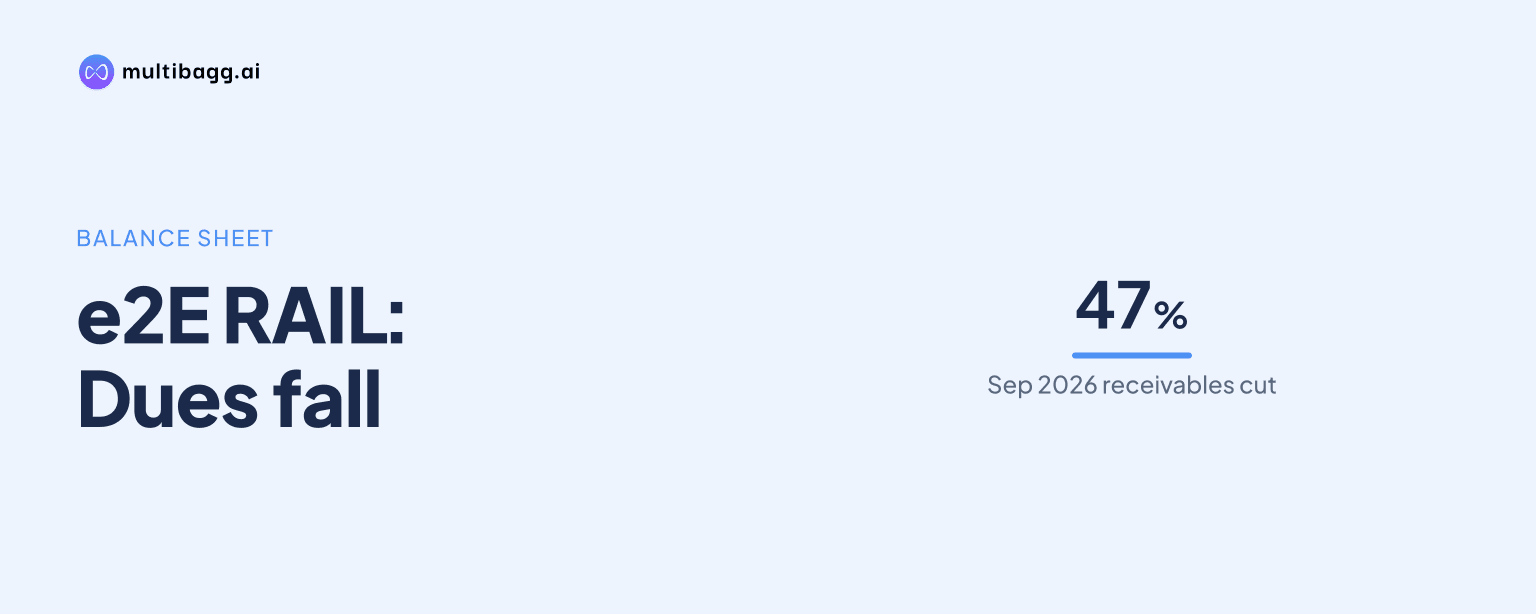
e2E RAIL reduced trade receivables by 47% to ₹121 crore at September 2026 from ₹229 crore in March 2026, while short-term borrowings rose ₹47 crore to ₹196 crore. The presentation also reported ₹270 crore of collections through 12 November 2026, including ₹199 crore from opening receivables.
Know E to E Transportation Infrastructure inside out
Results, valuation, peers and who's buying, in one view.
Why did e2E RAIL's trade receivables fall in H1 FY27?
e2E RAIL's trade receivables fell by ₹108 crore, or 47%, from ₹229 crore at March 2026 to ₹121 crore at September 2026. The reduction was the largest decline among the company's current-asset line items over the six-month period. The ₹108 crore figure in the cash-flow summary describes the H1 FY27 reduction in receivables, while the balance sheet reports the closing balance of ₹121 crore.
The company reported total cash collections of ₹270 crore through 12 November 2026, including ₹199 crore from opening receivables of ₹228 crore. This disclosure extends beyond the 30 September 2026 balance-sheet date, so it does not directly reconcile to the September receivables balance. It nevertheless identifies collections from opening debtors as a major component of cash received after the March 2026 position.
Trade payables also declined, reaching ₹117 crore at September 2026 from ₹172 crore at March 2026. The balance-sheet movement was ₹55 crore, while the accompanying cash-flow commentary rounded the reduction to ₹56 crore. Dues to micro and small enterprises decreased from ₹23 crore to ₹14 crore, and dues to other enterprises fell from ₹149 crore to ₹103 crore.
How did e2E RAIL's borrowings change by September 2026?
e2E RAIL's short-term borrowings increased to ₹196 crore at September 2026 from ₹149 crore at March 2026, a rise of ₹47 crore. Long-term borrowings increased by ₹19 crore to ₹33 crore over the same period. Total reported borrowings were therefore ₹229 crore at September 2026, compared with ₹163 crore six months earlier.
The increase in borrowings occurred while trade receivables and payables both declined, recording simultaneous collection, supplier-settlement and funding movements. Cash flow from financial activities was ₹52 crore in the six months to September 2026, compared with ₹37 crore in the six months to September 2025. The presentation does not allocate the additional borrowings to individual projects or borrowing facilities.
Finance cost was ₹13.80 crore in H1 FY27, up from ₹9.85 crore in H1 FY26, while revenue from operations rose to ₹161.11 crore from ₹111 crore. Earnings before interest, tax, depreciation and amortisation, or EBITDA, margin was 3.16% in H1 FY27, compared with negative 1.31% a year earlier. e2E RAIL still reported a profit after tax loss of ₹4.53 crore, narrowed from a ₹7.31 crore loss in H1 FY26.
Got a follow-up? Ask IRIS
Did e2E RAIL's operating cash outflow improve?
e2E RAIL reported net cash used in operating activities of ₹39 crore in H1 FY27, compared with ₹65 crore in H2 FY26 and ₹102 crore for full-year FY26. Management therefore described the operating cash outflow as falling from the second half of FY26. Against H1 FY26, however, the operating outflow was ₹2 crore higher than the ₹37 crore outflow reported for September 2025.
Changes in working capital consumed ₹42 crore in the six months to September 2026, versus ₹39 crore in the six months to September 2025. Operating profit before working-capital changes improved to ₹6 crore from a ₹1 crore loss, but cash generated from operations remained negative at ₹37 crore, compared with negative ₹39 crore a year earlier. Direct taxes paid were ₹3 crore in H1 FY27.
Investing cash outflow was ₹25 crore in H1 FY27, compared with ₹6 crore in H1 FY26, while financing cash inflow was ₹52 crore. Cash and cash equivalents ended the period at ₹4 crore, versus ₹8 crore at September 2025. This cash-flow measure is separately presented from the ₹105 crore balance-sheet line for cash and bank balances at September 2026.
What remains in e2E RAIL's current-asset balance?
e2E RAIL's total current assets declined to ₹503 crore at September 2026 from ₹526 crore at March 2026, despite a ₹61 crore increase in other current assets to ₹224 crore. The receivables reduction was partly offset by inventory rising from ₹5 crore to ₹23 crore, short-term loans and advances increasing from ₹20 crore to ₹29 crore, and other current assets growing from ₹163 crore to ₹224 crore.
Management said the collection cycle for other current assets, including unbilled revenue and security deposits, is generally about 2 to 2.5 years because of contractual terms. It also said multiple projects were approaching commissioning and completion, and that it expects the current-asset load to reduce significantly by year-end. That expectation is management's stated outlook rather than a reported September 2026 result.
Total assets were broadly unchanged at ₹555 crore in September 2026, compared with ₹556 crore in March 2026. Non-current assets increased to ₹53 crore from ₹30 crore, including non-current investments rising to ₹12 crore from ₹1 crore and intangible assets rising to ₹5 crore from ₹1 crore. Total equity declined to ₹201 crore from ₹205 crore as reserves and surplus moved to ₹184 crore from ₹188 crore.
Conclusion
e2E RAIL's H1 FY27 disclosures show a substantial fall in trade receivables alongside lower trade payables, but also higher short-term and long-term borrowings. Operating cash outflow of ₹39 crore was below the ₹65 crore cited for H2 FY26, while finance cost rose to ₹13.80 crore as reported revenue reached ₹161.11 crore.
The next disclosed point to watch is management's expectation that projects nearing commissioning and completion will reduce the current-asset load significantly by year-end. Further collections from the ₹228 crore opening-receivables base, and changes in borrowings from the September 2026 total of ₹229 crore, will indicate how that plan affects cash flow.