










E2E Rail says debt support can fund 40%-45% growth for two years
Key highlights
- E2E Rail said no additional equity is expected for at least two years while pursuing 40%-45% compound annual growth.
- Indian Railways represents 70% of E2E Rail's business and generally pays accepted invoices in less than 30 days.
- Private sidings account for about 25%-30% of business and provide about 95% initial payment versus about 80% for Indian Railways work.
- E2E Rail aims to raise project-level margins from roughly 17%-18% to 23%-26% through its product strategy.
powered by IRIS
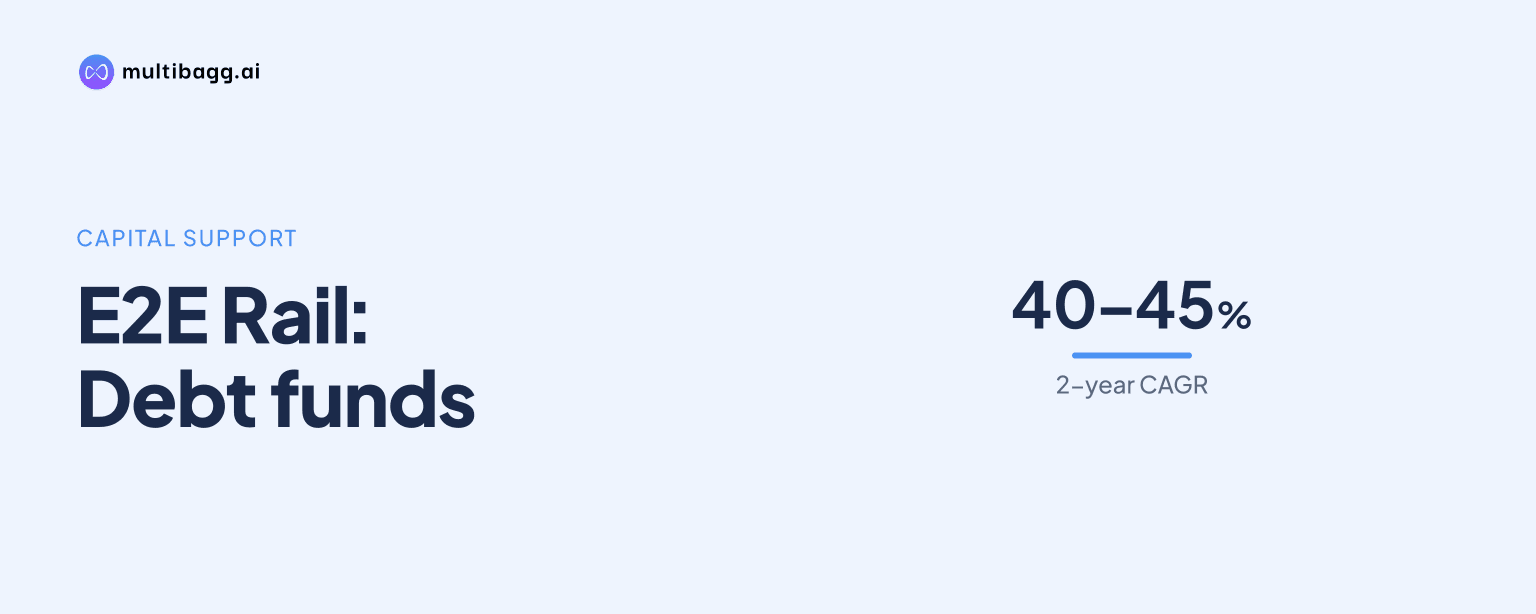
E2E Rail said it expects no additional equity for at least two years while pursuing 40%-45% compound annual growth, relying on debt providers, higher private-siding receipts and planned margin expansion. Management said equity could be considered only for acquisitions or product additions beyond the company’s current plans.
Know E to E Transportation Infrastructure inside out
Results, valuation, peers and who's buying, in one view.
Why does E2E Rail expect no equity raise?
E2E Rail expects no additional equity requirement for at least two years while maintaining its current 40%-45% compound annual growth rate, according to management. The company said its debt providers, including State Bank of India, ICICI Bank and HDFC Bank, understand the contract structure and operating-cash-flow pattern and are providing the debt needed for this pace of growth. Management did not provide a debt balance, borrowing cost or financing limit on the call.
The position reflects management's view that its current operating model can be funded without slowing expansion, rather than a statement that cash flow will necessarily be positive every year. Management said some negative cash flow could still arise because revenue is growing faster than cash is recovered from earlier projects. However, it expects the cash-flow outcome to be substantially better than before the initial public offering as business mix and margins change.
How do Indian Railways contracts affect E2E Rail cash flow?
E2E Rail said 70% of its business currently comes from Indian Railways, where accepted invoices are normally paid in less than 30 days. The working-capital issue is not described as slow payment after invoice acceptance. Instead, it comes from bill-of-quantities contracts, under which the company generally receives about 80% of the sale value for an item initially, with the remaining amount linked to later project milestones.
Management said a further 5%-10% is released on successful execution, another 5% on commissioning, and a final 5% after the defect-liability period. That means roughly 20% can sit as unbilled revenue even after the supply has been made, because payment remains tied to execution and commissioning. E2E Rail said its historic unbilled revenue has progressively returned to the business as projects were commissioned, but faster growth increases the build-up before earlier amounts are recovered.
Management also said it had collected almost 87%-90% of the debtors referred to during the discussion from March 2026 to the current first half. That statement indicates collections were a management focus, but the call did not disclose the total receivables balance, the value collected or the period-end operating cash flow. Investors therefore cannot derive a receivables-days figure or quantify the claimed improvement from this discussion alone.
Which changes could improve E2E Rail funding capacity?
E2E Rail said private sidings are the first mechanism to improve cash generation. Private-siding work accounted for about 25%-30% of the business at the time of the call, and management plans to increase that share. In contrast with Indian Railways projects, where about 80% is initially received, private-siding contracts provide about 95%, according to management, reducing cash held back against later execution milestones.
The company began its private-siding business in 2023 and said it now works with about 19 sidings across ports, cement plants and steel factories. Management described these contracts as having materially fewer contractual cash-flow constraints than Indian Railways work. The source does not disclose revenue from the 19 sites, their profitability or a target private-siding revenue mix, so the expected cash-flow benefit remains dependent on management executing its plan to expand the segment.
The second mechanism is a planned improvement in project-level margin. E2E Rail said current project margins are roughly 17%-18%, and it aims to lift them to 23%-26% through products developed under its NOVA subsidiary. Management said system integration should remain the top-line growth provider, while the product layer should improve margin profile, giving the company more internally generated cash despite the 80% initial billing structure in Indian Railways contracts.
Got a follow-up? Ask IRIS
Can Kavach growth be funded within E2E Rail's current plan?
E2E Rail said Kavach, the railway safety system it is developing through NOVA, is included in its broader working-capital planning rather than treated as a separate funding shock. Management said it already has an order book of Rs 1,200 crore without Kavach and has factored working capital for that business. It added that its revenue objective for fiscal year 2029, or FY29, is Rs 1,000 crore, comprising existing operations as well as new Kavach-related tenders.
For tenders, management said the earnest money deposit is about 2% of advertised tender value and can be submitted through bank guarantees. Once an order is received, it said no performance bank guarantee is required because Indian Railways permits an insurance security bond. Management put the normal project working-capital cycle at about 25%-30% of order value, but did not provide a separate numerical estimate for Kavach inventory or working capital.
Kavach's approval sequence affects how quickly the opportunity can convert into sales and cash. E2E Rail said it is already eligible to bid for 100% of station-Kavach orders, while prototype approval for locomotive Kavach would allow it to bid for 20% of locomotive tenders. Eligibility for the remaining 80% of locomotive orders depends on completion of field trials, which management said could take around a year.
Management said it would begin building inventory a couple of months before field-trial approval, after gaining a reasonable view of timing and the order book. It therefore does not expect a major incremental working-capital burden from Kavach. For locomotive orders, management said the delivery timeline is a strict 12 months from award, whereas station-Kavach contracts typically run for about two to two-and-a-half years and can be extended because of related system work.
Conclusion
E2E Rail's funding outlook rests on a specific combination of debt availability, private-siding growth and a planned move from roughly 17%-18% to 23%-26% project margins. The key constraint remains the Indian Railways contract mechanism: 70% of current business is exposed to a structure that initially releases about 80% of contract value and defers the remainder to execution, commissioning and defect-liability milestones.
The next items to watch are whether private sidings rise above their current 25%-30% business share, whether NOVA products support the stated margin improvement, and whether Kavach approvals occur on management's indicated timetable. Management said it expects a first Kavach order around January, plans to bid station-Kavach tenders in November and December, and expects full locomotive eligibility only after field trials that may take around a year.