










E2E Rail Keeps Nova Wholly Owned, Tata Elxsi Gets Royalty
Key highlights
- Nova will remain a wholly owned E2E Rail subsidiary and is intended to receive RDSO approval to supply Kavach.
- Tata Elxsi is set to receive roughly Rs 10 to Rs 12 of royalty for every Rs 100 core-Kavach product sale.
- E2E Rail and Tata Elxsi will share 50:50 the development investment and IP generated under the approved core-Kavach agreement.
- Locomotive Kavach orders have a strict 12-month deadline for field trials, supply and fitting.
powered by IRIS
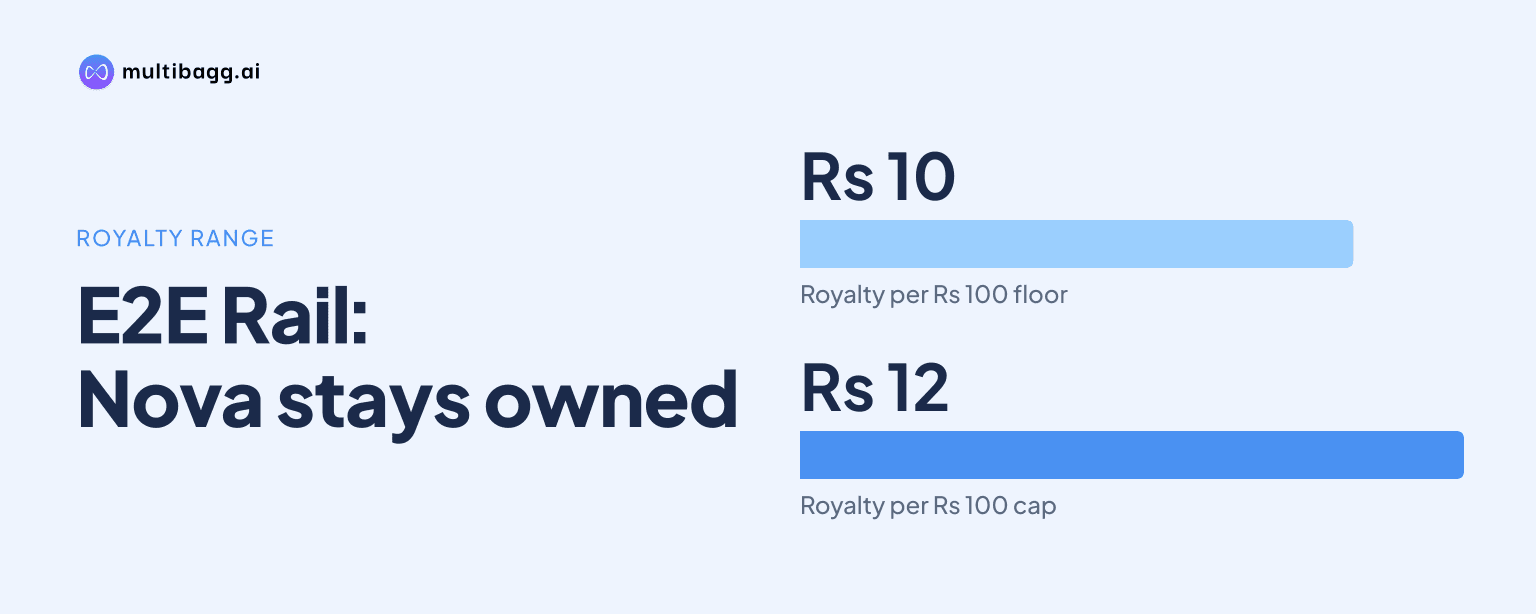
E To E Transportation Infrastructure Limited said Nova will remain its wholly owned Kavach original equipment manufacturer, while Tata Elxsi will receive roughly Rs 10 to Rs 12 for each Rs 100 core-Kavach product sale to Indian Railways. The arrangement gives Tata Elxsi 50:50 rights in jointly developed core-Kavach intellectual property, not equity in Nova.
Know E to E Transportation Infrastructure inside out
Results, valuation, peers and who's buying, in one view.
How does E2E Rail’s Kavach supply model work?
E2E Rail said Nova is the entity that will receive approval from the Research Designs and Standards Organisation, or RDSO, to supply Kavach. Nova, a wholly owned E2E Rail subsidiary, will supply the Kavach product to E2E Rail, while E2E Rail will participate in tenders and deliver the other components required for a complete Kavach installation.
This places the core-product role with Nova and the customer-contracting and system-integration roles with E2E Rail. Management described Nova as the original equipment manufacturer, or OEM, while E2E Rail’s tender package can include Kavach hardware alongside other equipment and work needed to commission a railway installation.
The structure does not make Nova the tendering entity for the wider project. E2E Rail said it will bid for and win the tenders, with Nova supplying Kavach into those contracts. The distinction matters because E2E Rail already operates a system-integration business and said its expertise lies in integrating Kavach, commissioning projects and converting order book into revenue and cash flow.
E2E Rail also said its existing Rs 1,200 crore order book excludes Kavach. Management therefore presented Kavach as an additional business line within its operating model rather than as a separate single-product manufacturing operation, contrasting its position with companies it described as single-product manufacturers.
What royalty will Tata Elxsi receive from Kavach sales?
Tata Elxsi will receive a royalty of roughly Rs 10 to Rs 12 for every Rs 100 core-Kavach product sold to Indian Railways, according to E2E Rail’s illustration. Management said the royalty relates to the core Kavach hardware developed under the agreement, rather than to all the components and services in a full installation package.
E2E Rail confirmed that the royalty calculation uses E2E Rail’s total selling price to Indian Railways, not Nova’s selling price to E2E Rail. Management also said Nova and E2E Rail must undertake further work to build the final Rs 100 product, meaning the example is a royalty allocation rather than a full statement of product costs, margins or profit sharing.
E2E Rail did not disclose the expected value of development intangibles from Nova or Kavach, calling the information proprietary. It said, however, that development costs were budgeted in its initial public offering fund raise, so it is not seeking incremental money to fund that development.
Got a follow-up? Ask IRIS
How are Kavach intellectual property and development costs shared?
E2E Rail said intellectual property, or IP, generated through the approved core-Kavach development will be shared 50:50 with Tata Elxsi. The two companies will also each fund 50% of the investment for this co-development work, according to management.
The 50:50 arrangement applies to the IP produced under the Kavach agreement, not to Nova’s shareholding. Asked whether Tata Elxsi would become a Nova shareholder because it shares development expenditure, management said no and described Tata Elxsi as an IP holder of the Kavach hardware platform.
The current approval is limited to Kavach co-development. E2E Rail said both companies are public companies, so any work on additional products would be considered individually and would require specific approvals from both boards, rather than being covered automatically by the existing arrangement.
For future products, the share of jointly developed IP will depend on how much of the Kavach platform is reusable. Management said that share could be significantly less than 50% where a new application needs substantial hardware customisation, even if the product has some engagement with the jointly developed platform.
What execution requirements apply to E2E Rail’s Kavach plans?
E2E Rail said locomotive Kavach orders carry a strict 12-month deadline from award to prove the field trial and supply and fit the equipment. If the supplier does not meet that requirement, the unfulfilled part of the tender can be retendered, a result management said has already occurred for some companies.
Station Kavach contracts have materially longer timelines of around 2 to 2.5 years because they form part of a broader systems contract. E2E Rail said these schedules can be extended when other related infrastructure works are pending, and management said it would begin actively bidding for station Kavach because those projects offer more time for execution.
Tender participation requires an earnest money deposit, or EMD, of about 2% of the advertised tender value, management said. It added that the EMD can be provided through bank guarantees and that, after an order is received, Indian Railways permits an insurance security bond instead of a performance bank guarantee.
E2E Rail put normal project working capital at around 25% to 30% of order value. Management said it had factored working capital into its Rs 1,200 crore order book and expects to build inventory a couple of months before field-trial approval, based on its assessment of the approval timetable.
Management reiterated a target of about Rs 1,000 crore in revenue by FY29, comprising existing operations and new Kavach-related tenders. It also said it added more than Rs 700 crore of new order book in the first half and expects year-end order-book coverage of at least two times the revenue it is targeting for the following year.
Conclusion
The disclosed model keeps Nova wholly owned by E2E Rail while assigning Tata Elxsi an economic interest in the co-developed core Kavach hardware through a royalty of roughly Rs 10 to Rs 12 per Rs 100 product sale. E2E Rail retains tender participation, system integration and delivery responsibility for the broader Kavach package, while the partners share 50:50 development funding and IP generated under the approved agreement.
The next issues to watch are Nova’s RDSO approval and completion of field trials, particularly because locomotive awards have a 12-month supply-and-fit deadline. Management’s plans to bid actively for station Kavach, pursue about Rs 1,000 crore of FY29 revenue and seek separate board approvals for any future products will determine how far the partnership extends beyond the current core-Kavach scope.