










Chetana H1 EBITDA margin reaches 26.6% after cost actions
Key highlights
- Chetana reported H1 FY27 consolidated turnover of Rs 65.63 crore, up 12% year on year.
- Chetana's H1 FY27 consolidated EBITDA margin rose 310 basis points to 26.6% from 23.5%.
- Chetana said advance paper buying produced about 7% to 8% purchase-side savings after 2% to 3% inventory costs.
- Chetana reported H1 FY27 consolidated PAT of Rs 12.07 crore and PAT margin of 18.4%.
powered by IRIS
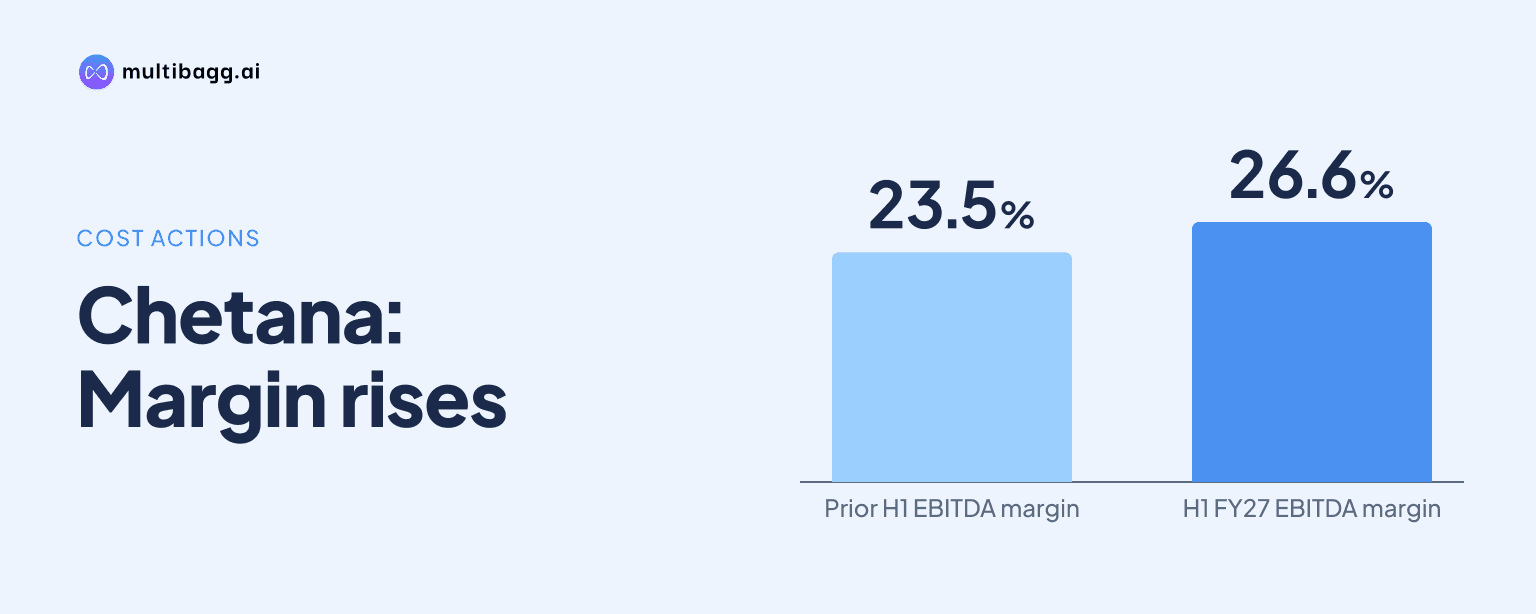
Chetana Education Limited lifted its consolidated earnings before interest, tax, depreciation and amortisation (EBITDA) margin to 26.6% in H1 FY27 from 23.5% a year earlier, as turnover rose 12% to Rs 65.63 crore. Management attributed the 310-basis-point increase to advance paper buying, a streamlined employee base and lower borrowing costs.
Know Chetana Education inside out
Results, valuation, peers and who's buying, in one view.
Why did Chetana's H1 EBITDA margin rise?
Chetana's H1 FY27 EBITDA margin rose because revenue growth was accompanied by procurement, staffing and finance-cost actions. Consolidated EBITDA was Rs 17.47 crore on turnover of Rs 65.63 crore, producing a 26.6% margin, compared with 23.5% in H1 FY26. Management also described turnover as increasing from about Rs 58 crore to about Rs 65 crore.
The reported margin expansion was not presented as only a volume effect. Management said its costing strategy, employee-strength streamlining and lower interest rates reduced expenses, while the increase in turnover contributed to profitability. Consolidated profit after tax (PAT) was Rs 12.07 crore, and PAT margin rose to 18.4% from 16.1% a year earlier.
PAT means profit after tax. The change in PAT margin was larger than the change in revenue because management cited both operating measures, including paper purchasing and staffing, and a lower finance-cost burden after its bank switch.
How did advance paper buying reduce Chetana's costs?
Chetana said it avoided much of a nearly 15% peak-season increase in paper prices by buying paper around two months in advance. Management estimated that the 2% to 3% cost of carrying the inventory was offset by savings of about 7% to 8% on the paper-purchase side.
The procurement measure is relevant to Chetana's core print and publishing business. On a standalone basis, Chetana reported H1 FY27 turnover of Rs 64.47 crore, up 10.3% year on year, EBITDA of Rs 16.72 crore and PAT of Rs 11.36 crore. Management did not disclose paper's share of total costs or the rupee value of the paper saving.
The 7% to 8% figure is therefore management's estimate of savings on paper purchases rather than a disclosed reduction in company-wide expenses. Its comparison indicates that the company accepted a 2% to 3% inventory cost to protect against a much larger paper-price movement during the peak season.
What did staffing and lower interest costs contribute?
Chetana said it streamlined employee strength in H1 FY27, identifying that action as one of the major contributors to the EBITDA-margin increase. Management did not give the employee count before or after the exercise, or quantify the associated savings in rupees.
Chetana also shifted its banking relationship from Saraswat Bank to Axis Bank and obtained a lower interest rate. Management directly linked the bank change to the rise in PAT margin to 18.4% in H1 FY27 from 16.1% in H1 FY26, a 230-basis-point improvement.
The mechanisms affect different profit measures. Paper procurement and employee-strength changes can influence EBITDA because they concern operating costs, while a lower borrowing rate affects PAT after finance costs. Chetana reported consolidated EBITDA of Rs 17.47 crore and PAT of Rs 12.07 crore for H1 FY27.
Got a follow-up? Ask IRIS
Can Chetana sustain its H1 FY27 margin improvement?
Chetana did not provide an EBITDA-margin target for the remainder of FY27, although management said revenue growth visibility for FY27 was 18% to 20% over FY26. The continuation of the H1 margin outcome will depend on paper-cost conditions, inventory planning, employee costs and the revenue mix across its newer businesses.
Management said stationery carries EBITDA margin of about 12%, compared with the approximately 25% average EBITDA margin it cited for the company. H1 FY27 stationery revenue was around Rs 4 crore, and management said it expects the division to achieve at least four times its current revenue in the next academic year.
The over-the-top (OTT) education platform has a different margin profile. Management said OTT revenue was expected to be around Rs 2.5 crore for the full year and estimated its EBITDA margin at 35% to 40%, but said adoption by schools would take time. The company is offering six months of free subscription through its Smart School Program to encourage use.
How could new businesses affect Chetana's revenue mix?
Chetana said government and institutional orders may have EBITDA margins of about 18% to 20%, below the approximately 25% company average cited by management. It had received an order worth Rs 4 crore for delivery within the next month and said two government contracts would be delivered in the third quarter of FY27.
Chetana's Gold Circle programme is intended to increase revenue from existing pre-primary schools. Management said a typical publisher may earn Rs 1.5 lakh to Rs 2 lakh from a school, while Chetana aims to reach Rs 3 lakh to Rs 4 lakh by supplying the full curriculum alongside teacher support, student kits, assessment papers and OTT access.
The Smart School Program had enrolled around 60 schools in FY27, with interactive flat panels provided free in return for a three-year customer commitment. Chetana also said more than 8,000 secondary-school teachers had registered for its Books & Beyond artificial-intelligence teaching tool, which is being extended to teachers serving children aged three to six.
What are Chetana's plans for Olympiad and stationery?
Chetana launched the NextGen Olympiad three months before the November 17, 2026 call and said it had reached more than 175 schools and distributed around 24,000 examination papers. At Rs 150 per exam, management described the Olympiad primarily as a way to deepen school relationships rather than a major immediate revenue contributor.
Management aims to raise Olympiad preparation by five to six times in the next academic year, with results expected in the following financial year. The exam covers five subjects, including mathematics, science, English, financial literacy and STEM, or science, technology, engineering and mathematics.
For stationery, Chetana said it had delivered orders to more than 100 schools after reintroducing the category in FY27. Management expects to serve 500 to 600 schools in the next academic year, compared with the 100-plus schools achieved so far, while acknowledging that stationery has a lower margin than publishing and OTT.
Conclusion
Chetana's H1 FY27 performance indicates that profit growth reflected more than higher sales. Advance paper procurement reduced exposure to a nearly 15% seasonal paper-price increase, employee-strength changes lowered operating costs, and a lower borrowing rate supported PAT. The result also shows that expanding lower-margin stationery and institutional work could alter the mix of future revenue.
The next indicators are delivery of the two government contracts in the third quarter of FY27, progress toward management's 18% to 20% FY27 growth outlook, and execution of the next academic year's Olympiad and stationery plans. Management has not set a consolidated EBITDA-margin target, while its planned expansion spans businesses with stated margins ranging from about 12% for stationery to 35% to 40% for OTT.