










Chetana targets OTT revenue at 30% of publishing in 3 years
Key highlights
- Chetana management said OTT revenue could reach at least 30% of publishing revenue within 3 years.
- Chetana described current OTT platform revenue at around Rs 2.5 crore.
- Chetana charges Rs 30 per child per month, or Rs 360 annually, for OTT streaming.
- Chetana reported H1 FY27 consolidated turnover of Rs 65.63 crore and an EBITDA margin of 26.6%.
powered by IRIS
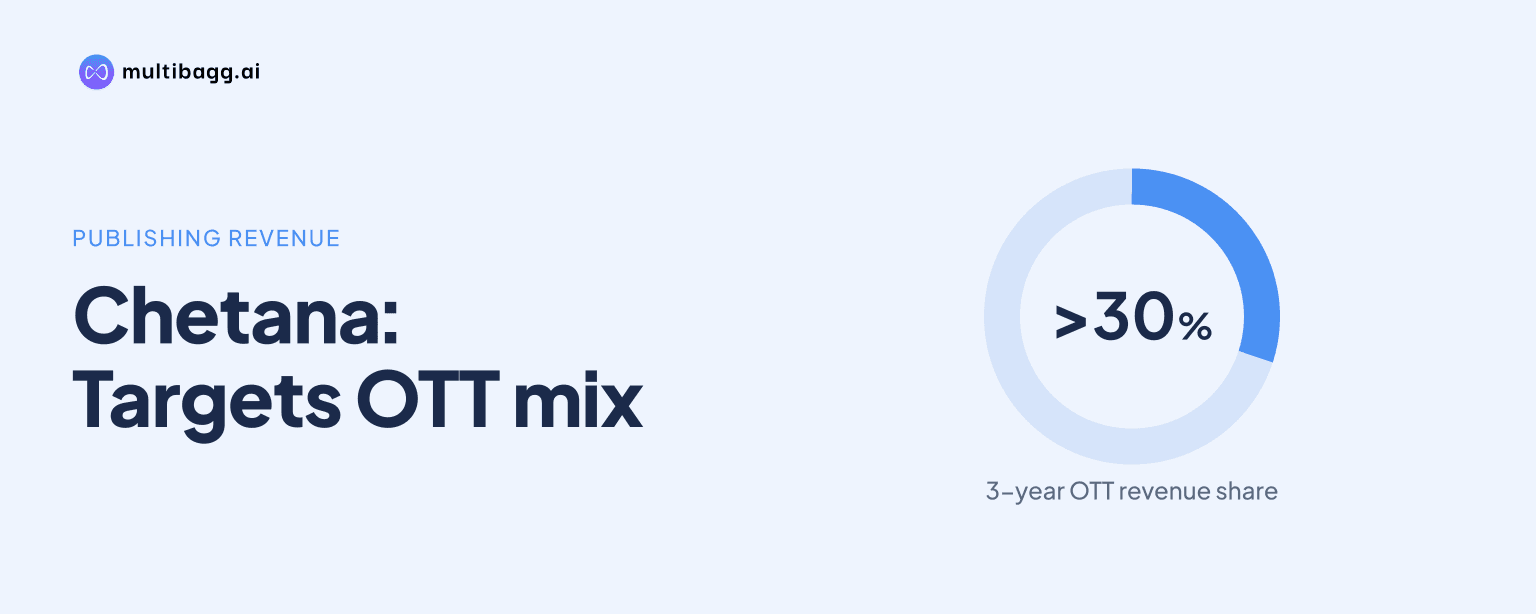
On November 17, 2026, Chetana Education Limited said its OTT platform could within three years add revenue equal to at least 30% of its publishing business, compared with around Rs 2.5 crore of current platform revenue, as management prioritises school adoption of its Rs 30-per-student monthly software-as-a-service model.
Know Chetana Education inside out
Results, valuation, peers and who's buying, in one view.
What is Chetana's three-year OTT revenue target?
Chetana expects OTT revenue to reach at least 30% of publishing revenue within three years. Management stated the ambition during the H1 FY27 earnings call but did not provide the publishing revenue base, a rupee target or an annual timetable for the platform's expansion.
The target is set against consolidated H1 FY27 turnover of Rs 65.63 crore, up about 12% year on year, and standalone turnover of Rs 64.47 crore, up 10.3%. Chetana did not separately disclose publishing revenue for the half year, so the 30% objective cannot be converted into a precise amount from the call.
Chetana said OTT revenue was around Rs 2.5 crore overall, including more than Rs 1 crore already generated from students and further revenue expected over the next six months. The company said the video library had previously been included with books, meaning it had not created separately identified digital revenue before the OTT offering.
How does Chetana charge for its OTT platform?
Chetana charges Rs 30 per child per month, or Rs 360 annually, for OTT streaming access. Management described this as a software-as-a-service, or SaaS, model that seeks recurring student payments rather than relying only on the sale of printed books.
The platform contains more than 35,000 educational videos that were earlier integrated into the book offering. Chetana said the content-production cost was already included in book processing, while the OTT service now provides a separate route to monetise those videos through streaming.
Chetana said its content can be streamed through seven platforms, including Samsung devices, Apple laptops and tablets. The company is introducing the service through schools, where management said the practical challenge is persuading teachers and students to use content delivered through television, laptops, tablets or projectors.
Why is Chetana focused on adoption before OTT revenue?
Chetana is focused first on adoption because management said schools are taking time to shift from traditional teaching methods to digital classroom content. It said the OTT platform is a longer-term opportunity and that revenue growth depends on schools becoming comfortable with its use.
Through the Smart School Program, Chetana gives participating schools an interactive flat-panel, or IFP, screen free of cost and binds customers for three years. About 60 schools joined the programme in its first year, and management said it would modify the programme to add more schools and improve sales and profitability.
Chetana is lowering the initial payment barrier by offering a nominal registration fee and six months of free OTT access under the Smart School Program. Management said this allows schools to get used to the platform before subscriptions become a larger revenue contributor.
Early deployment data showed that more than 60 schools participated in the OTT channel, with a success ratio of almost 90%, according to management. It attributed the exceptions to changes in certain Microsoft or Google policies and said the remaining implementations had worked successfully.
Got a follow-up? Ask IRIS
How does Chetana use school programmes to sell digital services?
Chetana uses Gold Circle and Books & Beyond to deepen its relationship with schools beyond individual book orders. Gold Circle gives pre-primary schools teacher support, student kits, assessment papers and OTT access if they purchase the full Chetana curriculum.
Management said a conventional publisher may receive orders for two or three titles out of 10, while Gold Circle is intended to secure all seven to eight subjects from a school. Chetana plans to approach at least 5,000 pre-primary schools, though it did not give a conversion target or a timetable for enrolments.
Books & Beyond, Chetana's artificial-intelligence-based teacher tool, had more than 8,000 registered secondary-school teachers after its first year. The company is extending it to pre-primary teachers working with children aged three to six, enabling worksheets, quizzes and notes to be generated through the portal.
These programmes sit alongside Chetana's existing book business, which management said is split almost 50%-50% between Maharashtra State Board and Central Board of Secondary Education, or CBSE, revenue. Management said the objective is to increase revenue per school from a typical Rs 1.5 lakh to Rs 2 lakh to Rs 3 lakh to Rs 4 lakh.
What margins has Chetana indicated for OTT?
Chetana indicated that OTT could have an earnings before interest, tax, depreciation and amortisation, or EBITDA, margin of 35% to 40%. This was management's indication rather than a reported segment result, and Chetana did not disclose separate OTT profit or loss in H1 FY27.
The indicated OTT range compares with management's approximate 25% average EBITDA margin and about 12% for stationery. Stationery generated around Rs 4 crore in the first half, while management said that segment has lower margins than publishing and OTT.
At the consolidated level, Chetana reported H1 FY27 EBITDA of Rs 17.47 crore and a 26.6% margin, compared with 23.5% a year earlier. Management attributed the increase to cost strategies, streamlined employee numbers, lower finance costs and higher revenue.
Management also cited advance paper purchases as a contributor to profitability. It said peak-season paper prices increased by almost 15%, while buying paper about two months ahead helped the company save about 7% to 8% on the purchase side after allowing for inventory costs of 2% to 3%.
Which partnerships support Chetana's OTT offering?
Chetana said its arrangements with Physics Wallah, Aditya Birla Education and Chin2 Bhosle are for OTT content rather than books. Physics Wallah contributes competitive-exam preparation expertise, while Chin2 Bhosle provides National Education Policy-based children's content, songs, rhymes and workshops.
Aditya Birla Education provides a mental-health programme for the platform, according to management. These content additions support Chetana's plan to make its OTT library relevant across school needs while it works on adoption at the Rs 30-per-student monthly price point.
Chetana also uses Beam Outsourcing Service for technology, examination administration and results in its NextGen Scholar Olympiad, while Chetana handles marketing and distribution. The Olympiad had reached more than 175 schools and distributed around 24,000 examination papers after launching about three months before the call.
Management expects the Olympiad to expand to around 750 to 1,000 schools in the next academic year, from more than 175 schools in its initial four months. It also said the Rs 150 price per exam means the Olympiad's direct revenue contribution may be limited, while its school relationships could support broader product sales.
Conclusion
Chetana's digital plan is to convert an existing library of more than 35,000 videos into subscription revenue while using school hardware, full-curriculum sales, teacher tools and third-party content to encourage recurring use. The platform's around Rs 2.5 crore revenue remains small relative to H1 FY27 consolidated turnover of Rs 65.63 crore, but management has set a three-year objective of at least 30% of publishing revenue.
The next measure to watch is whether the modified Smart School Program grows beyond its first 60 schools and converts free six-month access into paid subscriptions. Management also plans to approach at least 5,000 pre-primary schools through Gold Circle and said it expects FY27 revenue growth of 18% to 20%, while longer-term digital progress depends on classroom adoption.