










Chetana NextGen Olympiad targets 750-1,000 schools
Key highlights
- Chetana's NextGen Olympiad had reached more than 175 schools and distributed around 24,000 papers by November 17, 2026.
- Chetana targets 750 to 1,000 schools for NextGen Olympiad in the next academic year.
- Chetana prices each NextGen Olympiad exam at 150 rupees across five subjects.
- Chetana reported H1 FY27 consolidated turnover of Rs 65.63 crore, up about 12% year on year.
powered by IRIS
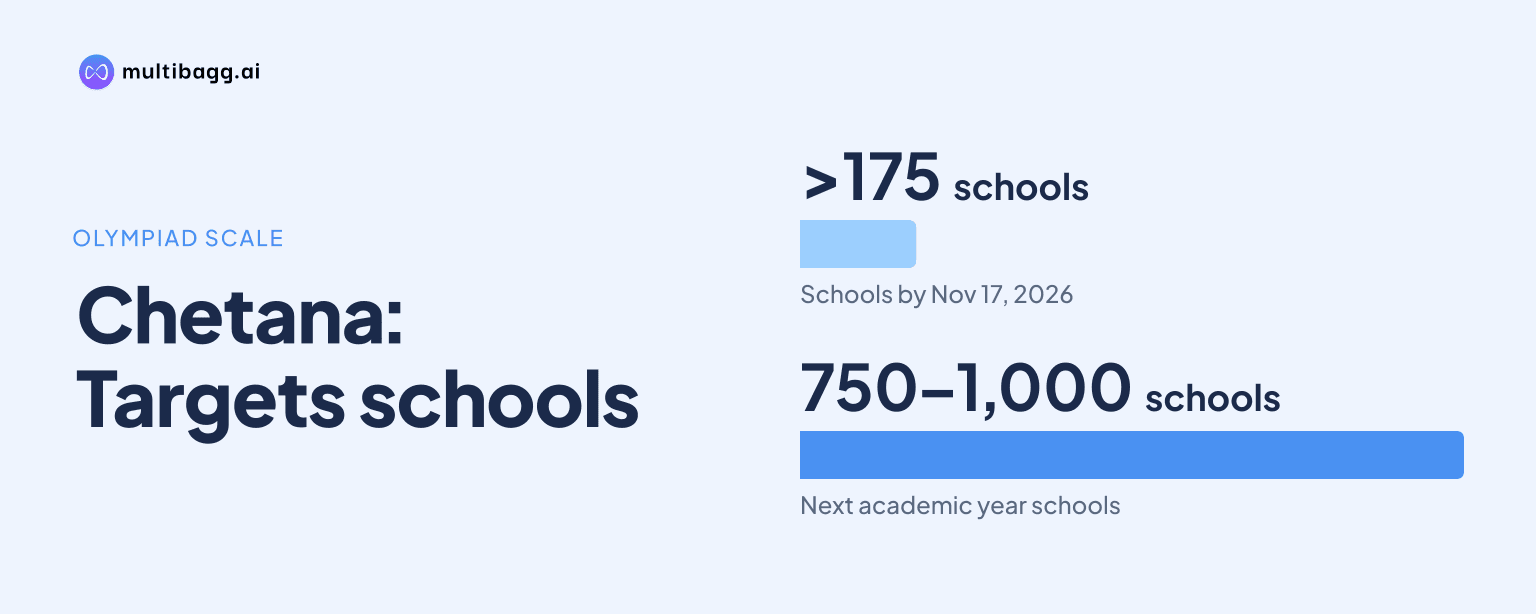
Chetana Education Limited aims to bring 750 to 1,000 schools into its NextGen Olympiad in the next academic year, after the first rollout reached more than 175 schools and distributed about 24,000 examination papers by November 17, 2026. Management said the 150-rupee exam is intended primarily to deepen school relationships.
Know Chetana Education inside out
Results, valuation, peers and who's buying, in one view.
How far has Chetana's NextGen Olympiad rollout progressed?
Chetana's NextGen Olympiad had enrolled more than 175 schools and distributed around 24,000 papers by the H1 FY27 earnings call on November 17, 2026. Management initially said the product had launched about three months earlier, while a later response described it as a four-month-old rollout. It also said the launch began about one month later than intended, because it had ideally been planned before the academic year started.
Chetana expects 750 to 1,000 schools to join in the next academic year, compared with the initial base of more than 175 schools. Management described the expansion expectation as four to five times, although the stated school range extends beyond a simple fivefold increase from 175 schools. The company did not provide a target for examination papers, student registrations or the number of schools likely to renew after the first year.
What does Chetana's NextGen Olympiad offer students?
Chetana's NextGen Olympiad is a competitive examination for students in Grades 1 to 10 at Maharashtra State Board and Central Board of Secondary Education, or CBSE, schools. The programme covers five subjects: mathematics, science, English, financial literacy and STEM, which management described as technology, science, technology and management.
Chetana said the examination has two levels. Students first take a state-level examination, and successful participants move to a national-level examination scheduled after two months. Management did not disclose the qualifying score, the expected number of national-level participants, whether students can take multiple subjects, or any separate revenue and margin contribution for the Olympiad in FY27.
The price is 150 rupees per exam, according to management. Applying that price to around 24,000 papers implies a gross value of about Rs 36 lakh if every paper carries that charge, but Chetana did not report this as recognised revenue. Management said part of Olympiad revenue had entered its accounts and part remained to come, without stating the recorded amount or timing of recognition.
Why is Chetana offering a 150-rupee Olympiad?
Chetana said the Olympiad's main purpose is to establish closer links with schools rather than generate material near-term revenue from a 150-rupee exam. In response to an investor question, management said there are only two or three comparable Olympiad players in India relative to the number of schools, but it also said the low price limits direct revenue per school and subject.
Management's stated mechanism is that running a competitive exam in a school gives Chetana and its sales team more contact with that school. This approach is aligned with its plan to increase revenue per existing school rather than add new boards over the next couple of years. Chetana said its current business is roughly split 50%-50% between Maharashtra State Board and CBSE, with operations in more than 20 states.
Chetana is not presenting the Olympiad as a disclosed entry into additional curricula or territories. Management said it does not plan to introduce another board for at least a couple of years, instead focusing on South, West and North India within its existing presence. The Olympiad therefore adds a school-engagement product to its current publishing relationships, rather than replacing its core board-based book business.
Got a follow-up? Ask IRIS
How does Chetana connect the Olympiad with other programmes?
Chetana places the Olympiad alongside print and publishing, its over-the-top, or OTT, platform, stationery and institutional tender work. Management called print and publishing, Olympiad, OTT and stationery its four principal revenue areas, while describing institutional tender processing as unpredictable. It expects both stationery and Olympiad to grow four to five times from current levels, but gave no standalone Olympiad revenue target.
Chetana also uses the Gold Circle programme to seek wider adoption of its books at pre-primary schools. Schools joining Gold Circle must buy only Chetana books and receive teacher support, student kits, assessment papers and access to the Dijaa OTT platform. Management said it plans to reach at least 5,000 pre-primary schools, but had not set a conversion target by the November 17 call.
The Smart School Programme had about 60 participating schools in its first year. Under the programme, Chetana provides an interactive flat-panel, or IFP, free of cost in return for a three-year customer commitment. Its Books & Beyond artificial intelligence-based teaching tool had more than 8,000 registered secondary-school teachers and was being extended to teachers of children aged three to six in the pre-primary category.
What is Chetana's financial backdrop for the rollout?
Chetana reported consolidated H1 FY27 turnover of Rs 65.63 crore, up about 12% year on year from the comparable prior period. Earnings before interest, tax, depreciation and amortisation, or EBITDA, were Rs 17.47 crore, and the EBITDA margin rose 310 basis points to 26.6% from 23.5%. Profit after tax was Rs 12.07 crore, with margin increasing to 18.4% from 16.1%.
Management attributed the margin improvement to cost strategies, a streamlined employee base, lower finance costs and advance paper procurement. It said buying paper about two months early helped avoid a peak-season price increase of almost 15%, while the shift from Saraswat Bank to Axis Bank reduced interest costs. These measures relate to the established business; Chetana did not disclose a profitability profile for the Olympiad.
Management guided for FY27 revenue growth of 18% to 20% over FY26. It did not provide a detailed forecast for FY28 or FY29, saying it was too early to assess three newer components, but management expects at least double-digit growth over the next three years. That outlook is management guidance and does not identify the share expected from NextGen Olympiad.
Conclusion
Chetana's initial NextGen Olympiad rollout has created a base of more than 175 schools and around 24,000 distributed papers, while the 150-rupee price supports management's stated goal of increasing contact with schools. The product sits within a broader effort to combine books, teaching tools, OTT services, stationery and school programmes rather than depend on publishing alone.
The next disclosed milestone is the next academic year, when management aims for 750 to 1,000 Olympiad schools after a rollout it said began about one month late. Readers should watch whether Chetana reports recognised Olympiad revenue, gives paper or student targets, and delivers its FY27 revenue-growth guidance of 18% to 20%.