










Simmonds Marshall cuts borrowings 23% as H1 cash funds repayments
Key highlights
- Simmonds Marshall reduced total borrowings by Rs 6.43 crore, or 23%, to Rs 21.49 crore at September 30, 2026.
- Simmonds Marshall generated Rs 15.59 crore of operating cash flow in H1 FY27.
- Simmonds Marshall paid Rs 10.83 crore for debt and finance costs, Rs 2.97 crore of net capex and a Rs 90 lakh dividend in H1 FY27.
- Simmonds Marshall's debt-to-equity ratio declined to 0.33 times at September 2026 from 0.48 times at March 2026.
powered by IRIS
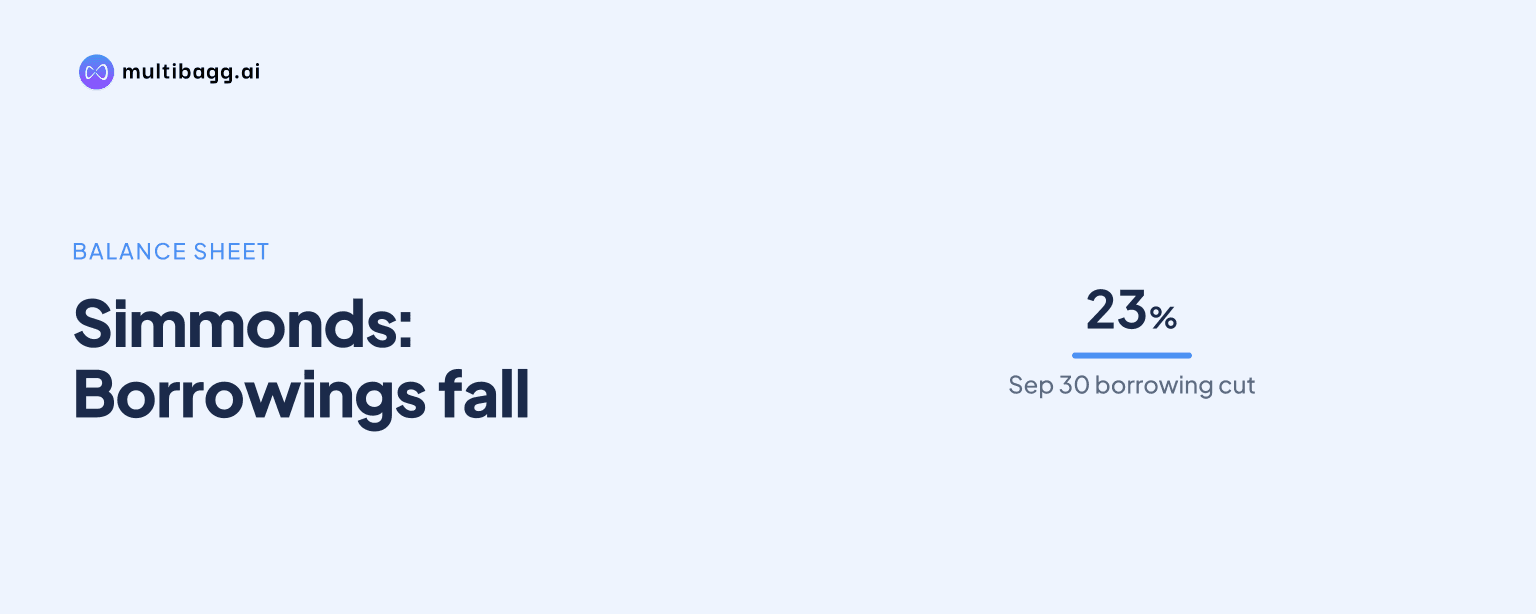
Simmonds Marshall Limited cut total borrowings 23% to Rs 21.49 crore at September 30, 2026, from Rs 27.92 crore at March 31, after first-half FY2026-27 (H1 FY27) operating cash flow of Rs 15.59 crore funded Rs 10.83 crore of debt and finance-cost repayments, Rs 2.97 crore of capital expenditure and a Rs 90 lakh dividend.
Know Simmonds Marshall inside out
Results, valuation, peers and who's buying, in one view.
How did Simmonds Marshall reduce borrowings in H1 FY27?
Simmonds Marshall reduced total borrowings by Rs 6.43 crore over the six months to September 30, 2026, bringing the balance to Rs 21.49 crore from Rs 27.92 crore on March 31. The presentation identifies Rs 10.83 crore of debt and finance-cost repayments in H1 FY27, funded alongside other cash uses from operating cash flow.
The reduction continued a quarter-by-quarter movement during FY2026-27. Borrowings fell from Rs 24.18 crore at June 2026 to Rs 21.49 crore at September 2026, a further Rs 2.69 crore decline in the second quarter. The September 2026 balance was also below Rs 34.81 crore at September 2025 and Rs 35.19 crore at December 2025, although the most directly comparable six-month reduction is from the March 2026 closing balance.
The debt-to-equity ratio, defined by the company as total borrowings divided by total equity, moved to 0.33 times at September 30, 2026 from 0.48 times at March 31, 2026. This was a 0.15-times change during the same period in which borrowings declined by Rs 6.43 crore, showing that the lower debt balance coincided with a lower reported leverage ratio.
What did Simmonds Marshall's operating cash flow pay for?
Simmonds Marshall generated Rs 15.59 crore of operating cash flow in H1 FY27, which paid for Rs 2.97 crore of net capital expenditure, Rs 10.83 crore of debt and finance-cost repayments, and Rs 90 lakh of dividends. The company reported closing cash of Rs 92 lakh at the end of the period, compared with opening cash of Rs 3 lakh.
Cash profit and non-cash items supplied Rs 16.74 crore in the cash-flow bridge. Working capital added Rs 1.02 crore, while tax paid consumed Rs 2.17 crore, resulting in the Rs 15.59 crore operating cash-flow figure. The presentation therefore separates cash generation from the subsequent spending decisions on capital expenditure, financing obligations and shareholder distributions.
Separately, Simmonds Marshall said it is raising annual cold-forming capacity from 12,000 metric tonnes to 15,000 metric tonnes, supported by new forming and thread-rolling machines. The Rs 2.97 crore net capital-expenditure outflow was reported in the same H1 FY27 cash-flow statement, but the presentation does not allocate that amount between individual projects.
The Rs 90 lakh final dividend paid related to FY2025-26. With the stated Rs 10.83 crore repayment category including both debt and finance cost, the presentation does not separately identify how much of that H1 cash outflow was principal repayment and how much was finance cost; it does, however, report the combined amount and the closing borrowings balance.
Got a follow-up? Ask IRIS
Did earnings support Simmonds Marshall's cash generation?
Simmonds Marshall's H1 FY27 revenue rose 25.0% year on year to Rs 130.68 crore, while earnings before interest, tax, depreciation and amortisation (EBITDA) increased 33.4% to Rs 17.22 crore and profit after tax (PAT) rose 52.3% to Rs 8.50 crore. Finance costs declined 20.6% to Rs 3.51 crore from Rs 4.42 crore in H1 FY26.
EBITDA margin increased to 13.2% in H1 FY27 from 12.3% a year earlier, a gain of 83 basis points, where one basis point equals one-hundredth of a percentage point. PAT margin rose to 6.5% from 5.3%, up 117 basis points. These profit and margin changes occurred in the same half year as the Rs 15.59 crore operating cash-flow result and Rs 6.43 crore reduction in borrowings.
Revenue growth was spread across all four reported categories. Two-wheelers, the largest category, generated Rs 64.36 crore in H1 FY27, up 19.4% from Rs 53.91 crore in H1 FY26. Commercial vehicles, including ancillary commercial vehicles, grew 42.0% to Rs 27.11 crore; industrial and others increased 30.4% to Rs 27.29 crore; and exports rose 12.1% to Rs 11.91 crore.
Second-quarter FY27 revenue was Rs 69.71 crore, up 27.2% year on year and 14.3% from Rs 60.97 crore in the first quarter. Second-quarter EBITDA was Rs 9.06 crore and PAT was Rs 4.83 crore. The presentation also notes that second-quarter other income included a Rs 40 lakh profit on sale of used assets, while EBITDA excludes other income.
What changed in Simmonds Marshall's working capital and returns?
Simmonds Marshall reported net working capital of Rs 49.37 crore at September 2026, compared with Rs 50.40 crore at June 2026 and Rs 50.39 crore at March 2026. Net working-capital days, calculated on trailing 12-month revenue, declined to 72 days in September from 79 days in June and 83 days in March.
The components moved in different directions over those six months. Inventory days decreased to 79 at September 2026 from 81 at March 2026, while receivable days rose to 60 from 52. Payable days increased to 62 from 48, and the reported movement in all three measures accompanied the Rs 1.02 crore positive working-capital contribution in the H1 FY27 cash-flow statement.
Annualised return on capital employed (ROCE) was 37.3% in Q2 FY27, compared with 30.9% in Q1 FY27 and 27.7% in Q2 FY26. Simmonds Marshall attributed the quarter-on-quarter increase to higher earnings before interest and tax and lower debt. H1 FY27 annualised ROCE was 33.9%.
Annualised return on equity (ROE) was 30.2% in Q2 FY27, versus 24.4% in Q1 FY27 and 29.9% in Q2 FY26. H1 FY27 ROE was 27.4%. These reported return measures should be read as annualised presentation metrics, while the cash-flow and borrowings figures cover the actual six months from March 31 to September 30, 2026.
Conclusion
Simmonds Marshall's H1 FY27 presentation shows operating cash flow of Rs 15.59 crore covering a combination of Rs 10.83 crore in debt and finance-cost repayments, Rs 2.97 crore of net capital expenditure and a Rs 90 lakh dividend. At the same time, revenue reached Rs 130.68 crore, PAT reached Rs 8.50 crore and total borrowings declined to Rs 21.49 crore, with debt to equity reported at 0.33 times.
The next point to watch is the disclosed increase in annual cold-forming capacity to 15,000 metric tonnes from 12,000 metric tonnes through new forming and thread-rolling machines. Simmonds Marshall also reported that exports were up 110% in Q2 FY27 versus Q1 FY27, while commercial-vehicle revenue was the fastest-growing H1 segment at 42.0% year-on-year growth.