










Simmonds Marshall plans 25% cold-forming capacity increase
Key highlights
- Simmonds Marshall plans to raise cold-forming capacity from 12,000 TPA to 15,000 TPA, a 25% increase.
- The Chakan plant covers 1,20,000 square feet on a campus of more than 10 acres.
- Simmonds Marshall lists 13 product ranges, including fasteners from M4 locking nuts to M70 bolts and studs.
- The Chakan facility has 1,076.76 kilowatt-peak of rooftop solar capacity and four listed ISO or IATF certifications.
powered by IRIS
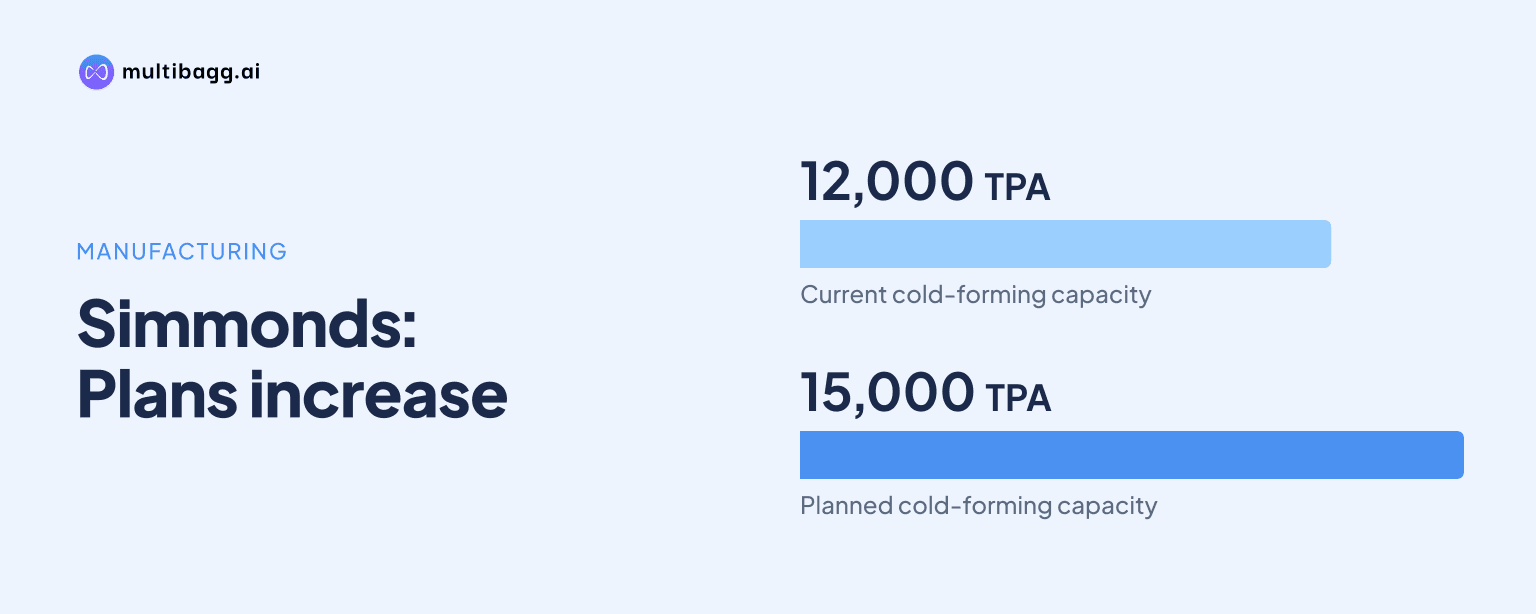
Simmonds Marshall Limited plans to raise cold-forming capacity by 25% from 12,000 to 15,000 tonnes per annum (TPA), adding 3,000 TPA at its Chakan, Pune manufacturing platform. The plan supports production across 13 ranges of self-locking nuts, special nuts, bolts, studs and cold-forged components.
Know Simmonds Marshall inside out
Results, valuation, peers and who's buying, in one view.
What cold-forming capacity is Simmonds Marshall adding?
Simmonds Marshall is adding 3,000 TPA of cold-forming capacity, taking stated capacity from 12,000 TPA to 15,000 TPA. The increase is 25% of the 12,000-TPA starting capacity. The presentation says capacity is being raised, but does not disclose a completion date, capital expenditure amount or the share already commissioned.
The added capacity is within a plant that produces more than 500 million nuts a year and covers metric sizes from M3 to M70, as well as imperial sizes. The annual nuts measure and the TPA capacity measure are different units, so the presentation does not state how many additional nuts the 3,000-TPA increase could produce.
Which manufacturing platform supports Simmonds Marshall's expansion?
Simmonds Marshall supports the expansion through its Chakan plant in Pune, which covers 1,20,000 square feet on a campus of more than 10 acres. Operations shifted to this facility in 2021. The company had previously invested in bolt machines and acquired Stud India, Chennai, with 99% ownership, in 2012.
The manufacturing sequence begins with incoming inspection of wire and bar stock, followed by cold forming and bar turning. Secondary operations include turning, slotting, knurling, drilling and pointing, before heat treatment, finishing, final quality control, packing and traceability.
Six-station cold formers make sleeves, bushes, collars and spacers, while multi-spindle automatic bar-turning centres serve automotive components. This separates the platform from a nuts-only operation: it combines cold-forged shapes, machined parts and fasteners. The process flow lists zinc, zinc-nickel, Dacro and trivalent finishes, while the portfolio also lists bright zinc, zinc blue, yellow, black and green finishes.
What products can Simmonds Marshall manufacture?
Simmonds Marshall lists 13 ranges of self-locking nuts, special nuts, bolts, studs and cold-forged components, supplied to international standards or customer prints. The product range includes catalogue parts and made-to-print components developed from a customer drawing.
The self-locking range includes nylon-insert locking nuts from M4 to M48, all-metal CleveLock nuts from M5 to M33, U-nuts from M5 to M22, and Phillidas products from M6 to M16. U-nuts use a metal insert and are specified for temperatures from minus 70 degrees Celsius to 250 degrees Celsius.
Special nuts include wheel nuts from M10 upward, dome cap nuts from M8 to M25, castle and slotted nuts from M12 to M48, and weld nuts from M5 to M10. The presentation says wheel nuts are approved by vehicle manufacturers and the Automotive Research Association of India.
Bolts and studs run from M5 to M70 in grades 4.6 to 12.9. Other products include paint-clearing screws from M6 to M10, Huck bolts from M12 to M24, and banjo or pipe-union bolts from M6 to M10. The M3 lower end of the plant's stated cold-forming size capability and the M70 upper end for bolts and studs show the stated size breadth across product groups.
Got a follow-up? Ask IRIS
How does Simmonds Marshall control quality for these products?
Simmonds Marshall states that its Chakan facility holds ISO 9001:2015 quality-management certification and International Automotive Task Force (IATF) 16949:2016 automotive quality-management certification. Its ISO 9001 and IATF certificates are stated as valid until April 2027.
The company also lists ISO 14001:2015 environmental-management certification and ISO 45001:2018 occupational health and safety certification. Those two certificates are stated as valid until May 2027, one month later than the ISO 9001 and IATF certificates.
Before dispatch, Simmonds Marshall says every batch is verified in its in-house laboratory. The listed checks include Rockwell and Brinell hardness testing, torque-tension and prevailing-torque testing, proof-load testing, metallurgical microscopy, salt-spray testing, dimensional and thread gauging, and coating-thickness measurement.
The quality process moves from feasibility assessment and production-part approval through in-process control, final inspection, traceability and feedback. Alongside these manufacturing and quality disclosures, the Chakan site has 1,076.76 kilowatt-peak of rooftop solar capacity. The presentation does not quantify solar generation, electricity savings, rejection rates or quality-cost outcomes.
How does the capacity plan fit Simmonds Marshall's served markets?
Simmonds Marshall identifies two-wheelers, commercial vehicles, railways, mining, wind energy and exports as its served segments. Its named original equipment manufacturer customers include Hero MotoCorp, Honda Motorcycle & Scooter India, Mahindra & Mahindra, VE Commercial Vehicles, Royal Enfield, Ashok Leyland, Bajaj Auto and TVS Motor Company.
The presentation reports two-wheeler industry sales of 21.71 million units in financial year 2025-26, up 10.7%, and commercial-vehicle industry sales of 1.08 million units, up about 12.6%. These industry figures provide the segment backdrop stated alongside Simmonds Marshall's products, but the presentation does not assign its planned 3,000-TPA addition to any one customer or end market.
For financial year 2025-26 standalone revenue by geography, India accounted for Rs 201.41 crore, or 90.4%, while outside India accounted for Rs 21.43 crore, or 9.6%. Simmonds Marshall therefore reported a domestic revenue base that was substantially larger than its overseas revenue base during the period.
Simmonds Marshall says its exports serve four continents, including six European countries, three countries in the Americas, two in Asia and one in Africa. The capacity presentation does not disclose export capacity allocation, utilisation levels or whether the 15,000-TPA target is intended to change the 90.4% domestic revenue share.
Conclusion
Simmonds Marshall's disclosed plan is a 3,000-TPA cold-forming capacity increase, from 12,000 TPA to 15,000 TPA. The manufacturing platform combines more than 500 million nuts of annual output, M3-to-M70 size capability, 13 product ranges and cold-forged components such as sleeves, bushes, collars and spacers.
What to watch next is execution of the move to 15,000 TPA, because Simmonds Marshall does not disclose a commissioning schedule, investment amount or capacity utilisation figure. Future updates could also clarify the end-market allocation of the added capacity across two-wheelers, commercial vehicles, exports and made-to-print components.