










Singer H1 EBITDA jumps 371% as sewing-machine profit rises
Key highlights
- Singer reported H1 2026-27 revenue of Rs 329.8 crore, up 43.4% year on year.
- Singer’s H1 2026-27 EBITDA rose 371.1% to Rs 16.4 crore, while profit after tax increased 576.2% to Rs 9.9 crore.
- Sewing Machine revenue rose 48.5% to Rs 271.4 crore and segment profit increased to Rs 25.7 crore.
- Home Appliance revenue increased 23.7% to Rs 58.4 crore, but the segment recorded an H1 loss of Rs 6.2 crore.
powered by IRIS
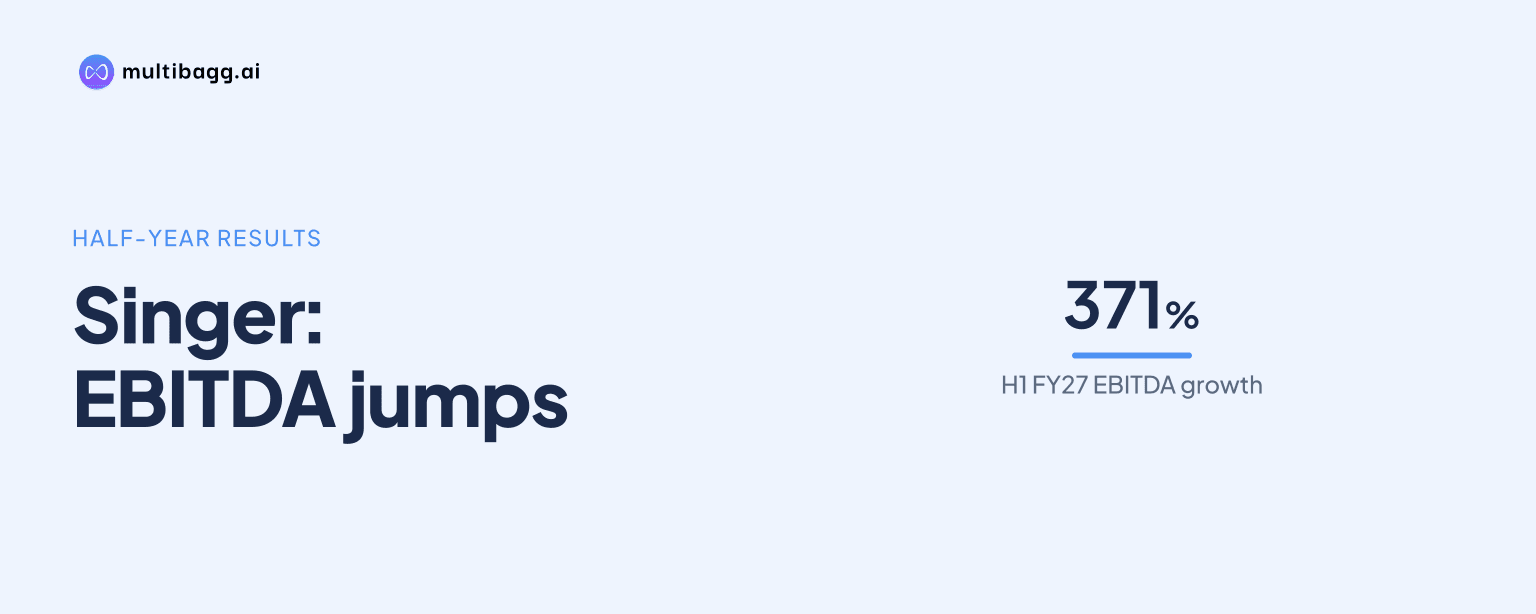
Singer India Limited reported H1 2026-27 EBITDA of Rs 16.4 crore, up 371.1% year on year, as Sewing Machine revenue rose 48.5% to Rs 271.4 crore and segment profit increased to Rs 25.7 crore. Singer’s total H1 revenue grew 43.4% to Rs 329.8 crore, while Home Appliance remained loss-making.
Know Singer India inside out
Results, valuation, peers and who's buying, in one view.
What drove Singer’s H1 2026-27 revenue growth?
Singer’s H1 2026-27 revenue growth was led by the Sewing Machine segment, whose sales increased 48.5% to Rs 271.4 crore from Rs 182.8 crore in the prior-year first half. Home Appliance revenue rose 23.7% to Rs 58.4 crore from Rs 47.2 crore, taking total H1 revenue to Rs 329.8 crore from Rs 230.0 crore.
The second quarter also showed growth in both segments. Q2 2026-27 revenue was Rs 185.2 crore, up 34.3% from Rs 137.9 crore in the prior-year period, as Sewing Machine revenue rose to Rs 156.3 crore from Rs 116.4 crore and Home Appliance revenue increased to Rs 28.9 crore from Rs 21.5 crore.
The presentation labels the prior-year period as LY and the current-year period as TY. Its product mix showed Home Appliance at 16% in Q2 2026-27 and 18% in H1 2026-27, while Sewing Machine represented 84% and 82%, respectively, indicating that Sewing Machine remained the larger business in both periods.
Singer attributed Sewing Machine growth to gains across channels and product categories. Trade-channel sales grew around 30% in both Q2 and H1, e-commerce sales rose around 15% in Q2 and around 25% in H1, and cast-iron sewing machines expanded by more than 35% in Q2 and more than 60% in H1.
How did Singer’s profit change in H1 2026-27?
Singer’s earnings rose faster than revenue in H1 2026-27, with EBITDA, or earnings before interest, tax, depreciation and amortisation, increasing 371.1% to Rs 16.4 crore. Profit before tax rose 576.8% to Rs 13.4 crore and profit after tax increased 576.2% to Rs 9.9 crore, according to the company’s key indicators.
Q2 2026-27 also recorded higher earnings, although at a lower growth rate than H1. EBITDA rose 85.4% year on year to Rs 10.9 crore, profit before tax increased 79.3% to Rs 9.4 crore, and profit after tax rose 81.2% to Rs 6.9 crore.
The segment comparison identifies Sewing Machine as the main contributor to the profit increase. Its H1 segment result nearly doubled to Rs 25.7 crore from Rs 13.0 crore, while the Home Appliance segment loss widened to Rs 6.2 crore from Rs 5.4 crore over the same periods.
Singer said improved gross margins across categories and channels contributed to Sewing Machine profitability. The company reported that Sewing Machine gross-margin value grew by more than 25% in Q2 and more than 40% in H1, despite continuing commodity-price inflation, which it said was managed through price positioning and product-cost optimisation.
Got a follow-up? Ask IRIS
Why did Singer’s Home Appliance segment remain loss-making?
Singer’s Home Appliance segment remained loss-making because of organisational strengthening for market expansion and higher extended producer responsibility, or EPR, costs. The segment recorded a Q2 loss of Rs 3.1 crore versus a Rs 3.0 crore loss a year earlier, while the H1 loss increased to Rs 6.2 crore from Rs 5.4 crore.
This profit result contrasted with higher Home Appliance sales. Segment revenue increased 34.4% in Q2 and 23.7% in H1, which Singer attributed to trade and e-commerce growth, portfolio expansion and expansion of its fan business.
Singer reported that its new fan line-up and distribution expansion lifted fan-segment sales by more than 240% in Q2 and more than 100% in H1. It also reported around 200% e-commerce growth for Home Appliance in Q2 and more than 100% growth in H1, alongside Home Appliance gross-margin value growth of more than 55% in Q2 and more than 30% in H1.
What is Singer doing to improve margins and costs?
Singer’s stated plan is to expand its profitable product portfolio, improve visibility, strengthen e-commerce and expand distribution. For gross-margin expansion, the company plans to focus on value selling and AZZ sewing machines, while removing loss-making stock-keeping units, or SKUs, from Home Appliance categories and channels.
Singer also plans to improve selling, general and administrative, or SG&A, cost productivity. Absolute SG&A expense increased by Rs 5.5 crore in Q2 as the company invested in frontline sales teams and the fan category, but SG&A fell to 21% of revenue from 25% in Q2 and to 23% from 28% in H1 year on year.
The company strengthened its Sewing Machine range by showcasing 10 Made-in-India Zig-Zag machine SKUs during dealer engagements. Singer said these machines are manufactured in India under new Bureau of Indian Standards, or BIS, requirements, and that it remains India’s sole active BIS-licensed manufacturer of Zig-Zag sewing machines.
AZZ sewing machines grew around 25% in both Q2 and H1, according to Singer, while high-speed industrial sewing machines grew around 25% in Q2 and around 10% in H1. These category results accompanied the company’s reported focus on value selling and the expansion of its sewing-machine portfolio.
Conclusion
Singer’s H1 2026-27 results show that Sewing Machine drove the increase in both revenue and profitability. Total revenue rose to Rs 329.8 crore from Rs 230.0 crore, while Sewing Machine segment profit increased to Rs 25.7 crore from Rs 13.0 crore; Home Appliance sales grew but its segment loss widened to Rs 6.2 crore.
The next results will indicate the effect of Singer’s plan to remove loss-making Home Appliance SKUs, improve SG&A productivity and focus on value selling and AZZ machines. Investors can also watch whether the reported H1 e-commerce growth of around 25% in Sewing Machine and more than 100% in Home Appliance continues as the company expands distribution and the fan category.