










Sirca localises premium systems after formula transfers
Key highlights
- Sirca completed formula transfers and commercial trials for acrylic and polyester coating systems in Q2 FY27.
- Q2 FY27 revenue from operations rose 22.13% year on year to Rs 160.20 crore.
- Q2 FY27 EBITDA excluding OI rose 6.42% to Rs 29.16 crore, while margin was 18.20%.
- Sirca plans to complete the UV transfer in H2 to shorten lead times and lower import dependence.
powered by IRIS
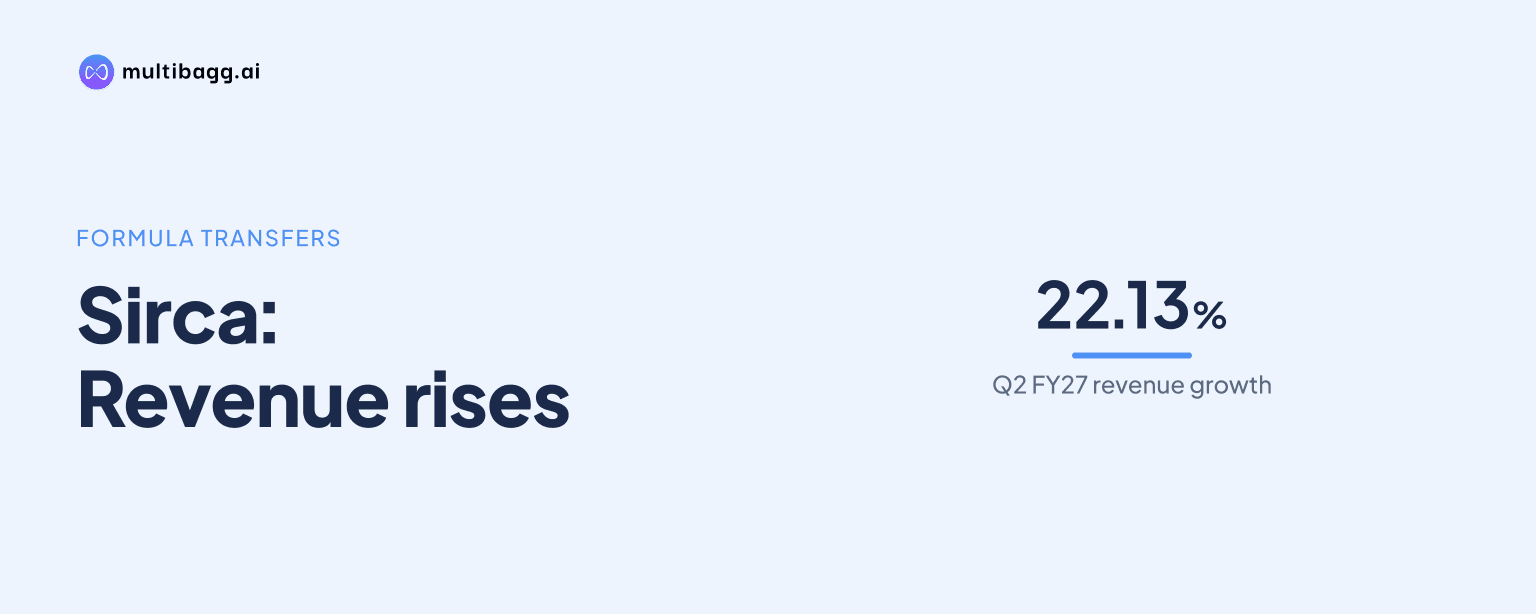
Sirca Wood Coatings (Italy) has completed formula transfers and commercial trials for acrylic and polyester coating systems, moving towards scaled local production in Q2 FY27, when revenue rose 22.13% year on year to Rs 160.20 crore. Management said selected ultraviolet, or UV, systems are next, with the stated aim of shortening lead times and reducing import dependence.
Know Sirca Paints India inside out
Results, valuation, peers and who's buying, in one view.
What has Sirca localised in its coatings portfolio?
Sirca has completed formula transfers and commercial trials for its acrylic and polyester systems, and is now focused on scaling local production while maintaining consistent quality. The Q2 FY27 update identifies selected UV systems as the next category in the localisation programme, rather than saying that the UV transfer has already been completed.
The programme covers premium wood-coating technologies that sit alongside the Sirca, Oikos, Unico and Wembley Valentino ranges. This portfolio spans economy to luxury finishes, according to management, allowing the product mix to respond to demand by price tier while acrylic and polyester production is moved locally.
Acrylic coatings are the fastest-growing element of Sirca's premium wood-coatings mix. Management attributes that position to the systems' non-yellowing finish, durability and lower volatile organic compound, or VOC, content, although the presentation does not disclose acrylic revenue, volume, capacity or the share made locally.
Why is Sirca shifting acrylic and polyester production locally?
Sirca says the planned ramp-up of localised acrylic and polyester production is intended to shorten lead times and lower import dependence. The stated mechanism is formula transfer followed by commercial trials, then scaled production with consistent quality, rather than a disclosed new plant investment or a published capacity target.
Management also cited local formulations and consolidated sourcing as tools that helped maintain material supply through disruption in West Asia during Q2 FY27. That operational backdrop coincided with Brent crude rising from about $70 a barrel in early July to nearly $97 by end-September, a move that increased input-cost pressure across the coatings portfolio.
Localisation is one of several margin levers named by management, alongside captive Wembley manufacturing, consolidated procurement and a richer premium mix. In Q2 FY27, earnings before interest, tax, depreciation and amortisation excluding other income, or EBITDA excluding OI, was Rs 29.16 crore, up 6.42% year on year, while revenue expanded faster at 22.13%.
Got a follow-up? Ask IRIS
How did Q2 FY27 results frame Sirca's localisation push?
Sirca reported Rs 160.20 crore of revenue from operations in Q2 FY27, compared with Rs 131.17 crore in Q2 FY26 and Rs 130.01 crore in Q1 FY27. Management linked growth to the Wembley mass and mid-premium range sold through Sirca's network, continued traction in acrylic and polyurethane, or PU, systems, and steady original equipment manufacturer, or OEM, offtake.
Profit after tax increased 12.26% year on year to Rs 20.32 crore in Q2 FY27, while EBITDA excluding OI increased 6.42% to Rs 29.16 crore. The difference between revenue and EBITDA growth reflects higher operating expenses, which rose 26.28% year on year to Rs 131.04 crore from Rs 103.77 crore.
The EBITDA margin was 18.20% in Q2 FY27, down from 20.89% a year earlier and 18.62% in Q1 FY27. Management said calibrated price increases partly offset higher inputs; sequentially, it described the margin decline as limited to 42 basis points, with one basis point equal to one-hundredth of a percentage point.
Sirca also reported H1 revenue of Rs 290.21 crore, up 18.3% from the comparable period, but did not provide an H1 profit figure on the cited pages. Finance cost fell 29.41% year on year to Rs 0.96 crore in Q2 FY27, while depreciation and amortisation rose 6.48% to Rs 2.79 crore.
What will Sirca do next on localised coatings?
Sirca plans to ramp up localised acrylic and polyester production in H2 and complete the UV transfer, according to its stated priorities. Management explicitly connects those actions with shorter lead times and lower import dependence, but gives no completion date, production-volume goal, cost-saving estimate or proportion of imports to be replaced.
The broader H2 plan includes strengthening margins through calibrated pricing, procurement consolidation and a richer mix. Management expects margins to improve gradually as price increases flow through, following the Q2 FY27 margin of 18.20%; this is management's expectation, not a disclosed numerical margin target.
Sirca also plans to scale Wembley nationally through its branches and dealers across trade, contractor and project channels. The dedicated Wembley facility is already operating in one integrated setup, while Wembley’s northern dealers are to carry Sirca and Valentino, extending distribution beyond North India.
For Q3, management plans dealer programmes, studio activations and contractor engagement to capture festive and wedding-season demand. It also continues architect and designer programmes, design-media features and the Sirca Parivaar Pro loyalty platform, measures intended to support specifier and contractor engagement rather than a separately quantified sales target.
Conclusion
Sirca's Q2 FY27 disclosures show that acrylic and polyester localisation has progressed beyond formula transfer into completed commercial trials, with local scaling now the operational task. The programme sits within a premium wood-coatings strategy that produced Rs 160.20 crore of quarterly revenue, but it is also being pursued during a period in which operating costs rose 26.28% and EBITDA margin declined year on year.
The next disclosure to watch is progress on the planned H2 ramp-up of acrylic and polyester systems and completion of the UV transfer. Management's plan also calls for pricing, procurement consolidation, national Wembley expansion and festive-season channel activity, while the unresolved measures are the local-production scale, timing, import-replacement level and any quantified effect on lead times or margins.