










Sirca Q2 FY27 revenue rose 22% as EBITDA margin fell to 18.20%
Key highlights
- Sirca’s Q2 FY27 revenue from operations rose 22.13% year on year to ₹160.20 crore.
- Sirca’s Q2 FY27 EBITDA margin excluding other income declined 269 basis points year on year to 18.20%.
- Sirca’s Q2 FY27 PAT increased 12.26% year on year to ₹20.32 crore.
- Sirca reported H1 FY27 revenue of ₹290.21 crore, up 18.3%.
powered by IRIS
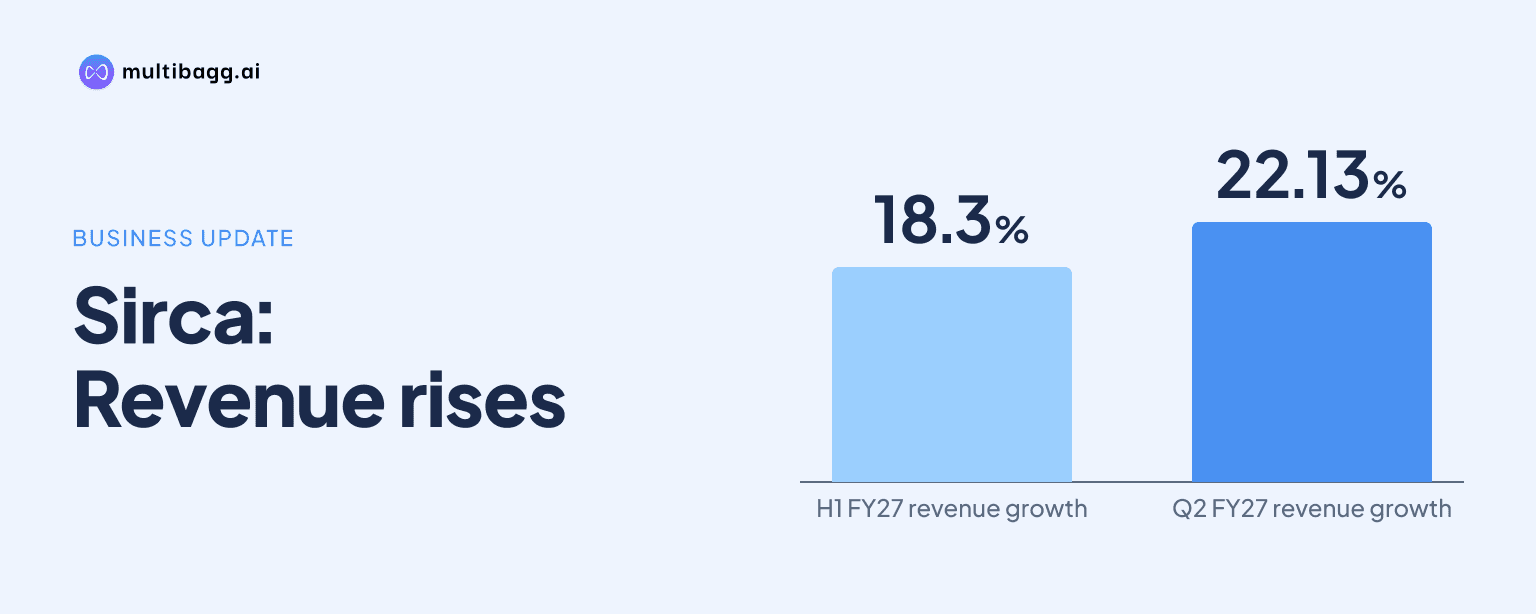
Sirca Paints India Limited reported Q2 FY27 revenue from operations of ₹160.20 crore, up 22.13% year on year, while earnings before interest, tax, depreciation and amortisation (EBITDA) margin, excluding other income, fell 269 basis points to 18.20% as operating expenses rose 26.28%; profit after tax increased 12.26% to ₹20.32 crore, aided by a lower effective tax rate.
Know Sirca Paints India inside out
Results, valuation, peers and who's buying, in one view.
What did Sirca report for Q2 FY27?
Sirca reported higher revenue, EBITDA and profit in Q2 FY27, although EBITDA grew more slowly than sales. Revenue from operations rose to ₹160.20 crore from ₹131.17 crore in Q2 FY26, while EBITDA excluding other income increased to ₹29.16 crore from ₹27.40 crore.
Profit before tax rose 8.70% year on year to ₹26.60 crore, while profit after tax (PAT) increased 12.26% to ₹20.32 crore from ₹18.10 crore. Earnings per share rose to ₹3.58 from ₹3.24, and management said the lower effective tax rate helped PAT growth during the quarter.
Why did Sirca’s EBITDA margin decline in Q2 FY27?
Sirca’s EBITDA margin declined because operating expenses increased faster than revenue amid higher input costs. Total operating expenses rose 26.28% year on year to ₹131.04 crore, compared with 22.13% revenue growth, reducing the EBITDA margin to 18.20% from 20.89% in Q2 FY26.
The EBITDA margin also declined 42 basis points from 18.62% in Q1 FY27. Management said Brent crude moved from about $70 a barrel in early July to nearly $97 by end-September 2026, and said calibrated price increases partly offset the input-cost increase.
EBITDA excluding other income nevertheless rose 20.46% sequentially from ₹24.21 crore in Q1 FY27 to ₹29.16 crore in Q2 FY27. Interest cost fell 29.41% year on year to ₹0.96 crore from ₹1.36 crore, while depreciation and amortisation increased 6.48% to ₹2.79 crore.
What drove Sirca’s Q2 FY27 revenue growth?
Sirca attributed Q2 FY27 growth to the Wembley mass and mid-premium range, continued demand for acrylic and polyurethane (PU) systems, and steady original equipment manufacturer (OEM) offtake. Revenue rose 23.22% sequentially from ₹130.01 crore in Q1 FY27 to ₹160.20 crore in Q2 FY27.
Management described acrylic coatings as the fastest-growing part of Sirca’s premium wood-coatings mix, citing their non-yellowing finish, durability and lower volatile organic compound content. Its Sirca, Oikos, Unico and Wembley Valentino ranges cover economy through luxury finishes, but the presentation does not disclose revenue by product, brand or price tier.
For H1 FY27, Sirca reported revenue of ₹290.21 crore, up 18.3%, and management said this was ahead of the broader paints industry. The presentation does not provide a separate H1 profit-and-loss statement or quantify the sales contribution from Wembley, acrylic systems, PU systems or OEM customers.
Got a follow-up? Ask IRIS
What is Sirca doing to protect margins and expand supply?
Sirca identified localised formulations, captive Wembley manufacturing, consolidated procurement and a richer premium mix as margin levers after reporting an 18.20% EBITDA margin in Q2 FY27. Management said consolidated sourcing and local formulations helped maintain material supply amid disruption in West Asia.
Management also said it took price increases across the portfolio while balancing margin protection with customer demand. It expects further benefit in H2 from these price increases, although it did not disclose an H2 EBITDA-margin target or a quantified financial benefit.
Wembley integration is on track, according to management, with a dedicated facility running production in one integrated setup and the range being extended to dealers beyond North India. Formula transfers and commercial trials for acrylic and polyester systems have been completed, with local production scaling and quality consistency identified as the next focus; selected ultraviolet systems are to follow.
How did Sirca position its brands and channels in Q2 FY27?
Sirca continued architect and designer programmes, design-media features and the Sirca Parivaar Pro loyalty platform for contractors in Q2 FY27. Management said product quality, technical service and specifier relationships carry particular weight in specialised wood coatings, where its portfolio spans economy to luxury finishes.
The presentation cited a market leader’s decorative-paints growth of 6% to 7% in volume and about 15% in value as an industry indicator. Management also said price increases were being accepted across the industry, while premiumisation, organised furniture manufacturing, Bureau of Indian Standards quality standards and specifier-led buying remained structural drivers.
Sirca’s 22.13% Q2 revenue growth exceeded the cited 15% decorative-paints value-growth indicator, but the presentation does not give a like-for-like wood-coatings market-growth figure. It also does not disclose market share, dealer numbers, contractor-platform membership or revenue from its architect and designer initiatives.
Conclusion
Sirca’s Q2 FY27 result showed faster sales growth than operating-profit growth: revenue increased 22.13% to ₹160.20 crore, while EBITDA excluding other income rose 6.42% to ₹29.16 crore and margin fell to 18.20%. PAT grew 12.26% to ₹20.32 crore, supported by the lower effective tax rate and a 29.41% decline in interest cost.
The next period to watch is H2 FY27, when management expects additional benefit from Q2 price increases. Progress in scaling local acrylic and polyester production, extending Wembley beyond North India and introducing selected ultraviolet systems will also be relevant, although the presentation gives no numerical targets or timetable for those initiatives.