










Sirca limits Q2 margin decline to 42 basis points sequentially
Key highlights
- Sirca’s Q2 FY27 EBITDA margin was 18.20%, down 42 basis points from 18.62% in Q1 FY27.
- Q2 FY27 revenue from operations increased 22.13% year on year to Rs 160.20 crore.
- Brent crude rose from about $70 per barrel in early July 2026 to nearly $97 by end-September 2026, according to management.
- H1 FY27 revenue rose 18.3% to Rs 290.21 crore and profit after tax increased 13.1% to Rs 36.53 crore.
powered by IRIS
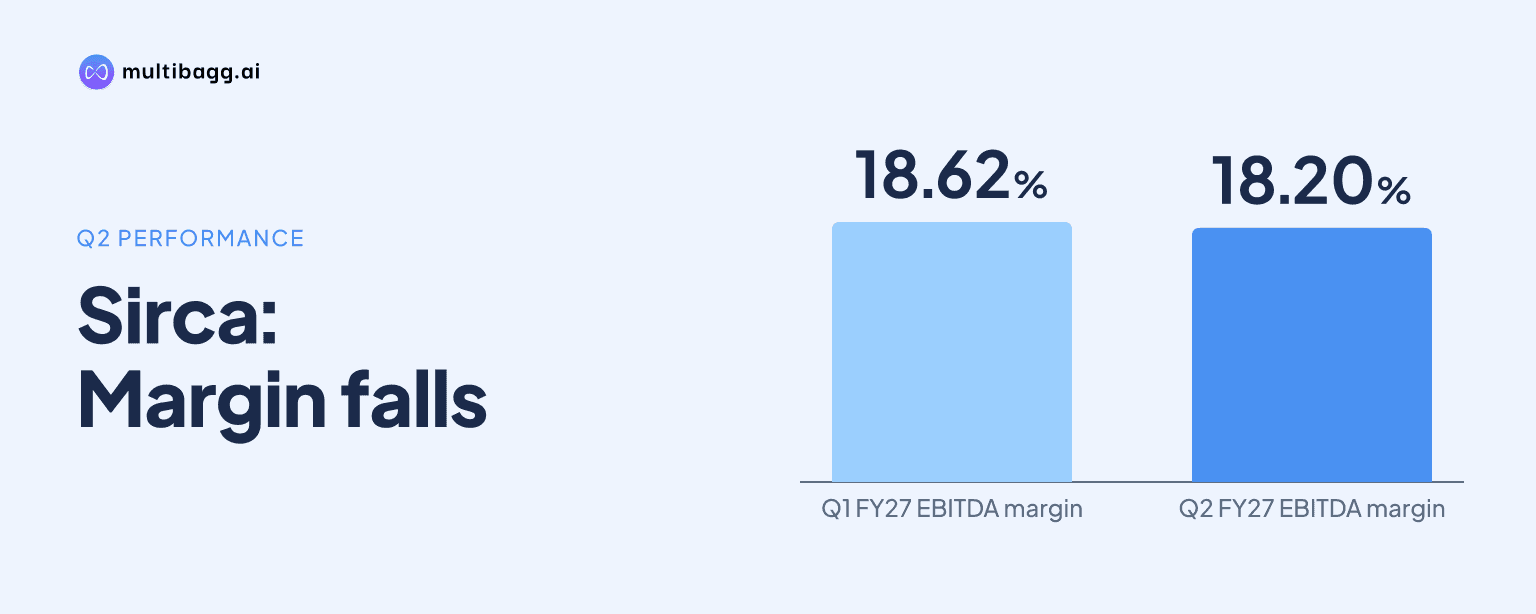
In the second quarter of financial year 2027 (Q2 FY27), Sirca Paints India Limited limited its earnings before interest, tax, depreciation and amortisation (EBITDA) margin decline to 42 basis points sequentially, reaching 18.20%, as Brent crude rose from about $70 a barrel in early July 2026 to nearly $97 by end-September 2026, management said.
Know Sirca Paints India inside out
Results, valuation, peers and who's buying, in one view.
Why did Sirca’s Q2 FY27 EBITDA margin decline?
Sirca’s EBITDA margin declined because operating expenses increased faster than revenue during Q2 FY27 as input costs rose. Revenue from operations grew 22.13% year on year to Rs 160.20 crore, while total operating expenditure rose 26.28% to Rs 131.04 crore. EBITDA excluding other income increased 6.42% to Rs 29.16 crore, but its margin fell from 20.89% in Q2 FY26 to 18.20%, a decline of 269 basis points.
The immediate cost pressure was linked by management to Brent’s move from about $70 a barrel in early July 2026 to nearly $97 at end-September 2026. Sequentially, EBITDA margin moved from 18.62% in Q1 FY27 to 18.20% in Q2 FY27. Sirca said calibrated portfolio price increases partly offset higher raw-material costs rather than fully neutralising them within the quarter.
Profit after tax rose faster than EBITDA on a sequential basis, increasing 25.35% from Rs 16.21 crore in Q1 FY27 to Rs 20.32 crore in Q2 FY27. On a year-on-year basis, profit after tax rose 12.26% from Rs 18.10 crore. Finance cost fell 29.41% year on year to Rs 96 lakh, while depreciation and amortisation was Rs 2.79 crore, helping limit the effect of the lower operating margin on reported profit.
How did Sirca contain the crude-driven cost increase?
Sirca said consolidated sourcing and local formulations helped it maintain material supply during disruption in West Asia while crude-linked input costs were rising. These measures, combined with calibrated price increases, limited the sequential EBITDA-margin decline to 42 basis points in Q2 FY27. The company described its pricing as balanced between protecting margins and maintaining customer demand across its portfolio.
The price actions had not fully contributed during Q2 FY27, according to management, which expects further benefit as they flow through in the second half of financial year 2027 (H2 FY27). This expectation is tied to a disclosed commercial mechanism rather than a fixed margin target: Sirca plans to retain calibrated pricing while pursuing procurement consolidation and a richer premium product mix. Revenue increased 23.22% sequentially, from Rs 130.01 crore in Q1 FY27 to Rs 160.20 crore in Q2 FY27.
Got a follow-up? Ask IRIS
Which manufacturing and product changes can support Sirca’s margins?
Sirca’s stated manufacturing levers are localised formulations, captive Wembley manufacturing and consolidated procurement. Formula transfers and commercial trials for acrylic and polyester systems have been completed, and the next step is scaling local production while maintaining quality consistency. The company also plans to complete the transfer of selected ultraviolet (UV) systems, aiming to shorten lead times and reduce import dependence.
Acrylic coatings are the fastest-growing part of Sirca’s premium wood-coatings mix, according to management. The company attributes demand to non-yellowing finish, durability and lower volatile organic compound (VOC) content. Its Sirca, Oikos, Unico and Wembley Valentino ranges cover economy through luxury finishes, allowing the sales mix to respond to demand across price tiers.
Wembley is another component of the margin plan because its dedicated facility operates in one integrated production setup. Sirca said Wembley integration is on track and that the range is being extended beyond North India through its dealer network. Q2 FY27 revenue included contributions from the Wembley mass and mid-premium range, continued traction in acrylic and polyurethane (PU) systems, and steady original equipment manufacturer (OEM) offtake.
The operational plan is not solely about volume growth. Local production is intended to reduce import dependence, while captive Wembley production and group procurement are among management’s stated margin levers. Sirca reported H1 FY27 revenue of Rs 290.21 crore, up 18.3%, while profit after tax rose 13.1% to Rs 36.53 crore despite the stated industry-wide rise in raw-material costs. Revenue expansion therefore outpaced profit growth during the first half.
What is Sirca planning for margins in H2 FY27?
Sirca is planning to strengthen margins gradually in H2 FY27 through price increases, procurement consolidation and a richer product mix, management said. The company does not provide a numerical EBITDA-margin target. Its outlook depends on pricing actions taking full effect, alongside localised production of acrylic and polyester systems and completion of the UV transfer.
Commercially, Sirca plans to scale Wembley nationally through branches and dealers serving trade, contractor and project channels. Wembley’s northern dealers are also expected to carry Sirca and Valentino products. The company intends to use third-quarter festive and wedding-season demand through dealer programmes, studio activations and contractor engagement, while expanding tier-2 and tier-3 distribution at a measured pace.
Sirca also plans to deepen OEM and institutional relationships with furniture, modular-kitchen and wardrobe manufacturers. Its presentation links this effort to growth in organised manufacturing and tighter Bureau of Indian Standards (BIS) norms. Separately, it is building PU-coatings exports under Wembley Valentino in selected markets, with management saying the contribution is expected to grow steadily rather than specifying a revenue amount or timeline.
Management’s H2 FY27 outlook is to grow ahead of the industry while margins improve as pricing actions take full effect. That outlook follows Q2 FY27 revenue growth of 22.13% and H1 FY27 revenue growth of 18.3%. It remains contingent on price realisation, consolidated procurement, local manufacturing scale-up and premium-mix contribution rather than being presented as a guaranteed outcome.
Conclusion
Sirca’s Q2 FY27 results show that sequential margin pressure was limited during a sharp crude-cost movement, although its 18.20% EBITDA margin remained 269 basis points below Q2 FY26. Revenue grew to Rs 160.20 crore while operating expenditure reached Rs 131.04 crore, making price recovery, sourcing and manufacturing localisation central to the gap between sales and profit growth.
The next issue to watch is whether management’s H2 FY27 pricing actions flow through as expected while acrylic, polyester and UV production transfers progress. Sirca’s plans to scale Wembley nationally, expand measuredly in tier-2 and tier-3 markets, and build OEM, institutional and selected export business will determine the support from mix and local manufacturing alongside procurement consolidation.