










SJVN starts construction on 669 MW Lower Arun project
Key highlights
- SJVN’s 669 MW Lower Arun project has an estimated cost of Rs 5,792.36 crore.
- Major construction packages have been awarded and construction activities are underway.
- Lower Arun is targeted for commissioning during FY 2030-31.
- Nepal will receive 21% of Lower Arun’s generated energy free of cost.
powered by IRIS
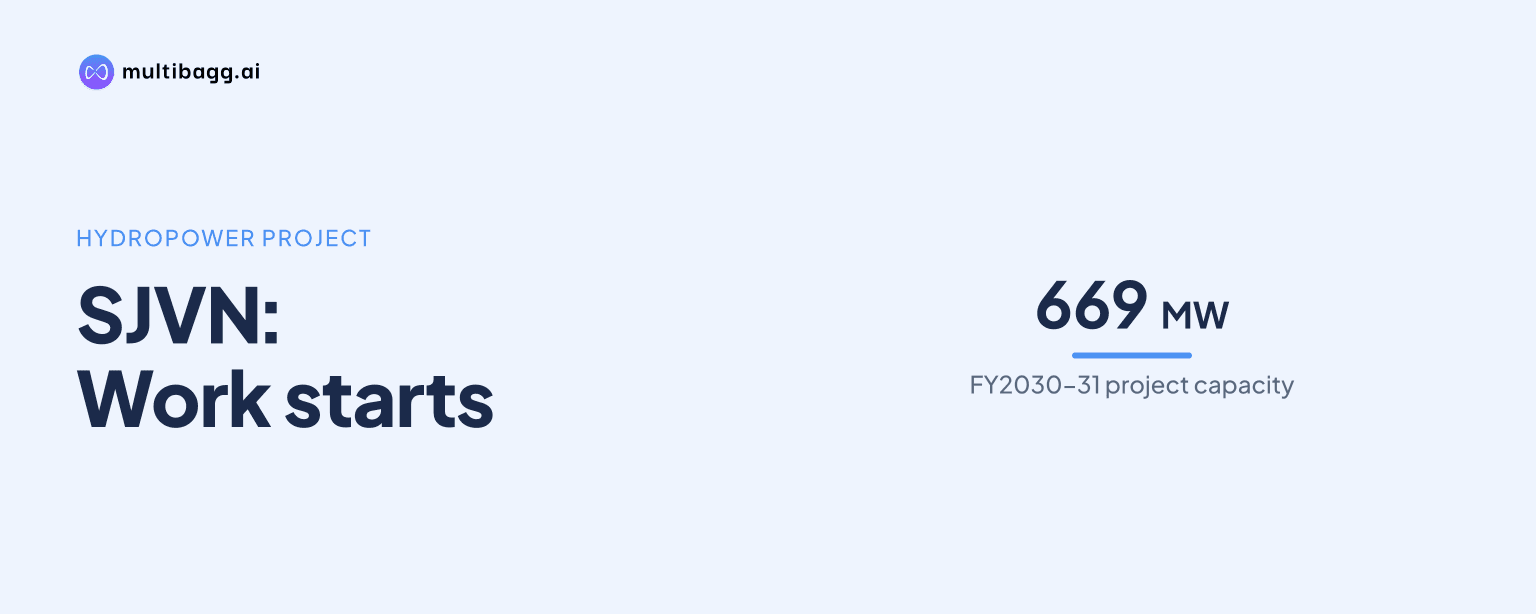
SJVN Limited says construction activities are underway at its Rs 5,792.36 crore, 669 MW Lower Arun Hydro Electric Project in Nepal after India’s and Nepal’s prime ministers laid its foundation stone on 23 November 2026, with commissioning targeted during FY 2030-31. Major construction packages have already been awarded.
Know SJVN inside out
Results, valuation, peers and who's buying, in one view.
What happened to SJVN’s Lower Arun project?
SJVN’s Lower Arun project reached a foundation-stone milestone through a virtual ceremony from New Delhi involving the prime ministers of India and Nepal on 23 November 2026. The company described Lower Arun as a 669 megawatt, or MW, hydroelectric project on the Arun River in eastern Nepal and said construction activities are underway after the award of major packages.
SJVN is developing the project through SJVN Lower Arun Power Development Company Pvt. Ltd., its wholly owned subsidiary. The project-site event included representatives of Nepal’s Ministry of Energy, Investment Board Nepal, district coordination bodies, local governments, forest departments, community forest user groups and local communities, while SJVN management and employees joined by live streaming.
The ceremony follows project agreements signed over nearly six years. Nepal awarded the 669 MW project to SJVN through international competitive bidding on 29 January 2021, followed by a memorandum of understanding with Investment Board Nepal on 11 July 2021 and a Project Development Agreement on 1 June 2023.
What are Lower Arun’s cost, capacity and delivery targets?
Lower Arun has an estimated cost of Rs 5,792.36 crore, planned capacity of 669 MW, expected annual generation of about 2,901 million units and a tentative tariff of Rs 4.99 per unit. SJVN has targeted commissioning during FY 2030-31, which is a stated project target rather than an operating date.
The plant will have four generating units of 167.25 MW each, adding to the stated 669 MW capacity. Its disclosed infrastructure includes a 17.4-kilometre head race tunnel and a surface powerhouse, which will use water from the Arun River for electricity generation.
SJVN is developing Lower Arun on a Build, Own, Operate and Transfer, or BOOT, basis. The announcement does not disclose the concession duration, financing mix, construction completion percentage or a specific commercial-operation date beyond the FY 2030-31 commissioning target.
How will SJVN’s Lower Arun operate with Arun-3?
Lower Arun will use water discharged from SJVN’s upstream 900 MW Arun-3 Hydro Electric Project under a Tandem Operation System. SJVN says this design will enable additional renewable-energy generation from the available water resources without construction of a separate storage reservoir for Lower Arun.
The 669 MW Lower Arun project has 231 MW less capacity than the 900 MW Arun-3 project, but the disclosed link is based on water use rather than a simple capacity expansion. Water released after generation at Arun-3 will be used to generate electricity at Lower Arun on the same Arun River.
SJVN identifies the tandem arrangement as a means of optimising water resources. Lower Arun’s design combines the water discharged from Arun-3 with four 167.25 MW units, a 17.4-kilometre head race tunnel and a surface powerhouse to support projected annual generation of approximately 2,901 million units.
Got a follow-up? Ask IRIS
What does Nepal receive under Lower Arun’s agreement?
Nepal will receive 21% of Lower Arun’s generated energy free of cost under the Project Development Agreement. SJVN expects the 669 MW project to generate approximately 2,901 million units annually, but the announcement does not state the annual number of free-energy units resulting from the 21% entitlement.
SJVN also expects Lower Arun to contribute to Nepal’s revenue through applicable taxes and royalties, while supporting foreign-exchange earnings through cross-border energy trade. These are expected outcomes, and the 23 November 2026 announcement does not provide rupee estimates for tax, royalty or export revenue, nor does it identify electricity buyers or transmission arrangements.
The company expects direct and indirect employment during the construction and operating phases of the Rs 5,792.36 crore project. It also expects local business opportunities in Sankhuwasabha and Bhojpur districts and lists schools, healthcare facilities, drinking-water systems and other community infrastructure as potential local-area development initiatives, without specifying spending, job totals or delivery timelines.
What should readers monitor before FY 2030-31?
The principal disclosed benchmark is commissioning during FY 2030-31, after the award of major construction packages and the start of construction activities. Progress on Lower Arun’s four 167.25 MW units, 17.4-kilometre head race tunnel and surface powerhouse will indicate its movement towards planned 669 MW capacity.
The operational relationship with the upstream 900 MW Arun-3 project is another matter to monitor because Lower Arun is designed around Arun-3’s discharged water. SJVN does not disclose Arun-3’s operating status, package contractors, package values, revised cost provisions or BOOT transfer terms in its 23 November 2026 announcement.
Conclusion
SJVN’s foundation-stone event marks a construction-stage development for a Rs 5,792.36 crore Nepal hydropower project planned at 669 MW. Its defining feature is tandem operation with the 900 MW upstream Arun-3 project, while the Project Development Agreement provides Nepal with 21% of Lower Arun’s generated energy free of cost.
The next stated milestone is commissioning during FY 2030-31. Updates on the awarded construction packages, the 17.4-kilometre tunnel, the four generating units and implementation of the Arun-3 water-use arrangement will show progress towards that target.