










SJVN Limited: Foundation Laid for 669 MW Lower Arun Project
Key highlights
- India and Nepal's prime ministers jointly laid the foundation stone for SJVN's 669 MW Lower Arun project on 23 November 2026.
- The Lower Arun project has an estimated cost of ₹5,792.36 crore and a tentative tariff of ₹4.99 per unit.
- SJVN expects the project to generate approximately 2,901 million units annually and commission in FY 2030-31.
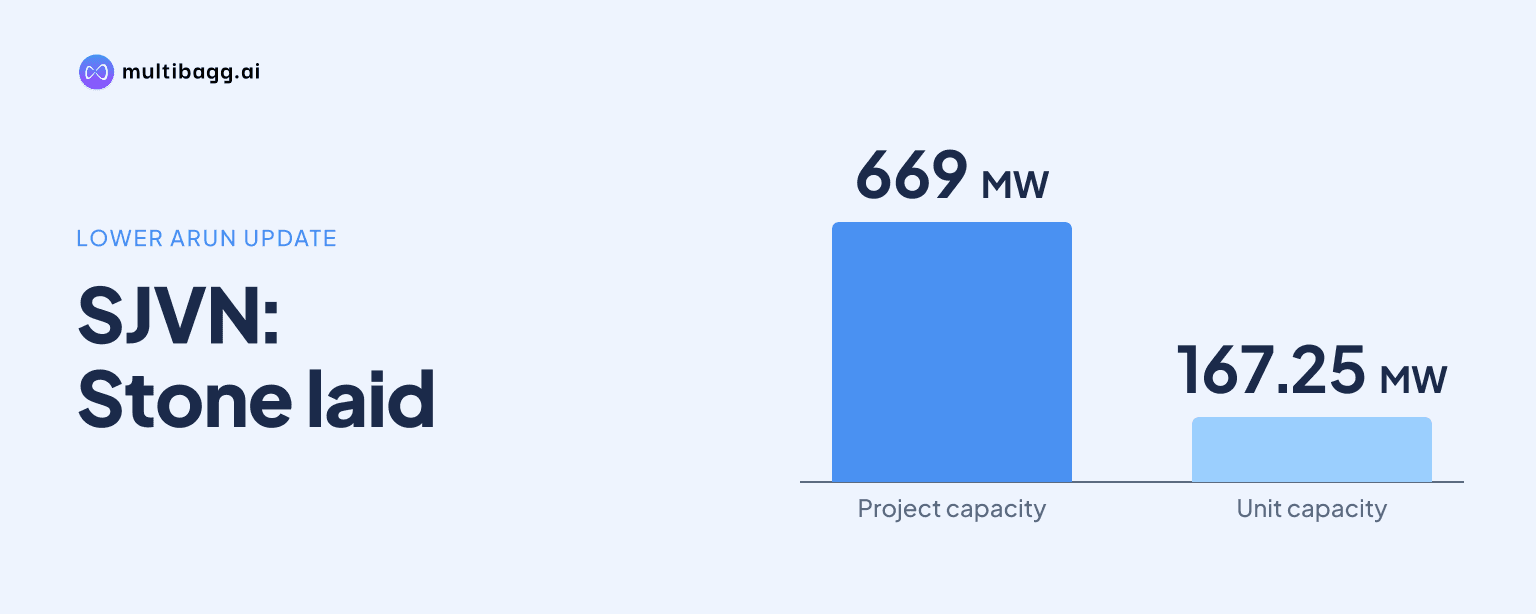
- The project includes four 167.25 MW generating units and a 17.4 km head race tunnel.
powered by IRIS
SJVN Limited said the prime ministers of India and Nepal jointly laid the foundation stone for its 669 MW Lower Arun Hydro Electric Project in Nepal, estimated to cost ₹5,792.36 crore and targeted for commissioning in FY31. The ceremony marks a formal milestone for a cross-border hydropower project whose major construction packages have already been awarded.
Know SJVN inside out
Results, valuation, peers and who's buying, in one view.
What happened at SJVN's Lower Arun project?
SJVN Limited announced that Prime Minister Narendra Modi and Nepal Prime Minister Balendra Shah jointly laid the foundation stone for the Lower Arun Hydro Electric Project through a virtual ceremony from New Delhi on 23 November 2026. The filing describes the event as a milestone in energy-sector cooperation between India and Nepal.
The 669 MW project is being developed on the Arun River in eastern Nepal's Sankhuwasabha and Bhojpur districts. SJVN is developing it through SJVN Lower Arun Power Development Company Pvt. Ltd., its wholly owned subsidiary. The project is planned as a run-of-river hydropower facility with four generating units of 167.25 MW each.
The foundation-stone event follows preparatory work at the site and the award of major construction packages. According to the company, construction activities are already under way. The virtual ceremony therefore signals the formal progression of the project while execution work continues in Nepal.
What are the Lower Arun project's cost and operating details?
The Lower Arun project has an estimated cost of ₹5,792.36 crore, a tentative tariff of ₹4.99 per unit, and expected annual generation of about 2,901 million units. SJVN has set a commissioning target during financial year 2030-31.
The project includes a 17.4 km head race tunnel and a surface powerhouse. It is being developed under the Build, Own, Operate and Transfer, or BOOT, model. Under this structure, the developer builds, owns and operates the asset for the agreed period before transferring it in line with the applicable project arrangement.
How did SJVN secure the Lower Arun project?
SJVN secured the Lower Arun project after the Government of Nepal awarded it to the company through international competitive bidding on 29 January 2021. The award established SJVN's role as the developer of the 669 MW project in Nepal.
The company subsequently signed a memorandum of understanding with Investment Board Nepal on 11 July 2021. A Project Development Agreement was signed on 1 June 2023 in the presence of the prime ministers of India and Nepal. These agreements set out the development pathway before the latest foundation-stone ceremony.
Got a follow-up? Ask IRIS
Why does the foundation stone matter for SJVN and Nepal?
The foundation stone matters because the project is a large, long-duration hydroelectric development for SJVN, with a stated capital cost of ₹5,792.36 crore and planned annual output of about 2,901 million units. The project is also among the company's overseas development initiatives through its Nepal-based subsidiary.
For Nepal, the project is located in Sankhuwasabha and Bhojpur districts and adds planned generating capacity on the Arun River. Its development is framed by SJVN as part of bilateral energy cooperation. The disclosed BOOT model and the Project Development Agreement provide the operating framework for the asset's development.
For investors, the filing provides operating and timeline details rather than any updated financial guidance for SJVN. The announced tentative tariff of ₹4.99 per unit and FY31 commissioning target are project-level parameters. Actual construction progress, project spending and delivery against the stated timeline will remain relevant execution factors.
What should investors track as construction progresses?
Investors can track progress on the construction activities that SJVN says are under way after major packages were awarded. The stated FY31 commissioning target gives a defined implementation horizon, while the 17.4 km tunnel, surface powerhouse and four-unit generation configuration indicate the principal physical components to be built.
They can also monitor company disclosures relating to project expenditure, construction milestones and any updates to the estimated ₹5,792.36 crore cost or tentative ₹4.99-per-unit tariff. The filing does not disclose a revised budget, a change in the commissioning target or a financial impact on SJVN's reported results.
SJVN is a Navratna central public sector enterprise under India's Ministry of Power and is a joint venture of the Government of India and the Government of Himachal Pradesh. The Lower Arun development is being undertaken by its wholly owned subsidiary, SJVN Lower Arun Power Development Company Pvt. Ltd.
Conclusion
The joint laying of the foundation stone formally marks the next stage of SJVN's 669 MW Lower Arun project in Nepal. With an estimated cost of ₹5,792.36 crore, expected annual generation of around 2,901 million units and a BOOT structure, the project is a material cross-border hydroelectric development in SJVN's project portfolio.
The next disclosed milestone is commissioning during FY 2030-31. Until then, investors will watch construction execution, expenditure against the estimated cost, and any company updates on the tentative tariff, project timeline or operational progress.