










SKP sees Rs 40 crore debt peak, debt-free within three years
Key highlights
- SKP management said approximately Rs 40 crore of debt was mostly at its peak during the Q2 and H1 FY27 call.
- SKP expects to become debt-free within a maximum of two to three years if it avoids a major expansion.
- Management expects the France business, which remains cash-negative, to break even in Q4.
- SKP targets ball-plant utilisation of 50% to 70% within one to three quarters.
powered by IRIS
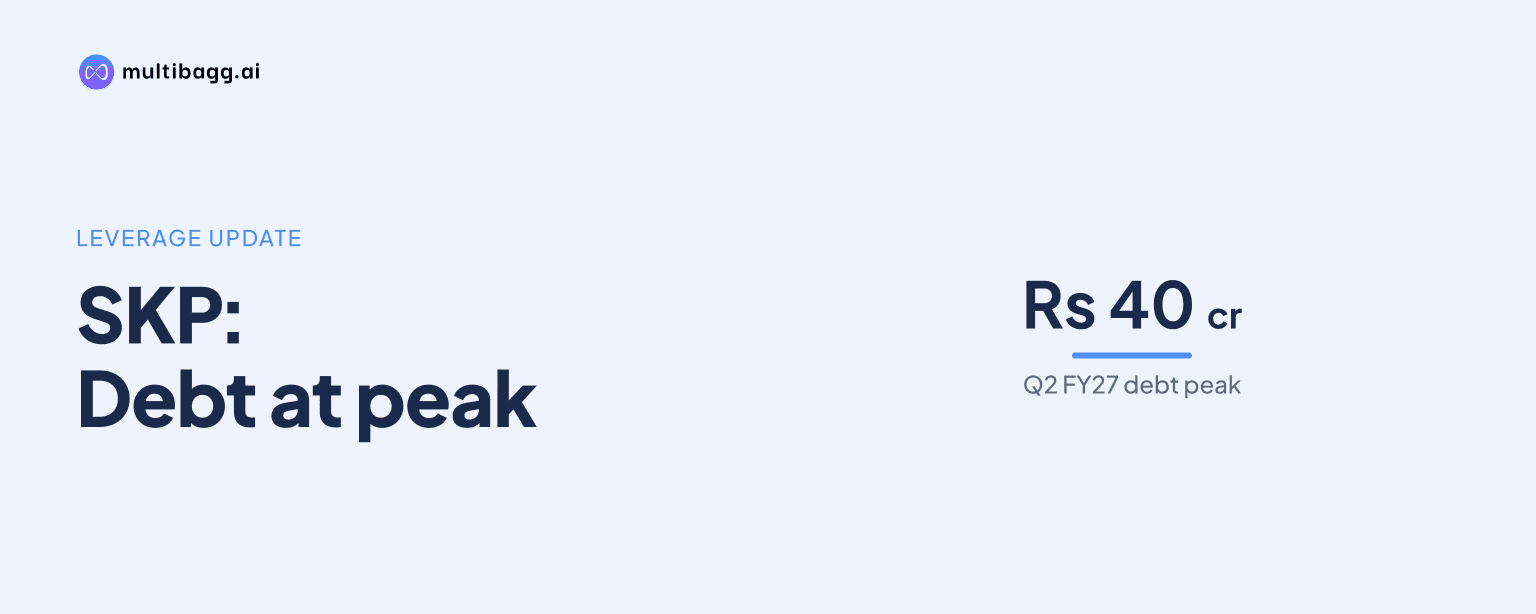
In its Q2 and H1 FY27 post-earnings call, SKP Bearing Industries Limited said approximately Rs 40 crore of debt was “mostly” at its peak and that it should become debt-free within a maximum of two to three years, unless it undertakes a major expansion requiring fresh investment.
Know SKP Bearing Industries inside out
Results, valuation, peers and who's buying, in one view.
What did SKP say about its Rs 40 crore debt?
SKP said the approximately Rs 40 crore borrowing level discussed on the call was “mostly” the peak. Management gave that response when an analyst asked whether current debt had reached its high point, but it did not disclose a dated gross-debt reconciliation, cash balance, net-debt figure or quarterly debt-repayment schedule during the Q2 and H1 FY27 call.
The peak-debt view reflects the current stage of SKP’s investments, including the France business turnaround and the ramp-up of its ball plant in India. Management said the France operation remains cash-negative, while the ball plant is awaiting customer-led volume increases after approvals, testing and field validation. Those operating developments, rather than a stated mandatory repayment plan, form the backdrop to management’s debt outlook.
SKP also distinguished between its India operations and the France business when discussing profitability. Management said India margins are sustainable unless product mix shifts toward lower-margin, high-volume ball categories, while France cannot achieve the same margin levels as India. It said consolidated margins may be lower because France adds volumes at a different margin profile, making the France turnaround relevant to future cash generation.
Can SKP become debt-free in two to three years?
SKP said it should be debt-free within a maximum of two to three years if it does not undertake another major expansion. This was management’s direct answer to a question on when approximately Rs 40 crore of debt could be eliminated, and it is conditional guidance rather than a commitment to reduce borrowings in every reporting period.
Management explicitly said business opportunities are more important than debt reduction. It said several opportunities were currently available and that SKP would invest if a favourable opportunity required capital. Therefore, a major investment could alter the two-to-three-year deleveraging path or require further borrowing, even though management considers the present debt level mostly at its peak.
The call did not provide annual repayment targets, projected interest costs, an operating-cash-flow forecast or a capital-expenditure budget for the next two to three years. SKP also did not identify whether a potential major expansion would be in India, France or another area. The disclosed position is narrower: management expects debt-free status within that period only if capital is not redirected to a major expansion.
Got a follow-up? Ask IRIS
How does France affect SKP's deleveraging path?
SKP expects its France business to break even in Q4, but management said the operation is still cash-negative. It described break-even as reaching a zero-cash-flow position and previously indicated that the quarter ending December could be the last loss-making quarter, with a turnaround potentially occurring around January. The Q4 expectation is management guidance, not a reported operating result.
Management said its confidence comes from discussions with most customers for the next calendar year, when pricing and volume decisions are generally finalised from September and October onward. It said customers had increased business-volume commitments and that SKP had started receiving larger orders for the next calendar year. Management also said it added two to three customers during the preceding two quarters.
The France business faces a significant slowdown in Europe, according to management, with customers under cost pressure. SKP said it sees an opportunity in combining Indian raw-material sourcing and tooling development with a manufacturing plant in France, which management believes can help it control costs while supplying European customers. That operational model underpins the Q4 break-even expectation and, if achieved, could reduce pressure for continuing financial support.
Management said the acquisition was expected to require a two-to-three-year gestation period and that a turnaround in the third or fourth year would be an achievement. It also said the acquisition cost itself was zero or negligible, while investment has been directed toward running the company. The timing of the France break-even remains an important unresolved factor in assessing whether SKP’s debt can decline on the stated schedule.
What could support SKP's cash generation in India?
SKP targets ball-plant utilisation of 50% to 70% within one to two quarters, with a maximum period of three quarters. Management said this is a target rather than achieved utilisation, based on customer approvals and a phased production ramp-up. It added that capacity allocation would not be limited to two customers because the company is also pursuing other accounts.
Management said two customers could initially take about 25% of the ball plant’s capacity each. It explained that customers typically begin with smaller volumes and subsequently assess product quality, delivery and sustainability before raising their share of business. If those customers ramp over four or five quarters, management estimated utilisation could be between 50% and 70%, subject to testing and field approvals.
For standalone operations, management said H2 FY27 should be better than H1 FY27. It attributed H1 pressure to higher petroleum-energy costs and interest rates, while price revisions had not yet been passed through by automotive and other customers. Management said the pricing turnaround started in Q2 and expects Q3 and Q4 to improve, without giving a specific earnings before interest, tax, depreciation and amortisation, or EBITDA, forecast.
Higher ball-plant utilisation and improved standalone performance could support the financial position that management described when discussing the approximately Rs 40 crore debt level. However, SKP did not quantify incremental revenue, EBITDA or cash flow from the 50% to 70% utilisation range on the call. The company said it would need to calculate the potential from India’s two plants before providing that figure.
Conclusion
SKP’s deleveraging outlook depends on several linked management expectations: approximately Rs 40 crore of debt is mostly at its peak, France reaches break-even in Q4, and the Indian ball plant moves toward 50% to 70% utilisation. The company has set out a conditional two-to-three-year route to debt-free status, but has not provided annual debt-repayment or cash-flow targets.
The next points to watch are management’s expected Q3 and Q4 FY27 improvement in standalone operations, the targeted Q4 France break-even and ball-plant utilisation over the next one to three quarters. Any decision to pursue a major expansion will also matter because management has said it would prioritise a compelling business opportunity over maintaining the stated deleveraging timetable.