










Skyways adds 200,000 cubic feet of Delhi cold-chain capacity
Key highlights
- Skyways is concluding a Delhi cold-chain facility with about 200,000 cubic feet of capacity.
- The Delhi facility will target healthcare, food and vegetable customers.
- Skyways has operationalised a Birmingham, UK warehouse for an automotive segment.
- Skyways’ H1 non-air revenue was Rs 568 crore, versus Rs 315 crore a year earlier.
powered by IRIS
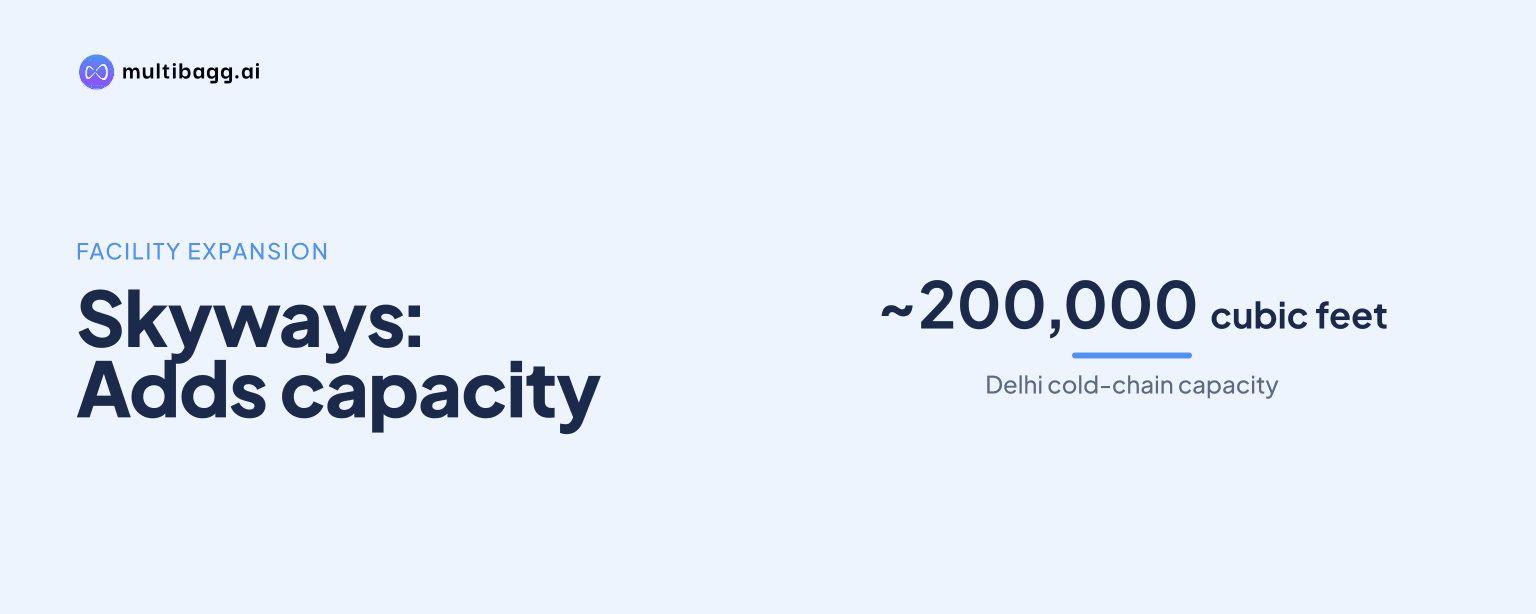
Skyways is concluding a Delhi cold-chain facility with about 200,000 cubic feet of capacity for healthcare, food and vegetable customers, while it has operationalised a Birmingham, UK warehouse aimed at the automotive segment. Management said the projects reflect selective, customer-led asset investment rather than a move away from its asset-light operating approach.
Know Skyways Air Services inside out
Results, valuation, peers and who's buying, in one view.
What facilities is Skyways adding in Delhi and Birmingham?
Skyways is concluding a Delhi cold-chain facility designed to add about 200,000 cubic feet of temperature-controlled capacity. Management said the facility will serve the healthcare sector as well as food and vegetable customers, making cold storage a specific addition to the group’s broader logistics offering rather than a general warehouse rollout.
Skyways has also recently operationalised a warehouse in Birmingham, UK, targeting a specific automotive segment. Management did not disclose the warehouse’s area, investment, customer name, revenue contribution or expected ramp-up period. It said the facility is intended to help Skyways grow and acquire more customers in the automotive area.
The two projects serve different customer needs. Delhi provides temperature-controlled handling for healthcare and perishable products, whereas Birmingham is a dedicated warehousing play for automotive customers. The contrast supports management’s description of an asset-sensitive model, under which an asset is added where customer demand or a defined logistics requirement supports it.
Why is Skyways investing in selected logistics assets?
Skyways said it has remained largely asset-light through its growth over the past couple of decades, but described its approach as asset-sensitive rather than simply asset-light. Management said it will invest in critical assets when a customer requirement supports the decision, while otherwise collaborating with other logistics providers and using their capacity.
Management identified warehousing, fulfilment services and distribution networks as capabilities that can support end-to-end customer requirements and cross-selling. It also cited movable equipment, including trucks and refrigerated trucks, as assets it may add where required. The stated objective is to retain flexibility while having infrastructure in selected areas that can make customers more closely tied to Skyways’ service portfolio.
The Delhi facility is particularly linked to Skyways’ stated intention to deepen its pharmaceutical business. Management called pharmaceuticals a key growth area and said customers in that segment require temperature-controlled facilities. It said each additional cold-chain capability would be assessed case by case, rather than through a blanket commitment to own logistics infrastructure.
How does the capacity plan fit Skyways’ wider growth strategy?
Skyways’ non-air businesses generated Rs 568 crore in the first half, up from Rs 315 crore in the comparable prior-year half, according to management. Those activities include ocean freight, express, trucking and other value-added services. The Delhi and Birmingham facilities add warehousing and cold-chain capabilities to that mix, potentially giving the group more services to offer existing freight customers.
Management said non-air activities had grown by about 80% to 90% year on year, while the specific H1 revenue comparison rose by Rs 253 crore. The company’s expansion logic is not limited to warehousing: it is seeking to provide air, ocean, express, trucking, fulfilment and distribution services in combination, especially for customers with omnichannel sales models.
Skyways also linked infrastructure to its international and import ambitions. Its air-import volumes increased from 2,500 tonnes in FY24 to 7,600 tonnes by the end of March FY26, and management said imports currently represent roughly 5% to 6% of business. It expects import volumes to grow and plans to open five new geographies in Asian markets, where it said much of India’s import flow originates.
Got a follow-up? Ask IRIS
What operating trends could support the new facilities?
Skyways reported that revenue per employee improved by about 67%, based on management’s calculation of 90% year-on-year revenue growth against about 15% headcount growth. Management also said digital booking and self-service systems can improve overall efficiency by 15% to 20%, although only about 15% to 20% of the overall business currently uses its platforms.
The company said its Express business is much more digitally adopted, with about 95% to 96% conducted through technology. Management expects the launch of ASAP, a recently introduced platform, to increase online transactions, including in Tier 3 and Tier 4 markets. These systems could support the expanded service portfolio by handling bookings and customer interactions more efficiently, but management gave no separate digital target for the Delhi cold-chain or Birmingham automotive facilities.
On margins, management said improvement should be gradual as revenue scale reduces employee-cost and other overhead ratios. It expects international offices to have better margins than India export business once they reach breakeven, and said it is targeting profit after tax, or PAT, breakeven in the geographies it is entering over one to two years. That context matters because the new facilities are part of a wider push into non-air and international services, not standalone financial targets.
What will determine further asset additions by Skyways?
Skyways said future infrastructure will depend on customer commitments, particularly long-term commitments, and on the operational need for a specific asset. That means the disclosed 200,000-cubic-foot Delhi facility and Birmingham automotive warehouse should not be read as a commitment to broad-based warehouse ownership. Management reiterated that it intends to use third-party logistics capacity where that is appropriate.
Demand in pharmaceuticals, food and vegetables could determine whether further cold-chain capacity is warranted, while automotive customer acquisition will be relevant to the Birmingham site. Management did not provide capital expenditure, leased-versus-owned details, utilisation rates, pricing, contract length or revenue targets for either project. Those undisclosed measures will be needed to assess how quickly the facilities contribute to the company’s stated cross-selling strategy.
Conclusion
Skyways is adding specialised infrastructure in two defined markets: about 200,000 cubic feet of Delhi cold-chain capacity for healthcare and perishables, and a Birmingham warehouse for automotive customers. The projects sit alongside H1 non-air revenue of Rs 568 crore, compared with Rs 315 crore a year earlier, and are consistent with management’s plan to broaden services while keeping asset commitments selective.
The next developments to watch are the completion and customer ramp-up of the Delhi facility, customer additions in Birmingham and management’s case-by-case decisions on pharmaceutical cold-chain assets. Skyways has also said it plans five new Asian geographies and expects roughly 40% to 42% growth in air-import volumes this year, which could expand the customer base for its wider logistics network.