










Skyways Air Services Files Q2 FY27 Earnings Call Transcript
Key highlights
- Skyways filed its Q2 and H1 FY27 earnings call transcript with the NSE on November 17, 2026.
- Q2 FY27 revenue from operations was ₹1,311.45 crore, up 90.3% year-on-year.
- Q2 FY27 PAT rose 129.6% year-on-year to ₹33.18 crore, with a PAT margin of 2.53%.
- Skyways said air cargo volumes increased 27% during the quarter and its global ranking improved to 42.
powered by IRIS
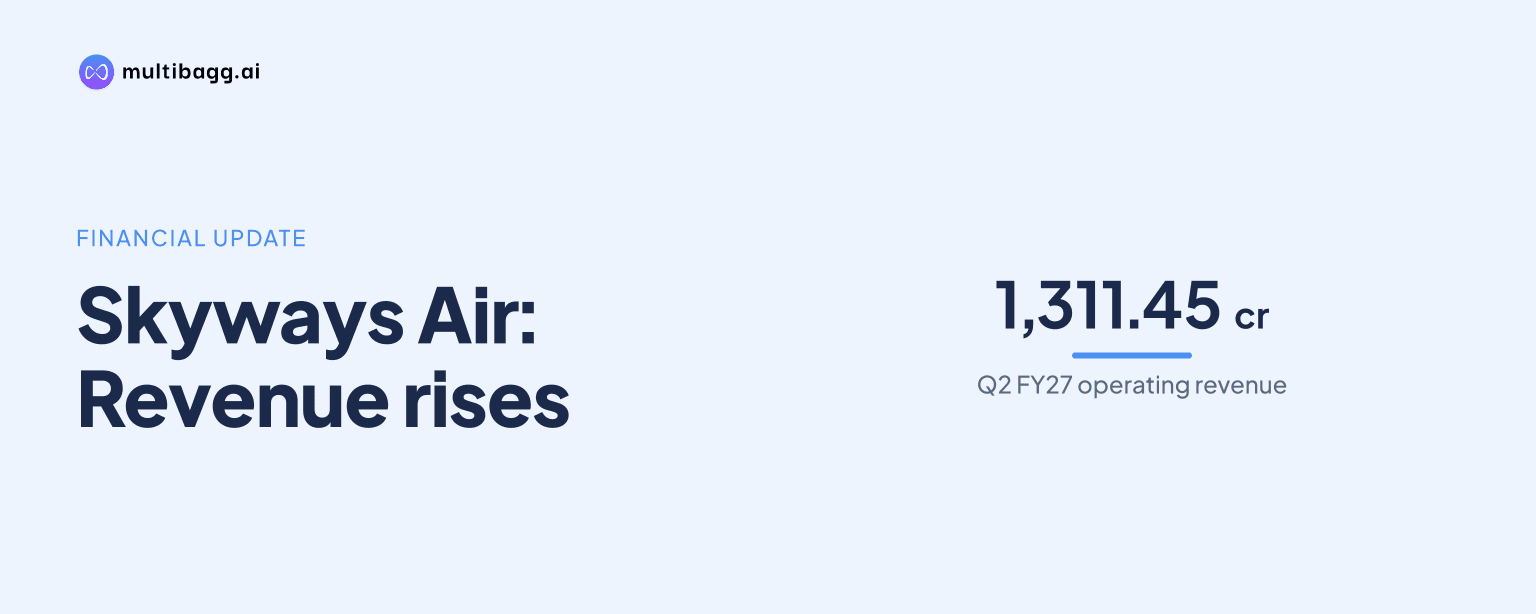
Skyways Air Services Limited filed the transcript of its Q2 and H1 FY27 earnings call held on November 17, 2026, following reported Q2 FY27 revenue of ₹1,311.45 crore, up 90.3% year-on-year. The filing gives investors a record of management's discussion of unaudited results for the quarter and half-year ended September 30, 2026.
Know Skyways Air Services inside out
Results, valuation, peers and who's buying, in one view.
What did Skyways Air Services file with the exchange?
Skyways filed the transcript of its Q2 FY27 earnings conference call with the NSE on November 17, 2026. The call, held at 4:30 pm IST, covered the company's unaudited financial results and operating performance for the September 2026 quarter and the first half of FY27.
The transcript is significant because it places management's comments on growth, profitability, cargo volumes and strategy in the public domain. It was the company's second earnings call since its listing, according to the management remarks included in the transcript.
Management said the group recorded broad-based growth across air cargo and non-air cargo operations. It cited contributions from ocean freight, express services, cross-border customs brokerage, trucking and other value-added logistics services alongside its air cargo business.
What were Skyways' Q2 FY27 financial results?
Skyways reported consolidated revenue from operations of ₹1,311.45 crore in Q2 FY27, a 90.3% increase from the year-earlier quarter and a 7.8% sequential increase. EBITDA rose 96% year-on-year to ₹58.47 crore, while profit after tax increased 129.6% to ₹33.18 crore.
The Q2 EBITDA margin was 4.46%, and the PAT margin was 2.53%. Management said the PAT margin improved by 43 basis points year-on-year. The figures show that profit grew faster than revenue during the quarter, although the disclosed operating and net margins remained relatively narrow.
For H1 FY27, revenue from operations was ₹2,527.99 crore, up 90.3% year-on-year. EBITDA for the half year rose 90% to ₹108.60 crore, and PAT increased 135% to ₹59.97 crore. H1 PAT margin improved by 46 basis points to 2.37%, according to management.
What operating trends did management discuss on the call?
Skyways said its air cargo volumes increased 27% during the quarter. Management stated that the Indian export market grew by roughly 8% in the same period and said the company's growth was nearly three times the pace of the industry in India and overseas.
The company said it retained its position as the number one air cargo player in India. It also said its global ranking improved by two positions to number 42 at the end of Q2. These statements were made by management during the earnings call and form part of the transcript filed with the exchange.
Non-air businesses also contributed to the reported expansion. Management said H1 revenue from these businesses rose from ₹315 crore in the previous corresponding half year to ₹566 crore in H1 FY27. The company described its operating model as an asset-light, technology-led integrated logistics service provider.
Got a follow-up? Ask IRIS
What is Skyways' stated growth strategy?
Skyways said its strategy rests on four pillars described as the Skyways Growth Quad: connected, scale-driven, smart and future-ready. Management linked these priorities to expanding business with existing customers, winning new customers, broadening technology-led products and strengthening its global network through larger carrier capacities.
The company said its growth was not concentrated in a single geography, customer segment or service line. This matters for investors because the call transcript identifies a wider mix of logistics operations behind the reported revenue increase, rather than attributing it only to air cargo.
Management also referred to an annualised return on capital of about 23%. However, the supplied call information does not provide FY27 margin guidance. The transcript therefore records strong reported growth and modest margin expansion, while leaving investors without a management target for full-year profitability margins.
How does the filing matter for investors and the logistics sector?
The filing provides a formal source for shareholders to assess the relationship between Skyways' revenue growth, cargo-volume growth and profitability. Revenue rose 90.3% year-on-year in both Q2 and H1 FY27, while air cargo volume growth was reported at 27% for the quarter, indicating that the company's reported sales expansion reflected more than volume growth alone.
The disclosed margin data is also relevant. Q2 EBITDA margin stood at 4.46% and PAT margin at 2.53%, even as EBITDA and PAT rose faster than revenue. Investors can use the transcript to track whether future quarters show further margin expansion, particularly because management did not state an FY27 margin target in the supplied material.
For the logistics industry, the discussion highlights the role of air cargo, export activity and a broader service portfolio in business performance. Skyways also disclosed that it received an appreciation award from Air India Cargo in Vietnam for service excellence and contribution to the air cargo ecosystem, adding context to its overseas cargo operations.
Conclusion
Skyways' November 17 filing makes the Q2 and H1 FY27 earnings-call discussion available to the market after a period of rapid reported growth. Q2 revenue reached ₹1,311.45 crore, PAT reached ₹33.18 crore and air cargo volumes increased 27%, while management also reported gains across non-air logistics verticals.
The next items to watch are subsequent financial disclosures for evidence on margins, the progress of non-air logistics revenue and any further detail on carrier capacity or global-network expansion. The supplied transcript does not provide a full-year FY27 margin target, leaving future reported results as the main measure of profitability progress.