










Smartworks says mature portfolio will cushion margin drag
Key highlights
- Smartworks said its 10 million square foot mature portfolio contributes 300 to 400 basis points more EBITDA margin.
- Smartworks plans to add roughly 3 million square feet this year, with new large campuses expected to break even in 10 to 12 months.
- Smartworks reported about 81% overall occupancy, versus 88% at mature centres and about 91% committed mature occupancy.
- Smartworks spent Rs 307 crore on capital expenditure in the first half, including 20% on campuses not yet generating revenue.
powered by IRIS
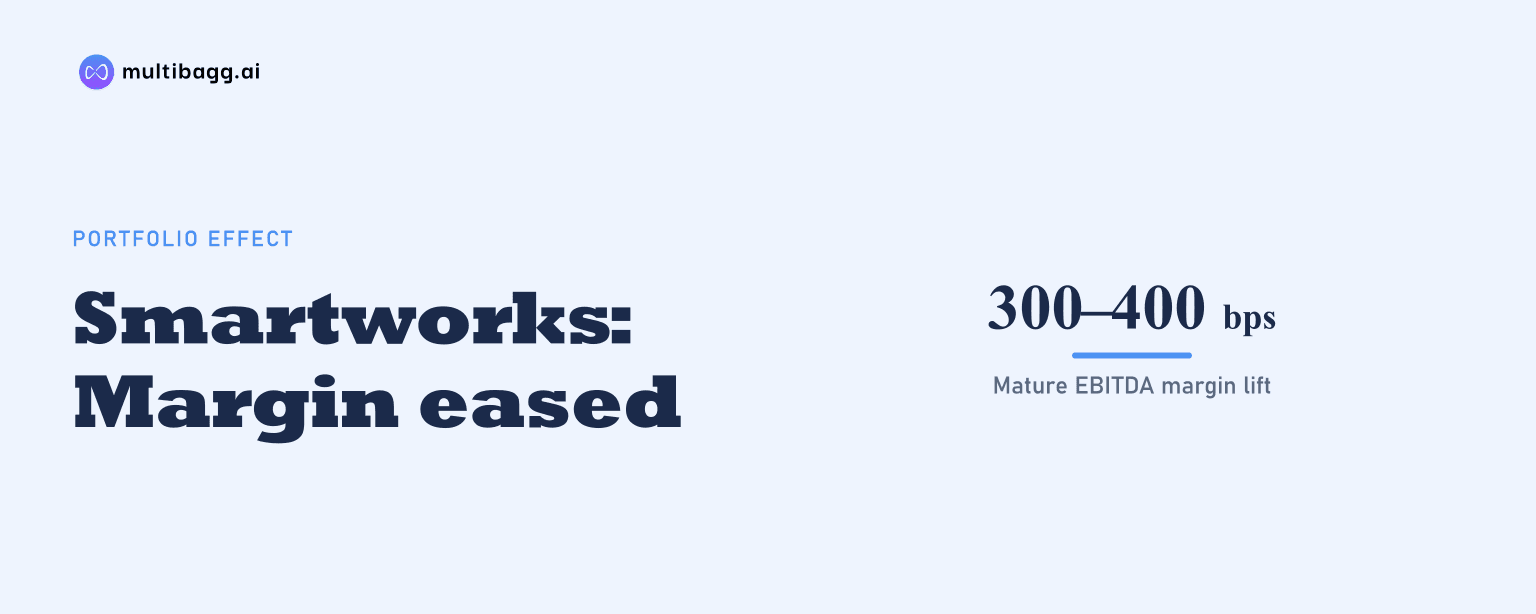
Smartworks says its 10 million square foot mature portfolio, which it expects to be fully or almost fully mature this year, provides 300 to 400 basis points more earnings before interest, taxes, depreciation and amortisation margin and is intended to offset the initial drag from roughly 3 million square feet of new capacity.
Know Smartworks Coworking Spaces inside out
Results, valuation, peers and who's buying, in one view.
How will Smartworks' mature portfolio protect margins?
Smartworks says the mature portfolio should absorb much of the margin pressure created as new campuses ramp up. Management said 10 million square feet that will be completely or almost completely mature this year contributes 300 to 400 basis points more EBITDA margin, helping limit the effect of the roughly 3 million square feet being added this year.
Management linked the difference to occupancy and cash generation at established locations. It said larger campuses are operating at above 90% occupancy and benefit from long customer tenures, while new campuses require investment in deposits and fit-outs before revenue begins. Smartworks also cited cost measures and preferred rental terms as factors behind its margin outlook.
The company did not provide a separately reported EBITDA margin for mature and new campuses. Its 300-to-400-basis-point estimate is management's description of the contribution from the mature portfolio, rather than a disclosed segment profitability measure.
When will Smartworks' new campuses reach breakeven?
Smartworks expects its new large campuses to reach breakeven occupancy within 10 to 12 months, supported by prefill of about 35%. Management said the demand visibility and prefill at these locations supported that timeframe, despite the campuses being larger than its historical additions.
Smartworks said mature campuses generally break even within a year and reach 88% to 90% occupancy within 18 months. Centre sizes have increased by more than two to three times, but management said the time required to reach about 90% occupancy remains below 18 months.
Management attributed this ramp-up partly to larger enterprise deals. The share of 1,000-seat deals increased to more than 41%, from 12% four to five years earlier, according to Smartworks. It said its model differs from back-to-back leasing because it opens campuses and fills them progressively, leaving a period between a centre becoming operational and revenue generation.
What is Smartworks spending on its expansion?
Smartworks reported Rs 307 crore of capital expenditure in the first half, with a meaningful part directed to newer campuses that had not started generating revenue. Management said 20% of first-half capital expenditure was on campuses where revenue had not yet commenced.
The company said adding roughly 3 million square feet this year would entail about twice the capital expenditure incurred in the last full year. Smartworks added 2 million square feet last year, versus 1 million square feet annually about three years ago, showing the larger scale of the current expansion cycle.
Management said fit-out spending remains near Rs 1,400 per square foot, plus the 4.5% to 5% inflation already factored into its plans. It attributed the ability to contain cost inflation to larger campuses and higher purchasing volumes, saying it is maintaining amenities rather than reducing them.
Maintenance capital expenditure is separate from new-campus investment. Smartworks estimated Rs 95 crore to Rs 100 crore of maintenance capital expenditure this year and said 12% to 15% of initial gross block generally goes towards maintenance annually. It also identified about 4.5 million square feet of space with more than three years of expiry in its maintenance-capital discussion.
Got a follow-up? Ask IRIS
Why is Smartworks' blended occupancy lower than mature occupancy?
Smartworks says blended occupancy is lower because newly opened campuses add seats before customers move in, while mature-centre occupancy remains higher. Management reported overall occupancy of about 81%, compared with 88% at mature centres and committed occupancy of about 91% for the mature portfolio.
The company said overall committed occupancy was 86%, indicating that about 5 percentage points of space was signed but under construction. It expects blended occupancy to trend towards 84% to 85% over the next four quarters, while retaining its 88% to 90% mature-campus occupancy guidance.
Large openings can alter the calculation quickly. Smartworks said Eastside and East Bridge each add more than 40,000 seats to the occupancy denominator, but customers ramp into those seats over time. Management said common amenities require three to four months to build, followed by a five-to-six-month lag before customers move into the space.
What is changing in Smartworks' revenue mix and realisations?
Smartworks says higher rental realisations are coming from annual escalation, new-campus mix and repricing of some older leases. Management said annual rental escalations remain 5% to 6%, while newer centres in West, Gurgaon and South markets start at higher rental bases and include more amenities.
Some leases signed during the COVID period have been repriced after voluntary churn, according to management. It said this process will continue when long-term leases expire, meaning the effect will occur over one or two years rather than in the next quarter or year.
Other operating revenue has also grown with the portfolio. Smartworks said pure ancillary-services revenue increased from about Rs 70 crore to Rs 170 crore in the first half, while its footprint rose from 9.1 million square feet to 10.9 million square feet. Parking, electricity, meeting rooms, conference rooms and food services contributed alongside Smart Vantage, value-added services and fit-out-as-a-service.
Management said other operating revenue includes recurring consumption from operating whole campuses, rather than only one-time transactions. It expects this revenue to grow by at least 20% if the footprint grows by 20%, although it did not disclose the EBITDA margin earned by individual service lines.
Conclusion
Smartworks' margin-resilience argument depends on the relative scale of its established portfolio and its additions: 10 million square feet of mature or near-mature campuses carrying a stated 300-to-400-basis-point EBITDA-margin benefit, alongside roughly 3 million square feet that initially require capital and reduce blended occupancy. Mature occupancy of 88% and committed mature occupancy of about 91% are central to that case.
The next evidence will be whether large new campuses reach management's stated 10-to-12-month breakeven timeline and whether mature sites maintain 88% to 90% occupancy within 18 months. Management also expects blended occupancy to move towards 84% to 85% over the next four quarters, while Rs 307 crore of first-half capital expenditure, including 20% on non-revenue-generating campuses, begins contributing revenue.