










Smartworks’ other operating revenue reaches Rs 170 crore in H1
Key highlights
- Smartworks reported Rs 170 crore of other operating revenue in H1, versus about Rs 70 crore in the prior-year H1.
- Smartworks’ footprint increased to 10.9 million square feet from 9.1 million square feet.
- Management said a 20% increase in footprint should generate at least 20% growth in other operating revenue.
- Smartworks reported about 91% committed occupancy at mature centres and about 86% committed occupancy across its current base.
powered by IRIS
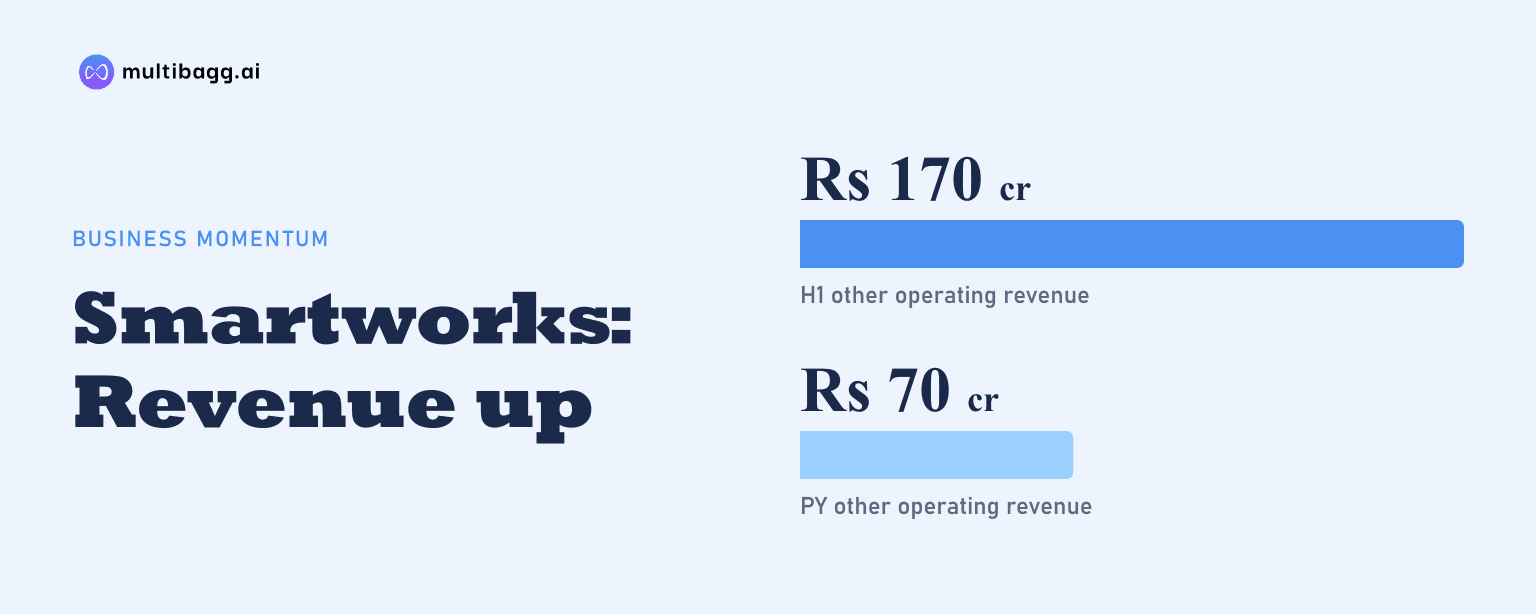
Smartworks reported Rs 170 crore of other operating revenue in H1, compared with about Rs 70 crore in the prior-year H1, as its footprint rose to 10.9 million square feet from 9.1 million square feet and newer services including Smart Vantage, value-added services and fit-out-as-a-service contributed.
Know Smartworks Coworking Spaces inside out
Results, valuation, peers and who's buying, in one view.
What drove Smartworks’ other operating revenue growth?
Smartworks said the H1 increase was driven by recurring ancillary services across a larger campus portfolio and by newer service verticals. Management cited electricity charges, car parking, meeting-room and conference-room bookings, and food services as revenue sources generated through the operation of campuses. The footprint expanded by 1.8 million square feet year on year, to 10.9 million square feet from 9.1 million square feet.
Management said the approximately Rs 70 crore in the prior-year H1 was purely ancillary revenue from buildings, while the Rs 170 crore in the latest H1 included contributions from Smart Vantage, value-added services, or VAS, and fit-out-as-a-service, or FaaS. The change means the latest H1 figure contains both established building services and newer offerings that were not part of the comparable base.
An analyst referred to 125% growth in other operating revenue during the quarter. Smartworks did not state a separate quarterly rupee figure in its reply, but management said the percentage growth appeared high because the starting base was small and two or three new verticals had been introduced. The company therefore attributed the rise to a combination of a larger 10.9 million-square-foot estate and a broader service mix.
Which Smartworks services produce recurring revenue?
Smartworks said other operating revenue is not limited to one-time transactions because many services arise repeatedly as customers use a campus. Electricity billing, parking, meeting rooms, conference facilities and food services generate consumption-linked revenue during occupancy. This mechanism differs from a revenue line dependent only on a fit-out project completed once for a customer.
The timing of service revenue can also precede full lease-rental recognition. Management said users often begin entering and occupying centres before rental revenue starts completely, with rental revenue generally beginning 10 to 20 days later. Electricity, parking and meeting-room income can therefore be recorded earlier in a newly occupied centre than the full rental contribution.
Smartworks said Smart Vantage, VAS and FaaS were all contributing from smaller bases in H1. FaaS adds a fit-out service, while VAS and Smart Vantage supplement the ancillary services delivered within campuses. Management did not provide separate H1 revenue amounts for each of the three verticals, so the disclosed Rs 170 crore does not show their individual contributions.
Will Smartworks’ other operating revenue track footprint growth?
Management said other operating revenue should grow at least in line with Smartworks’ footprint because many ancillary services are necessary for customers to occupy buildings. It told an analyst that a 20% increase in footprint should produce a minimum 20% increase in other operating revenue. That expectation is based on services such as electricity, parking and shared facilities being linked to campus use.
The year-on-year comparison shows that footprint increased about 20%, from 9.1 million square feet to 10.9 million square feet, while the ancillary and VAS-related revenue figure rose from about Rs 70 crore to Rs 170 crore. Management said the larger revenue increase also reflected the addition of Smart Vantage, VAS and FaaS, rather than footprint expansion alone. It did not provide a formal rupee target for other operating revenue.
Management distinguished this growth path from lease rentals at mature centres. Mature centres were about 91% committed, leaving limited additional capacity to sell within that existing supply. Smartworks said new supply would be the main source of later lease-rental growth, while ancillary services and newer verticals would also contribute to its FY27 revenue-growth guidance of 33% to 35%.
Got a follow-up? Ask IRIS
How do occupancy and new campuses affect Smartworks’ revenue mix?
Smartworks said overall occupancy was about 81%, while committed occupancy across its current base was about 86%. The roughly 5-percentage-point difference represented signed space that was under construction and expected to enter revenue over time. Mature centres had 88% occupancy and about 91% committed occupancy, which management described as the more relevant marker for assessing revenue from established campuses.
The company added about 2.5 million square feet over the preceding six months and leased close to 2 million square feet in the same period. It also expected around 1.7 million square feet to come up over the next two quarters. New capacity can reduce blended occupancy initially because newly opened seats enter the denominator before they are filled, even as service income can start when customers begin using the facilities.
For Eastside and East Bridge, Smartworks said about 35% prefill was visible, with a significant portion coming from existing clients expanding. East Bridge still required an occupancy certificate, or OC, before construction could start. Management said it expected the two campuses to reach break-even occupancy in about 10 to 12 months, supported by the disclosed prefill and demand visibility.
What does management expect for rentals and margins?
Management said both other operating revenue and lease rentals would support FY27 revenue growth of 33% to 35%. It expects recurring campus services, VAS, Smart Vantage and FaaS to contribute while new properties are built out. Lease rentals from the incoming supply were expected to rise more meaningfully toward the end of the next quarter and at the start of the following financial year, because most build-outs take three to four months.
Smartworks said earnings before interest, tax, depreciation and amortisation, or EBITDA, margin had increased by more than 360 basis points over six quarters, from 16.2% to about 19.8%. A basis point is one-hundredth of a percentage point. Management attributed the movement largely to operating leverage as mature campuses crossed the 12-month stage and said margins should remain at the upper end for the remainder of the year.
The company reported H1 capital expenditure of Rs 307 crore, with 20% spent on campuses that had not yet begun generating revenue. Smartworks said it was adding about 3 million square feet this year, compared with 2 million square feet last year. Management also estimated annual maintenance capital expenditure of about Rs 95 crore to Rs 100 crore, with the remaining spending directed to expansion and campus build-outs.
Conclusion
Smartworks’ Rs 170 crore H1 result shows that other operating revenue now includes more than building-related ancillary income. The increase from about Rs 70 crore in the prior-year H1 accompanied a 1.8 million-square-foot expansion in footprint and the launch of Smart Vantage, VAS and FaaS. Electricity, parking, meeting facilities and food services provide a recurring consumption-based element, while the new verticals broaden the line’s composition.
The next measures to watch are whether ancillary revenue grows at least in proportion with footprint, as management stated, and how quickly the 1.7 million square feet due over the next two quarters is occupied. Management’s timeline also depends on East Bridge receiving its OC, on the 35% prefill at Eastside and East Bridge converting into occupancy, and on the indicated 10-to-12-month path to break-even at those campuses.