










SMT lifts R&D intensity to 10.5% in H1 FY27
Key highlights
- SMT raised R&D spending to 10.5% of revenue in H1 FY27 from 8.6% in FY26.
- SMT reported R&D expenditure of Rs 76.26 crore in H1 FY27.
- SMT has 156 R&D members, 118 patents granted and 75 clinical studies including ongoing studies.
- Telangana uses 33% of its plant area and has annual catheter capacity of 600,000 units at 57% utilisation.
powered by IRIS
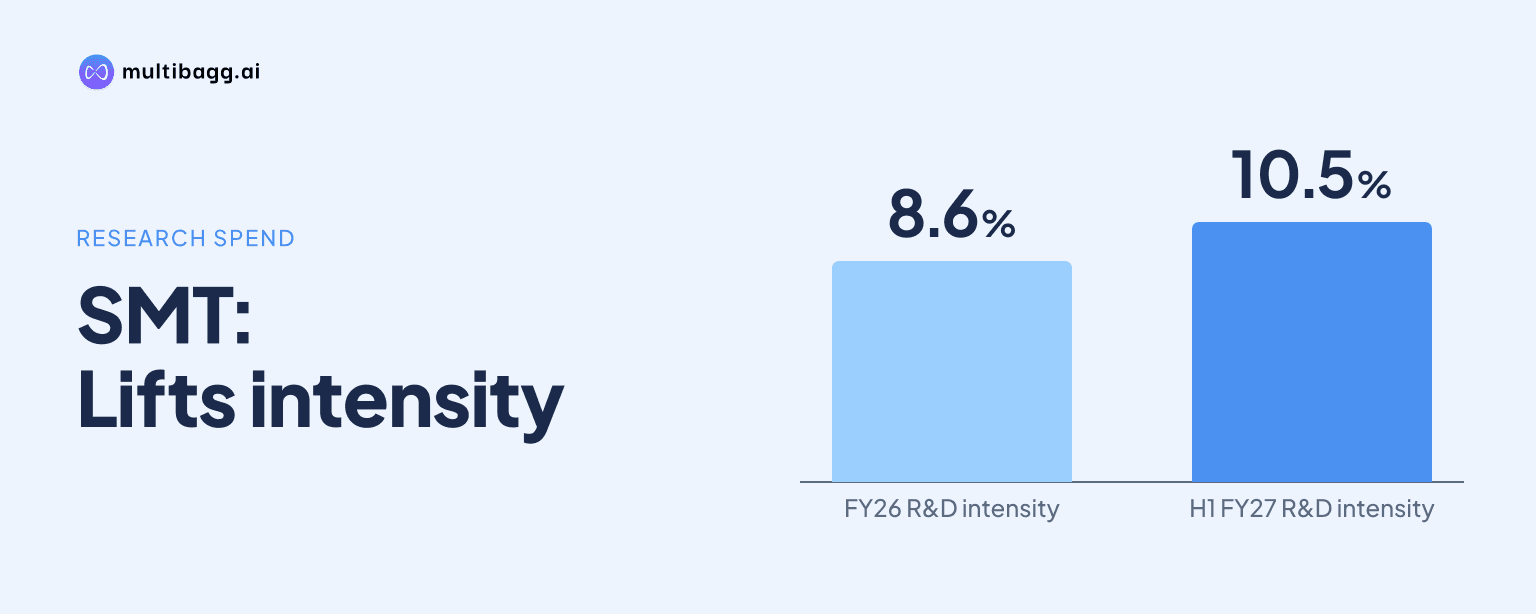
SMT raised research and development (R&D) spending to 10.5% of revenue in H1 FY27, up from 8.6% in FY26, while building nitinol processing, extrusion and braiding capabilities in-house alongside its existing self-manufactured balloon catheters and other production technologies.
Know Sahajanand Medical Technologies inside out
Results, valuation, peers and who's buying, in one view.
How much did SMT increase R&D spending?
SMT increased R&D intensity to 10.5% of revenue in H1 FY27, the highest level across the four reported periods. The ratio was 9.0% in FY24, 9.1% in FY25 and 8.6% in FY26, meaning the H1 FY27 figure was 1.9 percentage points above FY26. The presentation describes the FY24 to H1 FY27 range as about 9% to 10% of revenue.
R&D expenditure was Rs 76.26 crore in H1 FY27, compared with Rs 104.16 crore in FY26, Rs 92.99 crore in FY25 and Rs 81.46 crore in FY24. The H1 FY27 amount covers a half-year period, so it is not directly comparable with the preceding full-year figures as an annual spending measure. The higher revenue ratio nevertheless shows a larger share of H1 FY27 revenue allocated to R&D than in FY26.
SMT reports an R&D team of 156 members, including several members with Masters and PhDs. Its stated development scope includes catheter manufacturing, laser cutting, drug coating, drug and polymer formulation, medical-grade tubing extrusion, custom equipment design, advanced alloy processing, valve manufacturing, and braiding and lamination.
What R&D assets and intellectual property does SMT report?
SMT reports 118 patents granted, 79 additional patents in the pipeline, five design registrations and 75 clinical studies, including ongoing studies. These figures cover its intellectual-property and clinical-development base rather than a separate count for any one product, such as drug-eluting stents or structural-heart devices.
SMT operates R&D facilities in India and Nonthaburi, Thailand. The India facility is approved by the Department of Scientific and Industrial Research, while the Nonthaburi facility is described as Good Manufacturing Practice and CE certified, with CE referring to the European conformity marking cited by SMT.
The company also lists partnerships with the Institute of Chemical Technology, Sardar Vallabhbhai National Institute of Technology and the Technology Development Board. Its innovation awards include the 2025 Excellence in Clinical Evidence recognition from CSI NIC for a clinical programme involving more than 35,000 patients, as well as awards in 2022 from Informarkets and the Technology Development Board.
Which manufacturing technologies has SMT brought in-house?
SMT says it has replaced externally sourced balloon catheters with self-manufactured balloon catheters, a completed integration step that the company says has delivered cost savings and improved quality control. The presentation does not quantify those savings, but it identifies catheter manufacturing as one of the technologies already operated in-house.
SMT also lists drug and polymer formulation, laser cutting and valve manufacturing as in-house technologies. By contrast, it labels nitinol processing and extrusion and braiding as work in progress, meaning capabilities being built internally. The source does not give a completion date, output volume or investment amount for these work-in-progress activities.
Nitinol processing has a disclosed product connection because SMT describes its Hydra transcatheter aortic valve implantation (TAVI) device as having a self-expandable nitinol stent frame. The Thailand plant has annual capacity for 3,600 TAVI units at 53% utilisation and 30,000 occluder units at 46% utilisation, showing that its structural-heart production includes capacity below stated maximum levels.
SMT’s manufacturing list spans material formulation, component processing and finished-device production. Its Cocoon occluder is described as platinum coated to minimise nickel leaching, while Hydra is part of the company’s structural-heart portfolio. However, the presentation does not state that the pending nitinol, extrusion or braiding capabilities are already supplying either product line.
Got a follow-up? Ask IRIS
Where does SMT have room to scale production?
SMT identifies Telangana as the plant with stated room to scale because 33% of its area is utilised. The company says the remaining space can support additional drug-eluting stent (DES) and catheter capacity as demand grows. Telangana currently has annual capacity for 180,000 DES units at 20% utilisation and 600,000 catheter units at 57% utilisation.
The comparison with the other sites distinguishes unused building area from production-equipment utilisation. Sachin SEZ, Surat and Nonthaburi are both reported at 100% area utilisation, whereas Telangana is at 33%. Surat’s DES capacity is 780,000 units at 79% utilisation and its catheter capacity is 660,000 units at 72% utilisation.
The three plants have different listed approvals and certifications. Surat lists CE, Medical Device Single Audit Program, Central Drugs Standard Control Organization, ANVISA and Therapeutic Goods Administration coverage as described by SMT; Telangana lists Central Drugs Standard Control Organization approval and ISO 13485:2016; and Nonthaburi lists CE, ANVISA, Korean Good Manufacturing Practice, Thai Food and Drug Administration and ISO 13485:2016.
How does R&D support SMT’s device portfolio?
SMT links R&D investment to high-risk medical devices that require clinical trials, lengthy approvals, extensive clinical data and scientific selling. In the Indian risk-classification examples shown in the presentation, Class D includes coronary stents, cardiac catheterisation kits and occlusion catheters, while Class C includes bifurcation stents, introducer sheaths and microcatheters.
Clinical evidence is one component of this strategy. SMT says its Supraflex biodegradable polymer-coated DES was commercialised in 71 markets between FY24 and June 2026. The presentation cites the TALENT trial, which reported Supraflex was non-inferior to Xience on device-oriented endpoints at 12 months, with a lower clinically indicated target-lesion revascularisation rate in the per-protocol analysis.
SMT also reports that Hydra was commercialised in 36 markets and Cocoon in 55 markets between FY24 and June 2026. For Hydra, SMT shows an 8% permanent pacemaker implantation rate after 30 days, compared with a 7% to 15% range across six peers in its presentation. These product and clinical figures do not establish the financial return on the higher H1 FY27 R&D ratio.
Conclusion
SMT’s H1 FY27 R&D intensity of 10.5% was above the 8.6% reported in FY26 and sits alongside an integrated manufacturing approach that already includes balloon catheter production, laser cutting, formulations and valve manufacturing. The presentation connects this model with development across stents, catheters and structural-heart products, while distinguishing completed capabilities from those still under development.
The next disclosed matters to watch are progress in work-in-progress nitinol processing, extrusion and braiding, and the use of Telangana’s 33% area utilisation to add DES and catheter capacity as demand grows. SMT provides no completion date, investment amount or output target for the work-in-progress technologies, leaving those milestones unresolved.