










SoftTech Q2 PAT more than doubled as consolidated profit fell
Key highlights
- SoftTech’s Q2 FY27 standalone PAT rose 120.8% year on year to Rs 3.63 crore.
- Q2 FY27 consolidated PAT fell to Rs 0.21 crore from Rs 0.33 crore in Q2 FY26.
- A deferred Dubai order resulted in an approximately Rs 1 crore revenue reversal in Q2 FY27.
- H1 FY27 recurring revenue rose 46.2% to Rs 28.21 crore and represented 43.5% of sales.
powered by IRIS
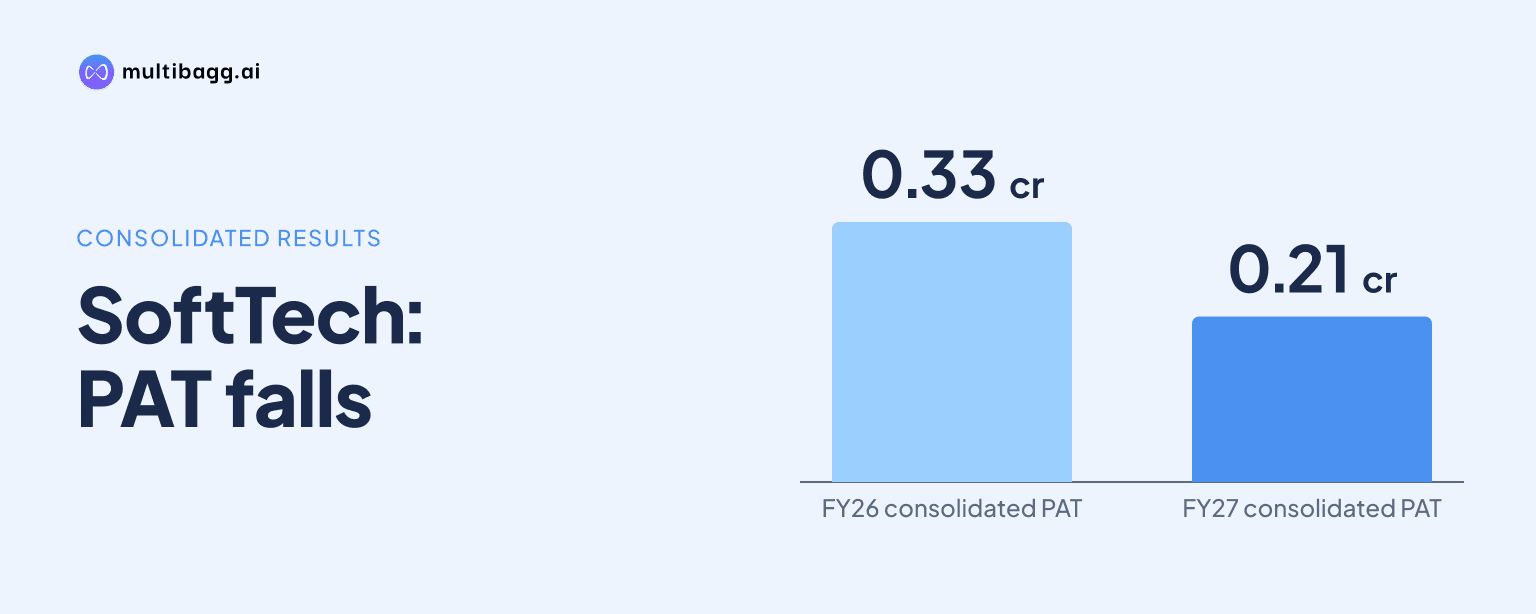
SoftTech reported a 120.8% year-on-year rise in standalone profit after tax to Rs 3.63 crore in Q2 FY27, while consolidated PAT fell to Rs 0.21 crore from Rs 0.33 crore. eTDR and platform revenue supported the domestic result, but Germany spending, depreciation and a Dubai revenue reversal restrained consolidation.
Know Softtech Engineers inside out
Results, valuation, peers and who's buying, in one view.
Why did SoftTech standalone PAT more than double in Q2 FY27?
SoftTech’s standalone PAT more than doubled because revenue growth and eTDR-related platform activity lifted operating profitability in Q2 FY27. Standalone revenue from operations rose 27.2% year on year to Rs 32.70 crore, while earnings before interest, tax, depreciation and amortisation, or EBITDA, increased 50.8% to Rs 11.47 crore. EBITDA margin expanded to 35.1% from 29.6% in Q2 FY26, supporting PAT of Rs 3.63 crore.
The Q2 result extended the standalone improvement seen in H1 FY27. Revenue rose 26.1% to Rs 64.92 crore, EBITDA increased 37.9% to Rs 21.07 crore and PAT grew 69.5% to Rs 5.55 crore. Management attributed this growth to new verticals including eTDR and ongoing traction in existing businesses, saying TDR-related business contributed to EBITDA and PAT.
Standalone costs also moved in a way that supported first-half profitability. Employee costs were broadly stable at Rs 13.01 crore in H1 FY27, while finance costs declined to Rs 1.89 crore from Rs 2.16 crore in H1 FY26, which management attributed to better fund utilisation. Other expenses increased to Rs 19.92 crore, mainly for technical professionals on projects and product scaling, but EBITDA still rose faster than revenue.
Why did SoftTech consolidated PAT decline despite higher revenue?
SoftTech’s consolidated PAT declined because Germany go-to-market spending, higher depreciation and amortisation, lower other income and a Dubai order reversal outweighed EBITDA growth. Consolidated Q2 FY27 revenue increased 17.6% to Rs 31.53 crore and EBITDA rose 14.4% to Rs 7.99 crore. Yet PAT fell to Rs 0.21 crore from Rs 0.33 crore a year earlier, while EBITDA margin narrowed to 25.3% from 26.0%.
The Dubai order created the most direct Q2 revenue effect. Management said the order value was about Rs 1.70 crore to Rs 1.80 crore, but roughly Rs 1 crore of earlier invoiced revenue was reversed in Q2 FY27 after the customer deferred the project owing to the geopolitical situation. The stated implementation period was 10 to 12 months, and management said there was no cancellation risk as of the call.
Depreciation and amortisation increased to Rs 6.85 crore in Q2 FY27 from Rs 5.65 crore in Q2 FY26, a rise of Rs 1.20 crore. Management said this, along with lower other income, had a greater effect at the profit-before-tax and PAT levels than at EBITDA. It linked the charge to investments in products and platforms intended for future growth.
The H1 FY27 comparison showed the same gap between growth and reported consolidated profit. Consolidated revenue grew 20.4% to Rs 64.82 crore and EBITDA rose 18.6% to Rs 17.04 crore, but PAT edged down to Rs 1.37 crore from Rs 1.44 crore in H1 FY26. Other expenses rose to Rs 21.43 crore, primarily because of Germany go-to-market investment, while EBITDA margin declined to 26.3% from 26.7%.
Got a follow-up? Ask IRIS
How did recurring revenue and eTDR support SoftTech’s domestic result?
SoftTech’s recurring revenue grew faster than its overall standalone business in H1 FY27, improving the revenue mix management linked to greater visibility and cash conversion. Recurring revenue increased 46.2% to Rs 28.21 crore from Rs 19.29 crore in H1 FY26. Its share of total sales rose to 43.5% from 37.5%, compared with 26.1% growth in total standalone revenue.
Software as a service, or SaaS, and transaction-based revenue increased 32.7% to Rs 18 crore in H1 FY27. Management said this reflected adoption of platform-led offerings, including CivitPLAN, an artificial-intelligence-based permitting solution offered to architects already on its platform. The company did not disclose the individual revenue contribution from eTDR or CivitPLAN.
SoftTech earns a 0.5% facilitation fee based on the transaction value conducted through its eTDR platform. Management said buyers and sellers transact on the platform while the relevant authority regulates the process, with State Bank of India escrow arrangements transferring funds to the parties, authority and SoftTech. Management also said lower real-estate activity had reduced recent eTDR volumes, though it saw better results in the current month.
Management said it was working to add eTDR business in more cities and states during the current or next quarter, without naming them. The margin contrast illustrates why the mix matters: standalone Q2 EBITDA margin was 35.1%, compared with consolidated margin of 25.3%. Management specifically associated the standalone improvement with eTDR-related activities and the platform-based model.
What is SoftTech spending on in Germany and other markets?
SoftTech is spending on adapting products for Germany, and management said these investments affected consolidated FY27 performance. The work includes adding German data sets, building codes and geographic information system, or GIS, maps to its platform. Consolidated employee expense was broadly stable at Rs 15.44 crore in H1 FY27 versus Rs 15.53 crore a year earlier, but other expenses increased to Rs 21.43 crore due mainly to Germany go-to-market activity.
Management said it had added sales directors in Germany and was prioritising a sustainable business build rather than faster conversion. It also said product-development costs would continue at a similar level, although their share of revenue should decline as products generate results in FY27 or FY28. This was management’s expectation, not formal financial guidance.
In the Middle East, management said a separate government permitting engagement was at an advanced stage and could be signed soon, but did not disclose its value or contract date. It distinguished that prospective government project from the deferred Dubai order. Management said a government conversion could support wider regional opportunities, but the transcript gives no signed-contract confirmation.
Domestic infrastructure is another planned expansion area. SoftTech disclosed a Rs 92.95 crore order from Jawaharlal Nehru Urban Port Trust in H1 FY27 for an artificial-intelligence-powered digital-twin solution. It also reported an order book of about Rs 300 crore and a sales pipeline of about Rs 625 crore across CivitCITY, CivitPORT and CivitINDUSTRY opportunities, while cautioning through its comments that conversion depends on future execution and closures.
Conclusion
SoftTech’s Q2 FY27 divergence reflects a domestic business that converted higher platform and eTDR activity into faster growth in revenue and PAT, alongside a consolidated business carrying overseas expansion costs and accounting effects. Standalone PAT rose by Rs 1.99 crore year on year to Rs 3.63 crore, while consolidated PAT declined by Rs 0.12 crore to Rs 0.21 crore.
The next disclosures to watch are progress on restarting the 10-to-12-month Dubai implementation, the expected signing of the Middle East government permitting engagement and commercial development in Germany. Management’s plan to add eTDR cities, execute the Rs 92.95 crore port order and convert its roughly Rs 300 crore order book and Rs 625 crore pipeline will also determine how much of the stated opportunity becomes reported revenue.