










SoftTech expects Rs 100-125 crore delivery in 12 months
Key highlights
- SoftTech expects Rs 100-125 crore of delivery from its approximately Rs 300 crore order book in the next 12 months.
- Management expects at least 40% conversion of SoftTech's Rs 625 crore sales pipeline, equal to Rs 250 crore.
- Management said 50%-75% of converted pipeline business could be delivered in 12 months, implying Rs 125-187.5 crore.
- The deferred Middle East order is almost Rs 1.8 crore and management said it represents about 1% of topline.
powered by IRIS
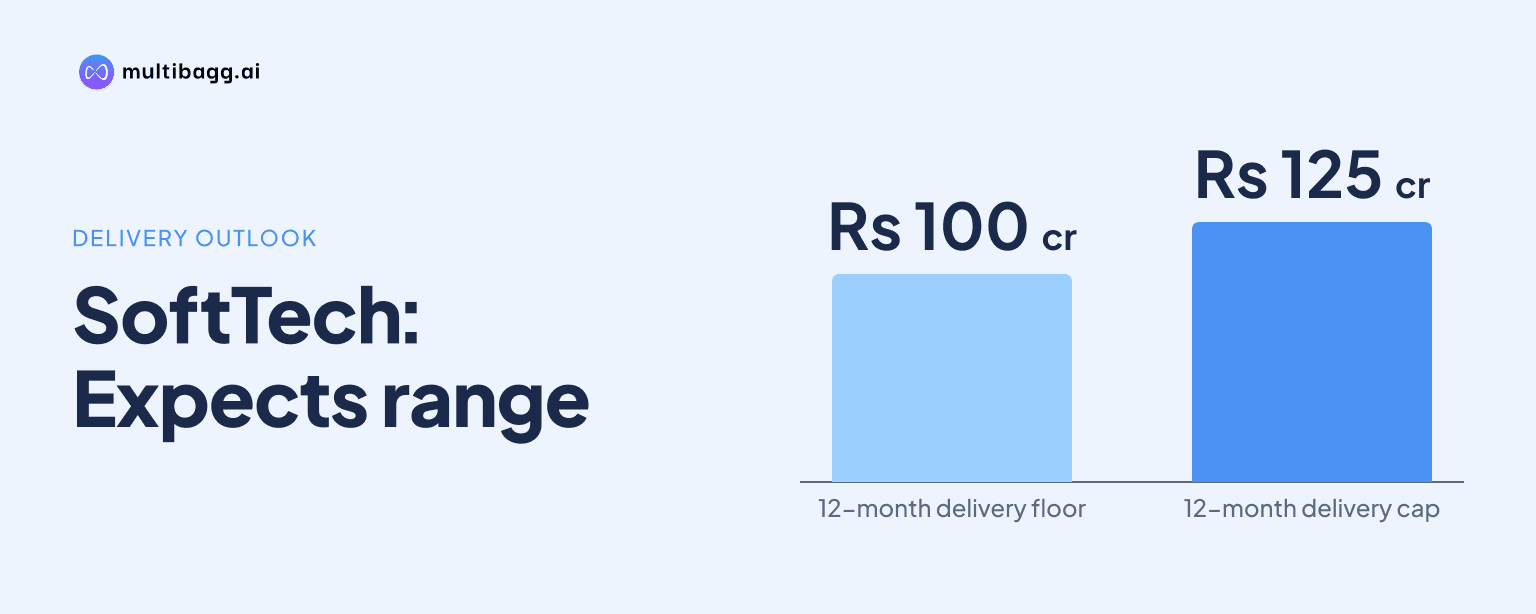
SoftTech Engineers Limited expects to deliver Rs 100 crore to Rs 125 crore from its approximately Rs 300 crore order book over the next 12 months, while management expects at least 40% of its Rs 625 crore sales pipeline to convert. The estimates set out separate assumptions for work already won and opportunities still awaiting conversion.
Know Softtech Engineers inside out
Results, valuation, peers and who's buying, in one view.
How much of SoftTech's order book can be delivered in 12 months?
SoftTech expects to deliver around Rs 100 crore to Rs 125 crore from its approximately Rs 300 crore order book during the next 12 months. Deepak Bang gave the range in response to a question on orders in hand, indicating that roughly one-third to just over two-fifths of existing orders could be executed in that period.
Management also said it was targeting bookings of about Rs 55 crore from the Rs 300 crore order book in “this financial year.” The call did not describe the Rs 55 crore booking target as equivalent to the Rs 100 crore to Rs 125 crore delivery estimate, and the current financial year may not be the same as a rolling 12-month period.
The order book consists of work already in hand, while the sales pipeline covers prospective business that still needs to be won. Management did not provide a stage-wise, geography-wise or segment-wise split of the Rs 625 crore pipeline during the call, despite being asked for a breakdown.
Management said its development spending supports products and platforms including the CIVIT application, the transfer of development rights, or TDR, platform, and products adapted for overseas markets. It said absolute development costs would remain around current levels or could rise slightly, while the proportion of costs to sales could decline if the business scales.
How much of SoftTech's sales pipeline may convert?
SoftTech expects to convert at least 40% of its Rs 625 crore sales pipeline, which is equivalent to Rs 250 crore when calculated from management’s stated assumption. Bang referred to an expected 40% achievement from the pipeline, while Vijay Gupta said management was confident that a minimum 40% would convert.
Bang said that 50% to 75% of the pipeline that converts could be delivered over the next 12 months. Applied to a Rs 250 crore converted amount, that delivery assumption produces a range of Rs 125 crore to Rs 187.5 crore, but this is arithmetic based on management’s conversion and delivery assumptions rather than reported order inflow.
The prospective pipeline is larger than the existing order book because it includes projects that have not yet become orders. Management linked future scale to overseas opportunities, TDR activity and GMP opportunities, but did not allocate any part of the Rs 625 crore pipeline to a particular country, product, government customer or commercial segment.
Management said it was at a very advanced stage on a Middle East government permitting engagement and expected a contract to be signed very soon. However, SoftTech did not disclose the country, contract value, contract term or a date by which it expected the agreement to be concluded.
Got a follow-up? Ask IRIS
Why do SoftTech's first-year pipeline assumptions differ?
SoftTech gave two different first-year pipeline measures, and the call did not reconcile them. Bang referred to delivering 50% to 75% of converted pipeline business within 12 months, whereas Gupta said SoftTech assumed 25% of the 40% conversion would be booked in the first year.
The latter assumption equates to Rs 62.5 crore, calculated as 25% of a Rs 250 crore converted pipeline. That differs from the Rs 125 crore to Rs 187.5 crore delivery range derived from Bang’s comments, because the executives used different terms: “booked” in Gupta’s statement and “deliver” in Bang’s statement.
The call does not define whether booking and delivery represent different commercial or revenue-recognition stages. As a result, the Rs 62.5 crore first-year booking calculation, the Rs 100 crore to Rs 125 crore order-book delivery estimate and the Rs 125 crore to Rs 187.5 crore pipeline-delivery calculation should be viewed as separate management statements, not added together as a single forecast.
Management said its shift from one-time business toward certified and platform-based models required development work that would be amortised and depreciated later. It said the company had reached a mature stage of development, but expected continuing investment for overseas-market product alignment, the TDR platform and the CIVIT application.
What could affect SoftTech's execution outlook?
SoftTech's 12-month execution outlook depends on converting pipeline opportunities, signing overseas government contracts and demand in the TDR market. Management said government engagements can take longer to convert, even though it described the Middle East permitting opportunity as close to signing.
Management distinguished that prospective Middle East government contract from a deferred Middle East order worth almost Rs 1.8 crore. Bang said the deferred order was about 1% of topline and was not large enough to directly affect financial year 2027, or FY27, targets; Gupta said management did not see FY27 downside from it.
TDR transaction activity is another factor because SoftTech said its CIVIT eTDR platform charges a 0.5% facilitation fee on the value transferred through the platform. The company said buyers deposit funds and sellers transfer TDRs through an escrow arrangement connected to SBI Bank, with SoftTech’s facilitation fee transferred during the process.
An analyst said TDR volumes in the current quarter were about Rs 400 crore to Rs 450 crore, compared with about Rs 8,000 crore for the full prior year. Management agreed that recent volumes were lower, attributing this to slower real-estate activity, lower permit issuance, geopolitical conditions, foreign-investment trends and additional regulatory frameworks, while saying results had improved in the current month.
SoftTech also expects some additional cities to be added to the TDR business during the current quarter and the following quarter. Management said it works with more than 1,500 cities and cited a Rs 92 crore opportunity from Jawaharlal Nehru Port Authority, adding that it planned to pursue 10 to 15 similar opportunities over the next three years.
Conclusion
SoftTech has given a defined framework for near-term execution: Rs 100 crore to Rs 125 crore of delivery from approximately Rs 300 crore of orders in hand over 12 months, alongside a minimum 40% conversion assumption for a Rs 625 crore pipeline. The pipeline could amount to Rs 250 crore of converted business, but the first-year booking and delivery comments use different measures and cannot be combined into one outlook figure.
The next items to watch are progress toward the expected Middle East permitting contract, whether new cities are added to the TDR platform in the current and next quarters, and execution against the Rs 55 crore booking target for this financial year. Management’s plan to pursue 10 to 15 opportunities similar to the Rs 92 crore Jawaharlal Nehru Port Authority opportunity will also determine how quickly its broader pipeline develops.