










Solar Industries India Limited Reports 80% Q2 FY27 Profit Growth
Key highlights
- Solar Industries India Limited reported Q2 FY27 consolidated revenue of ₹3,519 crore, up 69% year on year.
- SIIL's Q2 FY27 profit after tax rose 80% to ₹650 crore from ₹361 crore.
- SIIL's EBITDA increased 75% to ₹1,021 crore and margin expanded 107 basis points to 29.02%.
- SIIL disclosed a ₹20,178 crore order book and expects to surpass FY2026-27 guidance.
powered by IRIS
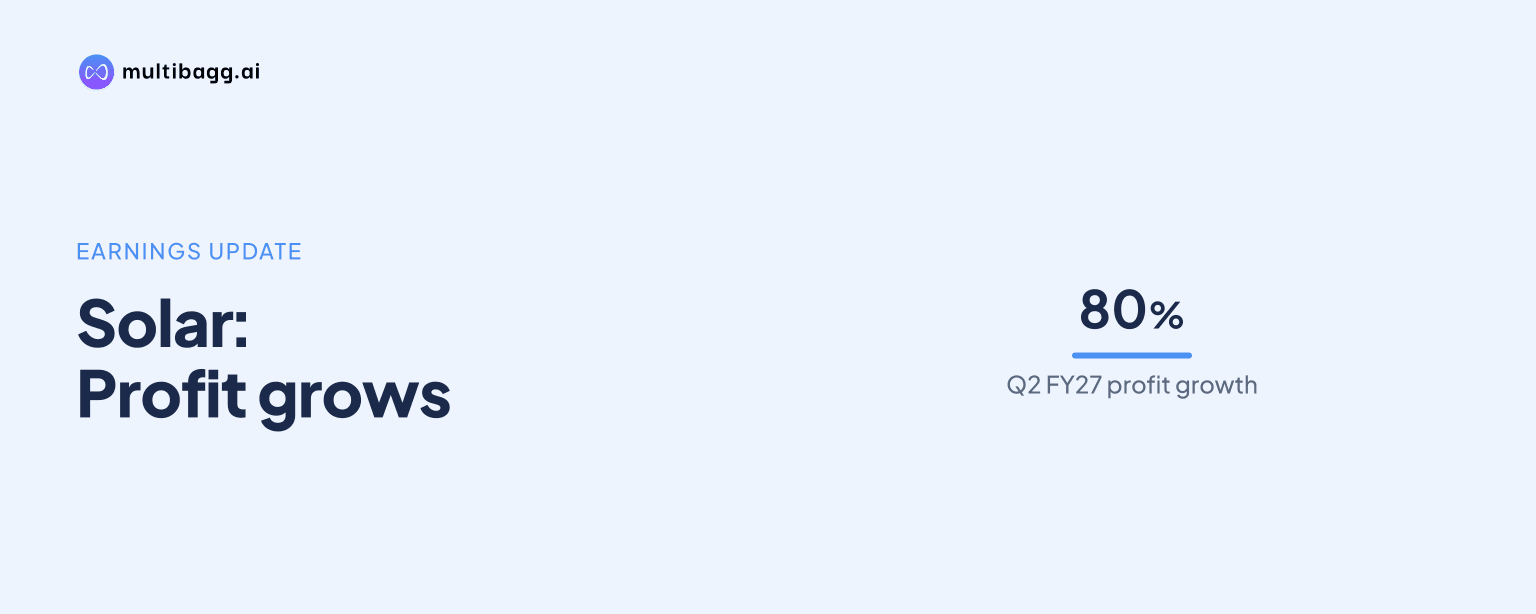
Solar Industries India Limited reported an 80% year-on-year increase in profit after tax to ₹650 crore for Q2 FY27, supported by 69% consolidated revenue growth to ₹3,519 crore in the July-September 2026 quarter. The company said its ₹20,178 crore order book supports its expectation of surpassing FY2026-27 guidance.
Know Sunil Industries inside out
Results, valuation, peers and who's buying, in one view.
What did Solar Industries India Limited report in Q2 FY27?
SIIL reported consolidated net revenue of ₹3,519 crore for Q2 FY27, compared with ₹2,082 crore in Q2 FY26. The 69% year-on-year increase was accompanied by stronger operating and profit metrics. EBITDA rose 75% to ₹1,021 crore from ₹582 crore, while profit before tax increased 79% to ₹877 crore from ₹490 crore.
Profit after tax rose to ₹650 crore from ₹361 crore in the comparable quarter a year earlier, representing 80% growth. The results were filed on November 3, 2026, during the broader September-quarter earnings season. As of November 4, 2026, 1,803 companies had declared Q2 FY27 results.
Which businesses drove SIIL's quarterly growth?
SIIL attributed its September-quarter momentum to Domestic Explosives, International Explosives and Defence. The company identified these three businesses as contributors to the substantial increase in consolidated revenue and earnings during the quarter.
The operating performance also improved on margins. SIIL's EBITDA margin reached 29.02%, compared with 27.95% in Q2 FY26. This was an expansion of 107 basis points, or 1.07 percentage points. The increase in EBITDA exceeded the revenue growth rate, which resulted in the reported margin improvement.
The company did not provide a revenue or profit split for the individual businesses in the available information. Its disclosure nevertheless places explosives and defence-related operations at the centre of the quarter's reported growth, rather than attributing the performance to a single segment.
How did SIIL perform in the first half of FY27?
SIIL recorded consolidated revenue of ₹7,187 crore in H1 FY27 ended September 30, 2026, up 70% from ₹4,237 crore in the year-earlier period. The first-half figures show that the faster growth reported in the September quarter followed a strong start to the financial year.
H1 FY27 profit after tax increased 84% to ₹1,316 crore, compared with ₹714 crore in H1 FY26. The six-month profit growth was higher than the 80% growth posted in the second quarter alone. These figures reflect the combined financial outcome for the June and September 2026 quarters.
The wider chemicals sector has also reported revenue and profit growth, although its aggregate margin trend differs from SIIL's. Among 72 non-financial chemicals companies with comparable year-ago quarters that had reported results by November 5, sales rose 37.7% and net profit increased 40.3% year on year. Their combined operating margin narrowed 15 basis points to 15.4%.
Got a follow-up? Ask IRIS
What does the ₹20,178 crore order book mean for SIIL?
SIIL disclosed an order book of ₹20,178 crore and said it expects to surpass its FY2026-27 annual guidance. The order book represents a disclosed base of pending business, while the company has not stated the value of its annual guidance in the available information.
For investors, the order book is relevant because it accompanies strong first-half revenue and profit growth. It provides context for management's stated confidence on the full-year outlook. However, the disclosure does not specify the execution schedule, segment-wise composition, margins, or the portion of the order book expected to be recognised during FY27.
The combination of growth in Domestic Explosives, International Explosives and Defence, along with the disclosed order book, is therefore the main operational context for SIIL's guidance comment. Any assessment of full-year performance would depend on execution, revenue recognition and operating conditions over the remaining months of FY27.
How does the result matter for investors and the chemicals industry?
SIIL's results stand out against the reported sector data because its revenue growth of 69% was above the 37.7% sales growth reported by the comparable group of chemicals companies. Its EBITDA margin also expanded by 107 basis points, while the aggregate operating margin for the comparable chemicals group contracted by 15 basis points.
The result provides investors with reported evidence of improved earnings scale during the first half. Revenue rose 70% and profit after tax rose 84% for H1 FY27. At the same time, the available information does not include a share-price reaction, valuation data, project-level details, or a quantified FY27 guidance target.
SIIL's Q2 filing is part of a broader earnings season where company-specific business mix remains important. The company's stated drivers span domestic, international and defence activities, which means future disclosures on segment performance and order execution will be relevant to understanding whether the first-half growth pattern continues.
Conclusion
Solar Industries India Limited delivered materially higher Q2 and H1 FY27 revenue, EBITDA and profit, with quarterly profit after tax rising 80% to ₹650 crore. The improvement was supported by the company's cited momentum in Domestic Explosives, International Explosives and Defence, alongside a 107-basis-point increase in EBITDA margin.
The next point to watch is SIIL's execution of its ₹20,178 crore order book and the company's stated expectation of surpassing FY2026-27 guidance. Further disclosures on order-book composition, execution timing and business-segment contributions would provide additional context for the full-year outlook.