










Jyoti CNC Automation Limited Reports ₹602 Crore Q2 FY27 Revenue
Key highlights
- Jyoti CNC reported consolidated Q2 FY27 revenue of ₹602 crore, up 18.5% year-on-year.
- Standalone Q2 FY27 EBITDA rose to ₹164 crore, with margin improving 320 basis points to 28%.
- Q2 FY27 machine sales increased to 1,911 units from 1,315 units a year earlier.
- Jyoti CNC's order book stood at ₹5,082 crore, with aerospace and defence accounting for 36%.
powered by IRIS
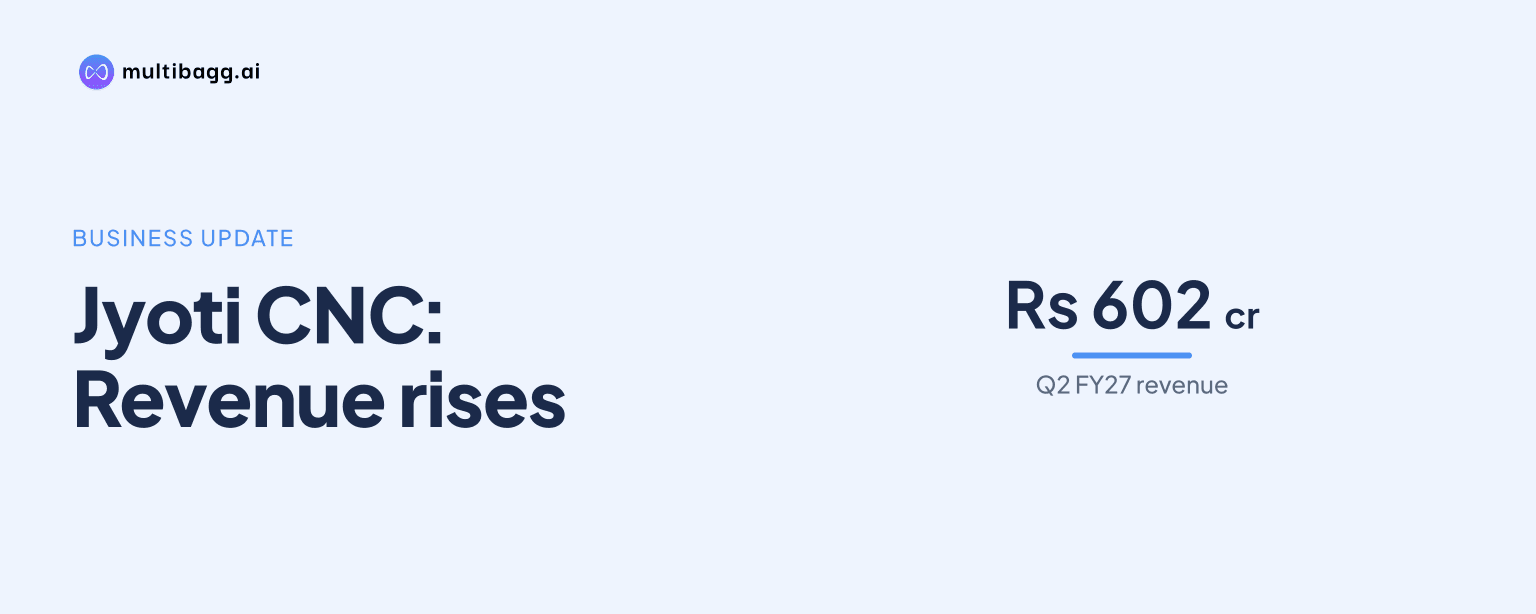
Jyoti CNC Automation Limited reported consolidated revenue of ₹602 crore in Q2 FY27, up 18.5% year-on-year from ₹508 crore, while its order book reached ₹5,082 crore. The quarterly update is significant because higher machine dispatches, improving standalone margins and a large order backlog support visibility for the company’s manufacturing operations.
Know Jyoti CNC Automation inside out
Results, valuation, peers and who's buying, in one view.
How did Jyoti CNC perform in Q2 FY27?
Jyoti CNC reported consolidated revenue of ₹602 crore for Q2 FY27, compared with ₹508 crore in Q2 FY26. Consolidated EBITDA was ₹131 crore, against ₹125 crore a year earlier, translating to an EBITDA margin of 21.8%. Consolidated profit after tax stood at ₹73 crore, with a margin of 12%.
On a standalone basis, revenue rose 31% year-on-year to ₹588 crore. Standalone EBITDA increased to ₹164 crore from ₹111 crore in Q2 FY26, and the EBITDA margin expanded by 320 basis points to 28%. Standalone profit after tax was ₹115 crore, up 46% year-on-year, with a 19.6% margin.
The difference between standalone and consolidated figures is material for readers assessing quarterly performance. The company disclosed both sets of results on its earnings call, but the provided information does not give a detailed reconciliation between them. The reported figures nonetheless show stronger year-on-year growth in standalone revenue and profitability.
What drove Jyoti CNC's quarterly machine sales?
Machine sales increased to 1,911 units in Q2 FY27 from 1,315 units in Q2 FY26. Management said it dispatched approximately 1,900 machines during the quarter, its highest quarterly dispatch level to date, indicating that production and deliveries were higher than the comparable period last year.
The company linked the operational increase to additional machines put to use during the quarter. Management said an additional 10,000 machines were deployed and that it continued to work on improving capacity utilisation and ramping production. These comments were made during the Q2 and H1 FY27 earnings conference call hosted by Elara Capital.
Management also said its foundry operations were expected to commence in the coming days. The company described the facility as part of its effort to reduce dependence on imports and improve backward integration. It also outlined plans to develop in-house capabilities for CNC controllers, motors, drives and operator interfaces.
What does Jyoti CNC's ₹5,082 crore order book contain?
Jyoti CNC's order book stood at ₹5,082 crore as of the earnings call, providing disclosed revenue visibility for upcoming quarters. Aerospace and defence was the largest end market, accounting for 36% of the order book, followed by automotive and auto components at 22% and general engineering at 21%.
Electronics manufacturing services represented 12% of the order book, while die and moulds accounted for 4%. The remaining 5% came from other sectors. This distribution shows that the backlog is spread across several industrial end markets rather than concentrated in one customer segment.
Got a follow-up? Ask IRIS
Why do the results matter for investors and industry?
The results matter because the company combined higher sales volumes with improved standalone profitability. A 320-basis-point increase in standalone EBITDA margin suggests that earnings grew faster than standalone revenue during the period. However, the consolidated EBITDA margin of 21.8% was lower than the standalone margin, making both reporting measures relevant when reviewing performance.
The order book is also important because it is substantially larger than the quarter’s consolidated revenue. Management described it as providing revenue visibility for the coming quarters, although it did not provide a delivery schedule, revenue conversion timeline or financial guidance during the supplied call extract.
The industry mix highlights Jyoti CNC's exposure to aerospace and defence, automotive, general engineering and electronics manufacturing services. Its planned foundry start and efforts to manufacture selected components internally are operational steps aimed at reducing import dependence. The company linked these initiatives to the Make in India vision, but did not quantify their expected financial effect.
What should investors monitor after the Q2 FY27 update?
Investors can monitor whether machine dispatches remain at elevated levels as the company raises capacity utilisation. The Q2 figure of 1,911 machines was significantly above 1,315 machines sold a year earlier, making future volume disclosures an important measure of execution.
Investors may also track the commencement and ramp-up of foundry operations, changes in EBITDA margins and the movement of the ₹5,082 crore order book. These data points can show whether higher production capacity, backward integration and new orders are translating into reported revenue and profitability without requiring assumptions beyond management's disclosures.
Conclusion
Jyoti CNC delivered higher Q2 FY27 revenue, machine sales and standalone profitability, while reporting a ₹5,082 crore order book across multiple industrial sectors. Consolidated revenue rose 18.5% to ₹602 crore, and the operational update pointed to a record quarterly dispatch level.
The next disclosed operational milestone is the commencement of foundry operations in the coming days. Investors will also watch subsequent quarterly updates for capacity utilisation, machine deliveries, order-book conversion and whether the reported margin gains are sustained.