










Jyoti foundry capacity set to reach 5,000 tonnes monthly
Key highlights
- Jyoti plans to raise total foundry capacity from 1,500 tonnes to 5,000 tonnes per month.
- The lost-foam vacuum-casting facility is intended to produce single castings of up to 15 tonnes.
- Foundry equipment was in transit, with completion expected within the quarter.
- Jyoti reported 3,317 machines in H1 FY27 and expects to cross 8,000 machines for the full year.
powered by IRIS
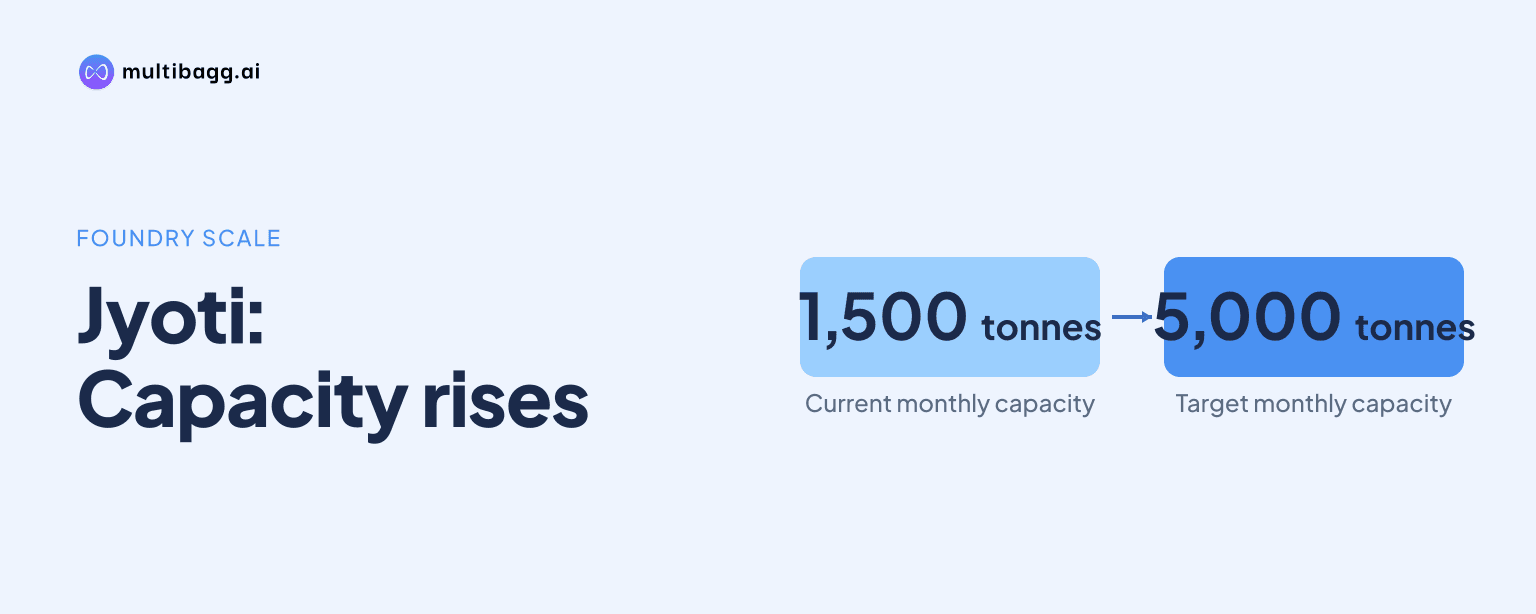
Jyoti CNC Automation Limited expects its new foundry to lift total capacity from 1,500 tonnes to 5,000 tonnes a month, with completion targeted within the quarter. The facility will use lost-foam vacuum casting and is intended to produce single-piece castings weighing up to 15 tonnes, management said during the earnings call.
Know Jyoti CNC Automation inside out
Results, valuation, peers and who's buying, in one view.
How much will Jyoti’s foundry capacity increase?
Jyoti’s total foundry capacity is set to increase by 3,500 tonnes a month, from 1,500 tonnes currently to 5,000 tonnes after the new facility is completed. Management specifically clarified that 5,000 tonnes a month is the combined total capacity, not an incremental addition to the existing foundry.
The planned capacity would be more than three times the current 1,500-tonne monthly level. An analyst asked whether total capacity would instead reach 20,000 tonnes a month, but management rejected that reading and restated the planned change as from 1,500 tonnes to 5,000 tonnes monthly.
Jyoti said machine assembly, sheet-metal operations and other activities at the new plant had already been put to use, while the foundry remained the final component. Management said the unfinished foundry was not creating a bottleneck for the company’s targets for the year, separating the broader plant start-up from the casting facility’s commissioning.
What casting technology will Jyoti use at the new foundry?
Jyoti will use lost-foam vacuum casting, which management described as a new technology area for the company’s planned application. The facility is intended to produce single castings of up to 15 tonnes, a scale management contrasted with the smaller components made by the few Indian foundries using the process.
The 15-tonne single-piece capability is the principal technical specification disclosed for the project. Management did not disclose the foundry’s capital cost, expected production yield, product mix, initial utilisation level or a timetable for the first commercial 15-tonne casting.
Management said all equipment for the lost-foam vacuum-casting installation was in transit and was expected to reach the site by the end of the month in which the call took place. Completion was expected within the quarter, leaving delivery, installation and commissioning as the immediate steps before the 5,000-tonne monthly capacity can be available.
Jyoti also said controllers would arrive over the next two years and were not included in the first year of its supply planning. Management said it expected existing suppliers to support its plan to maintain 25% to 30% growth over the next two to three years, while the foundry adds internal casting capacity.
Got a follow-up? Ask IRIS
When will Jyoti’s new foundry become operational?
Jyoti expects to complete the new foundry within the quarter, after equipment that was in transit reaches the site by month-end. Management did not provide a precise commissioning date, a commercial-production date or a target date for attaining the full 5,000-tonne monthly capacity.
The timing differs from the rest of the plant, where machine assembly and sheet-metal operations were already in use. Management said the foundry was on the last mile of completion, but also said there was no current production bottleneck against the company’s target for the year.
The commissioning target coincides with a planned rise in machine deliveries. Jyoti reported 3,317 machines in the first half of FY27 and said it expected more than 4,700 machines in the next two quarters, supporting management’s expectation that the company would cross 8,000 machines for the full year.
That delivery target compares with 5,600 machines in the previous full year. Management said it viewed 8,000 machines as a target requiring more than 50% growth, rather than as an easy objective, despite the first-half total of 3,317 machines.
How does the foundry fit Jyoti’s wider expansion plans?
Jyoti presented the foundry as part of its operating-capacity build-out, but did not disclose a dedicated budget for it. Separately, management outlined an electronics-component manufacturing project with a total projected cost of Rs 1,250 crore to Rs 1,300 crore, including Rs 1,020 crore for machinery.
Management said the first phase of the electronics project would involve Rs 400 crore to Rs 450 crore of investment over one year and could receive about Rs 200 crore of subsidy. It therefore put its own outlay for that first year at about Rs 200 crore, while stating that subsidies apply to machinery rather than land and buildings.
The call did not say that the new foundry is included in the Rs 1,250 crore to Rs 1,300 crore electronics project. The disclosed foundry details were its planned increase from 1,500 to 5,000 tonnes a month, lost-foam vacuum-casting technology, 15-tonne single-piece capacity and expected completion within the quarter.
Management said Jyoti and Huron combined were expected to grow by 25% to 30%, and it indicated that FY27 would be weighted 40% to the first half and 60% to the second half for revenue, earnings before interest, tax, depreciation and amortisation, and profit after tax. It also said operating cash flow was close to 47% of earnings before interest, tax, depreciation and amortisation and targeted 50% by year-end.
Conclusion
Jyoti’s planned foundry would increase total monthly casting capacity by 3,500 tonnes to 5,000 tonnes and add lost-foam vacuum casting for single pieces of up to 15 tonnes. The project complements a FY27 plan to cross 8,000 machine deliveries, compared with 5,600 machines in the prior full year, although management has not disclosed an initial utilisation target for the foundry.
The next disclosed milestone is the arrival of equipment by month-end and completion of the foundry within the quarter. Subsequent updates can clarify commissioning progress, commercial casting output and whether Jyoti advances toward management’s 25% to 30% combined Jyoti and Huron growth expectation and its 50% operating-cash-flow-to-earnings-before-interest-tax-depreciation-and-amortisation target by year-end.