










Jyoti deploys 110-plus engineers for in-house CNC controls
Key highlights
- Jyoti has more than 110 engineers in its dedicated CNC controller research and development team after 1.5 years of work.
- Jyoti plans to add 40 to 50 controller engineers in roughly six months, taking the team beyond 150 people.
- Jyoti has more than 200 designers in India, compared with 15 to 20 designers at Huron.
- Jyoti expects subsidies exceeding 50% on its Rs 1,020 crore controllers-and-drivers investment programme.
powered by IRIS
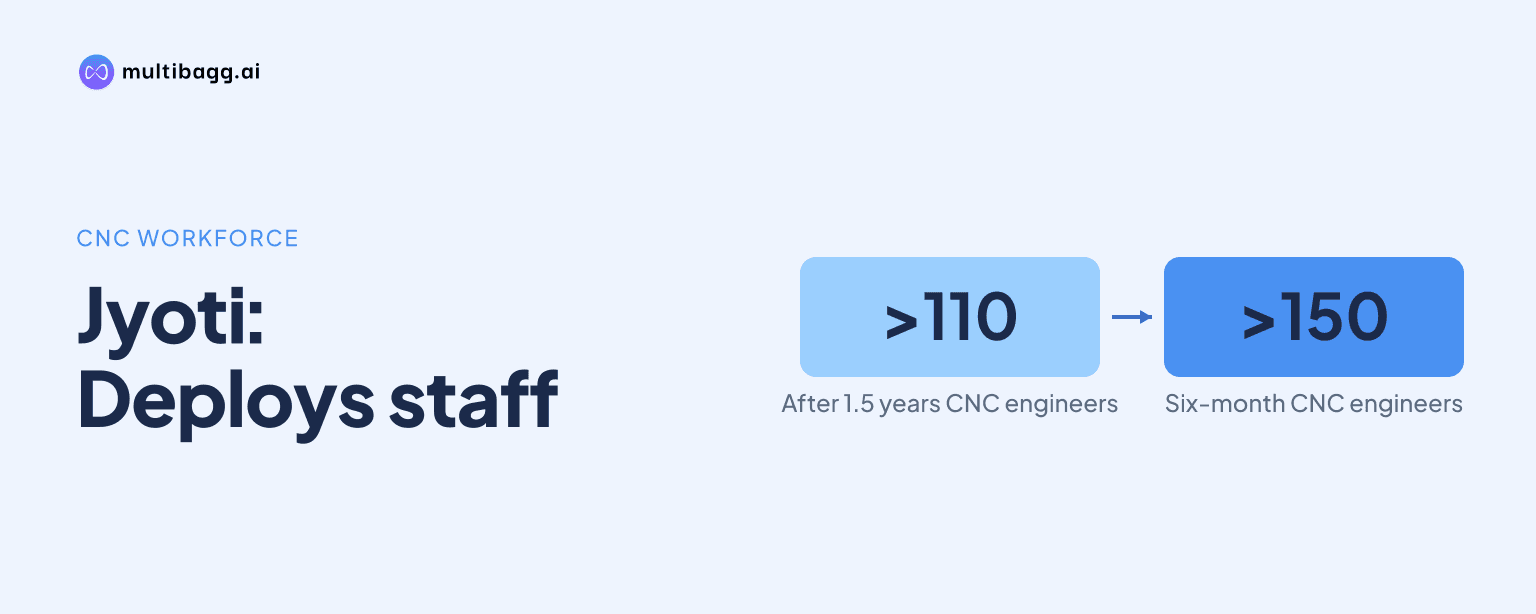
Jyoti has assigned more than 110 engineers to a dedicated CNC controller research and development team after 18 months of work, and management plans to add 40 to 50 engineers in roughly six months. The staffing plan supports Jyoti’s stated two-to-three-year effort to develop its electronics and become a mechatronics company.
Know Jyoti CNC Automation inside out
Results, valuation, peers and who's buying, in one view.
How large is Jyoti's CNC controller engineering team?
Jyoti’s controller division has more than 110 engineers working separately in its research and development centre after 1.5 years, according to management. It expects to add 40 to 50 engineers over the next roughly six months, which would take the dedicated controller-development team to more than 150 people.
The controller team is part of a wider domestic engineering base of more than 200 designers, compared with 15 to 20 designers at Huron. Management said some machines were designed by Huron jointly with Jyoti, but that the ownership of those designs remains with Jyoti.
Management did not disclose a separate research budget, product launch date or customer qualification timetable for the controller programme. It did say Jyoti added close to 950 people in the past six months, with the associated costs already booked while revenue from that expansion is still expected to come through.
What electronics does Jyoti plan to develop in-house?
Jyoti plans to develop its electronics over the next two to three years, including CNC controllers, drivers and servo motors. Management described this as a transition from a mechanical company that designs, makes and integrates machines to a mechatronics company combining mechanical equipment with electronics and controls.
After mechatronics, Jyoti intends to enter industrial automation, with robotics its first priority in that area, according to management. The company did not provide product specifications, expected controller revenue or a date for commercial deployment, so the disclosed plan remains an engineering and manufacturing initiative rather than a stated sales forecast.
Jyoti also said it is establishing a hardware manufacturing facility for the electronics programme, although management gave no capacity, cost or commissioning date. Separately, it described a Rs 1,020 crore investment programme for controllers and drivers, including nearly Rs 255 crore of central-government subsidy and an expectation that combined support could exceed 50% after state approval.
The controller investment sits alongside Jyoti’s FY27 capital expenditure programme, where management said Rs 183 crore, including advances, had been spent. Total FY27 outlay is projected at about Rs 450 crore to Rs 500 crore, with the foundry in its final stage while machine assembly and sheet-metal facilities are already in use.
Got a follow-up? Ask IRIS
Why does Jyoti think it can build CNC controllers?
Jyoti’s confidence is based on its engineering recruitment, customer base and management’s view that artificial intelligence can speed software development. Management said artificial intelligence has increased coding speed and output quality compared with the long development cycles that established controller suppliers have historically built over decades.
An analyst noted that relatively few global companies have developed commercially accepted controllers, citing Siemens and FANUC as established suppliers. Management acknowledged that customer acceptance remains a challenge, but said Jyoti has more than 15,000 customers and that about one-third are highly loyal customers who may accept trials of its products.
The company is pursuing the programme while scaling machine production. Management expects Jyoti to cross 8,000 machines in FY27 after delivering 3,317 machines in the first half, with more than 4,700 machines expected in the next two quarters.
Management said average machine realisation was about Rs 32 lakh in the quarter and that Rs 32 lakh to Rs 35 lakh had been its indicated range. It said machine volumes have become more important after capacity additions, while its comments on current product mix and margins did not establish the future cost or pricing of internally developed controllers.
What could affect Jyoti's controller rollout?
Jyoti is developing internal controls as it sees tighter external controller supply. Management said delivery times from controller suppliers had more than doubled amid higher global machine-tool order intake, citing Japan, Germany, Italy and the United States and linking demand to artificial intelligence and data-centre capacity investment.
Management said safety inventories and prior planning had allowed Jyoti to maintain growth despite those supply conditions. It added that it was not facing French dual-use licence challenges for machines made in India, although end-user certificate approvals on the French side were taking longer.
Production capacity and working capital could also affect the pace of testing and execution. Management said a former 1,500-machine capacity had supported execution of 1,900 machines, and it expects a further improvement over the next two quarters as additional capacity ramps up.
Inventory days had improved to close to 190 days from 203 days at the March level, according to management, which expects a further reduction by the financial year-end. On Huron, management said it responded to a notice received in the first week of April and had received no further communication, describing the position as status quo.
Conclusion
Jyoti has disclosed a substantial dedicated engineering commitment to its in-house controller project: more than 110 engineers after 18 months, with 40 to 50 more planned. The effort combines controller software, drivers, servo motors and planned hardware manufacturing as Jyoti seeks to move from mechanical machine production into mechatronics and, subsequently, industrial automation.
The next disclosed milestones are the planned hiring over roughly six months, progress on the hardware facility and the two-to-three-year electronics-development plan. Management also expects state support to lift subsidies beyond 50% of the Rs 1,020 crore programme, while the foundry’s completion and the FY27 target of more than 8,000 machines remain operational markers to watch.