










Jyoti CNC lifts Q2 standalone EBITDA margin to 27.9%
Key highlights
- Jyoti CNC’s Q2FY27 standalone revenue increased 31.1% to Rs 587.5 crore.
- Jyoti CNC’s Q2FY27 standalone EBITDA margin rose 320 basis points to 27.9%.
- Jyoti CNC’s Q2FY27 standalone profit after tax increased 45.6% to Rs 114.9 crore.
- Jyoti CNC reported a Rs 5,082 crore order book as of September 30, 2026.
powered by IRIS
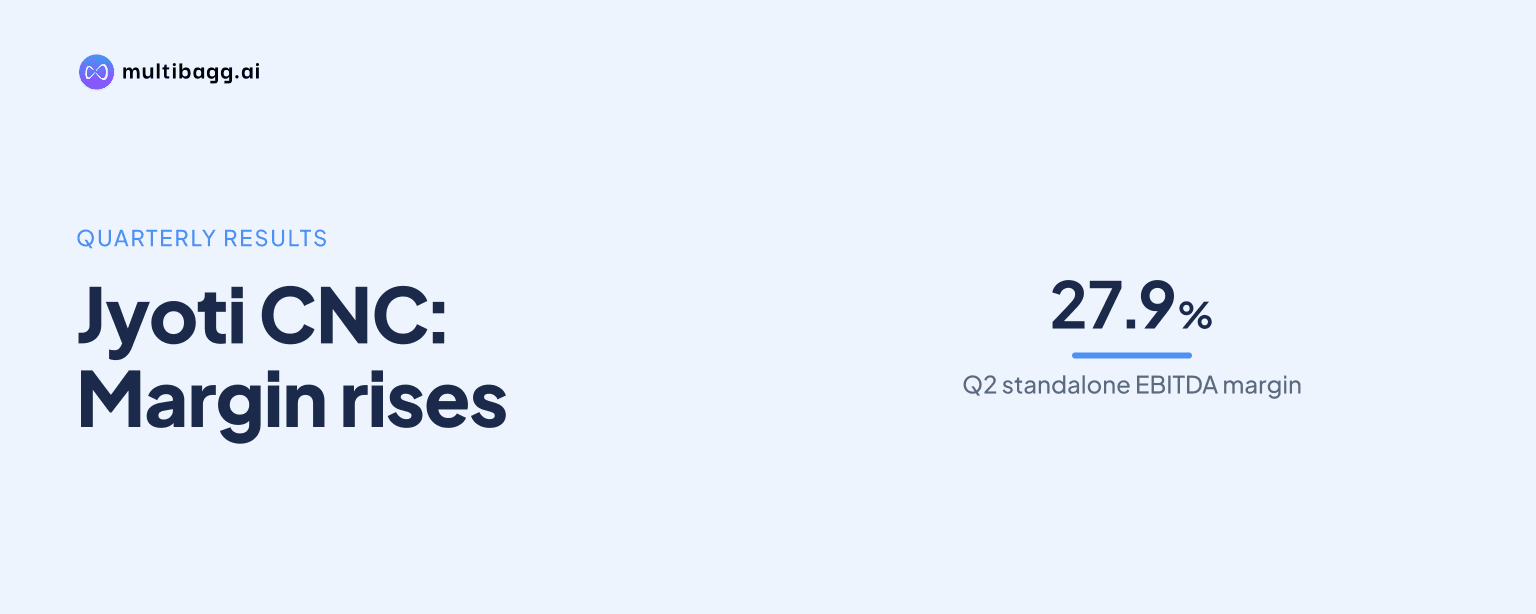
Jyoti CNC Automation Limited lifted standalone earnings before interest, tax, depreciation and amortisation (EBITDA) margin to 27.9% in Q2FY27, up 320 basis points from a year earlier, as revenue from operations rose 31.1% to Rs 587.5 crore and EBITDA increased 48.3% to Rs 163.9 crore. Gross and net profit margins also increased in the quarter.
Know Jyoti CNC Automation inside out
Results, valuation, peers and who's buying, in one view.
How did Jyoti CNC perform on standalone revenue and profit?
Jyoti CNC reported standalone revenue growth of 31.1% and profit after tax growth of 45.6% in Q2FY27. Revenue from operations rose from Rs 448.2 crore in Q2FY26 to Rs 587.5 crore, while profit after tax increased from Rs 78.9 crore to Rs 114.9 crore.
EBITDA rose by Rs 53.4 crore to Rs 163.9 crore in Q2FY27, compared with a Rs 139.3 crore increase in revenue. Gross profit increased 40.1% to Rs 324.8 crore from Rs 231.9 crore, exceeding the reported rate of sales growth.
Sequentially, Q2FY27 revenue was 15.4% higher than Rs 509.1 crore in Q1FY27, while EBITDA was 18.2% above Rs 138.7 crore. Profit after tax was Rs 114.9 crore, 31.3% higher than Rs 87.5 crore in Q1FY27.
Why did Jyoti CNC’s Q2 standalone margins expand?
Jyoti CNC’s reported Q2FY27 margin expansion coincided with gross profit growing faster than revenue and cost of goods sold growing more slowly. Gross profit margin rose to 55.3% from 51.7% in Q2FY26, a 360-basis-point increase, while cost of goods sold increased to Rs 262.7 crore from Rs 216.4 crore.
EBITDA margin increased to 27.9% from 24.7% a year earlier and from 27.2% in Q1FY27. Employee cost rose to Rs 76.4 crore from Rs 60.9 crore, and other expenses increased to Rs 84.6 crore from Rs 60.5 crore, while EBITDA rose to Rs 163.9 crore from Rs 110.5 crore.
Profit before tax margin reached 24.9%, compared with 22.9% in Q2FY26 and 21.7% in Q1FY27. Profit after tax margin rose to 19.6% from 17.6% a year earlier, despite depreciation increasing to Rs 12.9 crore from Rs 8.9 crore and finance cost increasing to Rs 8.8 crore from Rs 8.5 crore.
How did H1FY27 standalone margins compare with the previous year?
Jyoti CNC’s first-half FY27 standalone EBITDA margin was 27.6%, up 210 basis points from 25.5% in H1FY26. First-half revenue from operations increased 33.6% to Rs 1,096.6 crore, while EBITDA grew 44.7% to Rs 302.5 crore.
Gross profit margin rose 290 basis points to 54.1%, with gross profit up 41.3% to Rs 593.5 crore from Rs 419.9 crore. In contrast, profit after tax margin increased only 10 basis points to 18.5%, although profit after tax rose 34.0% to Rs 202.3 crore.
The presentation recorded H1FY27 finance cost of Rs 28.8 crore, against Rs 15.4 crore in H1FY26, while other income fell to Rs 7.7 crore from Rs 23.9 crore. These reported below-EBITDA items coincided with the smaller movement in first-half profit after tax margin relative to the EBITDA-margin increase.
Got a follow-up? Ask IRIS
How did Jyoti CNC’s consolidated results differ from standalone results?
Jyoti CNC’s consolidated Q2FY27 results showed revenue growth but lower EBITDA and profit margins than the prior-year quarter. Consolidated revenue rose 18.5% to Rs 602 crore from Rs 507.9 crore, while EBITDA increased 5.4% to Rs 131.3 crore.
Consolidated EBITDA margin declined to 21.8% from 24.5%, a 270-basis-point reduction, even as gross profit margin rose to 57.3% from 56.0%. Employee cost increased to Rs 106.7 crore from Rs 86.5 crore and other expenses rose to Rs 107 crore from Rs 73.4 crore.
Consolidated profit after tax declined 15.1% to Rs 72.6 crore from Rs 85.5 crore, and its margin fell to 12.1% from 16.8%. For H1FY27, consolidated revenue was up 21.0% to Rs 1,110.5 crore, while EBITDA margin was down 290 basis points to 21.6% and profit after tax declined 17.3% to Rs 129.7 crore.
What operating and order-book indicators did Jyoti CNC report?
Jyoti CNC reported record quarterly dispatches of 1,900 machines in Q2FY27 and an order book of Rs 5,082 crore as of September 30, 2026. The order book was Rs 4,848 crore on June 30, 2026, with Q2FY27 order intake of Rs 809 crore and order execution of Rs 575 crore.
Aerospace and defence represented 36% of the September 2026 order book, followed by auto and auto components at 22%, general engineering at 21%, and electronics manufacturing services (EMS) at 12%. Q2FY27 order intake had a different mix, with auto and auto components representing 50%, general engineering 27%, and aerospace and defence 13%.
Jyoti CNC also disclosed approval for Rs 1,020.65 crore of investment over five years at its Rajkot facility under the programme labelled ECMS in the presentation. The company said the investment is eligible for a capital subsidy of up to 25% and that it had applied for an additional matching subsidy under a Gujarat government scheme.
On a consolidated basis, net cash from operating activities was Rs 111.7 crore in the half year ended September 2026, compared with Rs 13.2 crore in the corresponding prior period. Operating cash flow to EBITDA conversion was 47% in H1FY27 versus 6% in H1FY26, and management said this momentum would continue.
Conclusion
Jyoti CNC’s Q2FY27 standalone performance paired 31.1% revenue growth with gross-margin, EBITDA-margin and profit-after-tax-margin expansion. The standalone EBITDA margin reached 27.9%, but the consolidated accounts showed a different result: EBITDA margin declined to 21.8% and consolidated profit after tax fell 15.1%.
The next reported markers are execution of the Rs 5,082 crore order book, dispatches following the Q2FY27 record of 1,900 machines, and progress on the five-year Rs 1,020.65 crore Rajkot investment. Management’s stated expectation for continued operating-cash-flow-to-EBITDA conversion momentum is also a disclosed item to watch.