










Jyoti CNC consolidated H1 profit fell 17% despite revenue growth
Key highlights
- Jyoti CNC’s consolidated H1FY27 revenue increased 21.0% to Rs 1,110.5 crore.
- Jyoti CNC’s consolidated H1FY27 PAT fell 17.3% to Rs 129.7 crore.
- Jyoti CNC’s consolidated H1FY27 EBITDA margin declined 290 basis points to 21.6%.
- Jyoti CNC reported a Rs 5,082 crore order book at September 30, 2026.
powered by IRIS
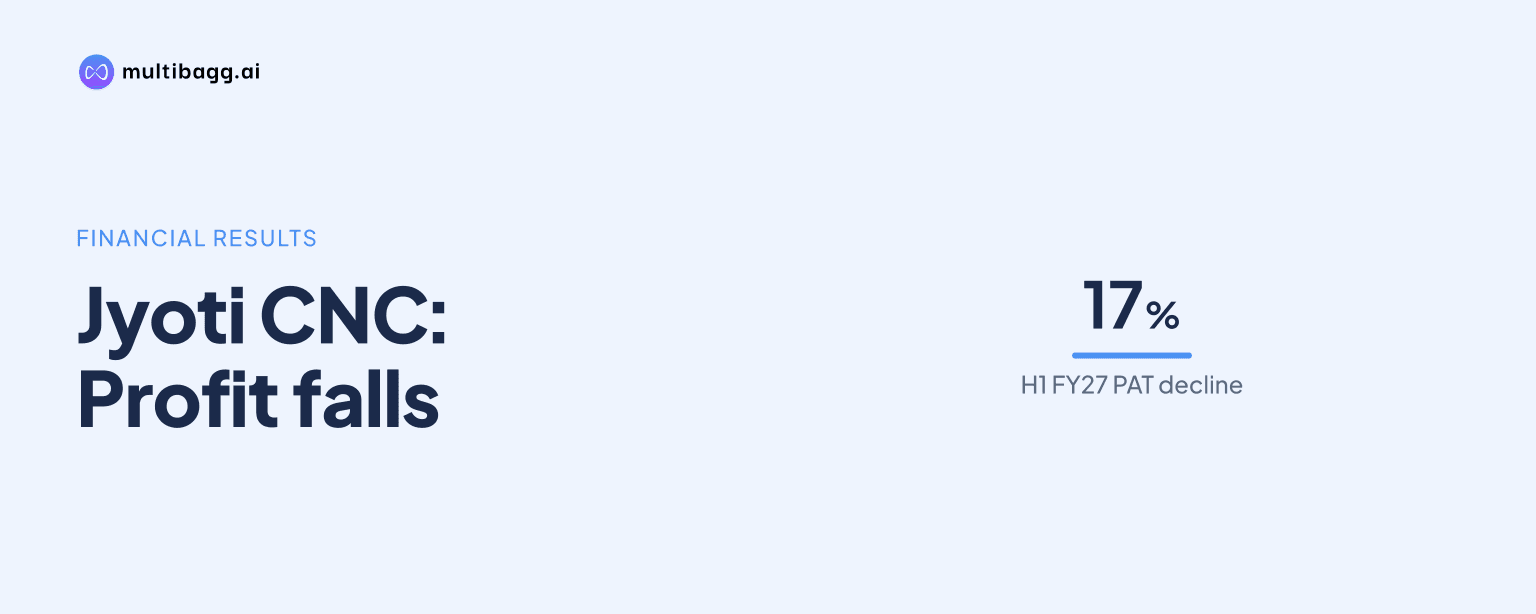
Jyoti CNC reported a 17.3% year-on-year fall in consolidated profit after tax (PAT) to Rs 129.7 crore in H1FY27, despite revenue from operations rising 21.0% to Rs 1,110.5 crore, as earnings before interest, tax, depreciation and amortisation (EBITDA) rose only 6.8% and PAT margin fell 540 basis points to 11.7%.
Know Jyoti CNC Automation inside out
Results, valuation, peers and who's buying, in one view.
Why did Jyoti CNC’s consolidated H1FY27 profit fall?
Jyoti CNC’s consolidated PAT declined because operating expenses grew faster than gross profit, while depreciation rose, other income fell and finance cost increased. Revenue increased by Rs 192.4 crore from Rs 918.1 crore in H1FY26, and gross profit increased by Rs 126.9 crore to Rs 640.9 crore. Employee cost rose by Rs 41.0 crore to Rs 200.0 crore, while other expenses increased by Rs 70.5 crore to Rs 200.7 crore.
These cost movements limited EBITDA growth to Rs 15.4 crore, taking H1FY27 EBITDA to Rs 240.2 crore from Rs 224.8 crore. Depreciation increased to Rs 31.0 crore from Rs 22.7 crore, other income fell to Rs 6.3 crore from Rs 29.6 crore, and finance cost rose to Rs 38.3 crore from Rs 26.4 crore. Profit before tax consequently fell 13.7% to Rs 177.1 crore, while tax declined slightly to Rs 47.4 crore from Rs 48.4 crore.
How did Jyoti CNC’s consolidated margins change in H1FY27?
Jyoti CNC’s gross margin improved in H1FY27, but EBITDA and PAT margins contracted. Gross profit margin increased by 170 basis points to 57.7% from 56.0% in H1FY26. EBITDA margin declined by 290 basis points to 21.6% from 24.5%, while PAT margin declined by 540 basis points to 11.7% from 17.1%.
The Q2FY27 result followed the same pattern. Consolidated revenue increased 18.5% to Rs 602.0 crore from Rs 507.9 crore in Q2FY26, and gross margin rose to 57.3% from 56.0%. However, EBITDA rose 5.4% to Rs 131.3 crore and its margin fell to 21.8% from 24.5%; PAT declined 15.1% to Rs 72.6 crore and its margin fell to 12.1% from 16.8%.
How did Jyoti CNC’s standalone performance compare with consolidated results?
Jyoti CNC’s standalone results increased across revenue, EBITDA and PAT in H1FY27, unlike the consolidated outcome. Standalone revenue grew 33.6% to Rs 1,096.6 crore from Rs 820.5 crore, EBITDA increased 44.7% to Rs 302.5 crore, and PAT rose 34.0% to Rs 202.3 crore. Standalone EBITDA margin increased by 210 basis points to 27.6%, while PAT margin increased by 10 basis points to 18.5%.
The reported difference was substantial despite the small revenue gap. Consolidated revenue of Rs 1,110.5 crore was Rs 13.9 crore higher than standalone revenue, but consolidated EBITDA of Rs 240.2 crore was Rs 62.3 crore below standalone EBITDA. Consolidated PAT of Rs 129.7 crore was Rs 72.6 crore below standalone PAT. The presentation does not identify the entity-level cause of this difference.
Got a follow-up? Ask IRIS
What changed in Jyoti CNC’s revenue mix and order book?
Jyoti CNC’s H1FY27 consolidated revenue mix shifted toward auto and auto components, which represented 36% of Rs 1,110 crore revenue, compared with 31% of Rs 918 crore in H1FY26. Aerospace and defence represented 28%, down from 34%, while general engineering remained at 23%. Electronic manufacturing services (EMS) increased to 6% from 3%, while other industries declined to 5% from 8%.
Jyoti CNC reported an order book of Rs 5,082 crore at September 30, 2026, compared with Rs 4,848 crore at June 30, 2026. Order intake was Rs 809 crore and order execution was Rs 575 crore during the period. Aerospace and defence represented 36% of the closing order book, followed by auto and auto components at 22%, general engineering at 21%, EMS at 12%, die-mould at 4% and others at 7%.
Q2FY27 order intake was more concentrated in auto and auto components than the closing order book. Auto and auto components accounted for 50% of intake, compared with 22% of the September 2026 order book, while general engineering represented 27% and aerospace and defence represented 13%. The presentation describes the Rs 5,082 crore order book as diversified across industries.
What do Jyoti CNC’s cash flow, balance sheet and investment plan show?
Jyoti CNC generated net cash from operating activities of Rs 111.7 crore in the period ended September 2026, compared with Rs 13.2 crore in September 2025. Cash generated from operations increased to Rs 149.0 crore from Rs 43.8 crore as the working-capital outflow narrowed to Rs 108.7 crore from Rs 184.1 crore. Operating-cash-flow-to-EBITDA conversion was 47% in H1FY27, compared with 6% in H1FY26.
Investing activities used Rs 193.5 crore in the September 2026 period, compared with Rs 144.7 crore a year earlier, and cash and cash equivalents ended at Rs 26.7 crore, down from Rs 52.9 crore at March 2026. Total assets increased to Rs 3,980.3 crore from Rs 3,615.3 crore, including inventories of Rs 1,440.5 crore versus Rs 1,166.0 crore. Non-current borrowings rose to Rs 511.9 crore from Rs 410.2 crore, while current borrowings declined to Rs 431.0 crore from Rs 439.5 crore.
Jyoti CNC also disclosed approval for an Rs 1,020.65 crore investment over five years at its Rajkot facility under the Electronics Components Manufacturing Scheme. The presentation says the investment is eligible for a capital subsidy of up to 25%, and that Jyoti CNC has applied for an additional matching subsidy under a Gujarat government scheme. The source does not quantify the investment’s future effect on revenue, costs or consolidated profitability.
Conclusion
Jyoti CNC’s H1FY27 consolidated result showed top-line growth without matching earnings growth. Revenue increased 21.0% and gross margin improved by 170 basis points, but employee cost and other expenses limited EBITDA growth to 6.8%. Higher depreciation and finance cost, together with lower other income, contributed to the 17.3% PAT decline, while the standalone business reported 34.0% PAT growth.
The main disclosed markers to watch are the Rs 5,082 crore order book at September 30, 2026, the 47% operating-cash-flow-to-EBITDA conversion in H1FY27, and the Rs 1,020.65 crore five-year Rajkot investment plan. Management said cash-conversion momentum is expected to continue, but the presentation does not provide an earnings target or a timetable for the investment’s impact on consolidated results.