










Jyoti CNC H1 consolidated PAT falls 17% as margins contract
Key highlights
- Jyoti CNC's consolidated H1FY27 revenue rose 21.0% to Rs 1,110.5 crore.
- Jyoti CNC's consolidated H1FY27 PAT fell 17.3% to Rs 129.7 crore.
- Jyoti CNC's consolidated EBITDA margin declined to 21.6% from 24.5% in H1FY26.
- Jyoti CNC's order book reached Rs 5,082 crore on 30 September 2026.
powered by IRIS
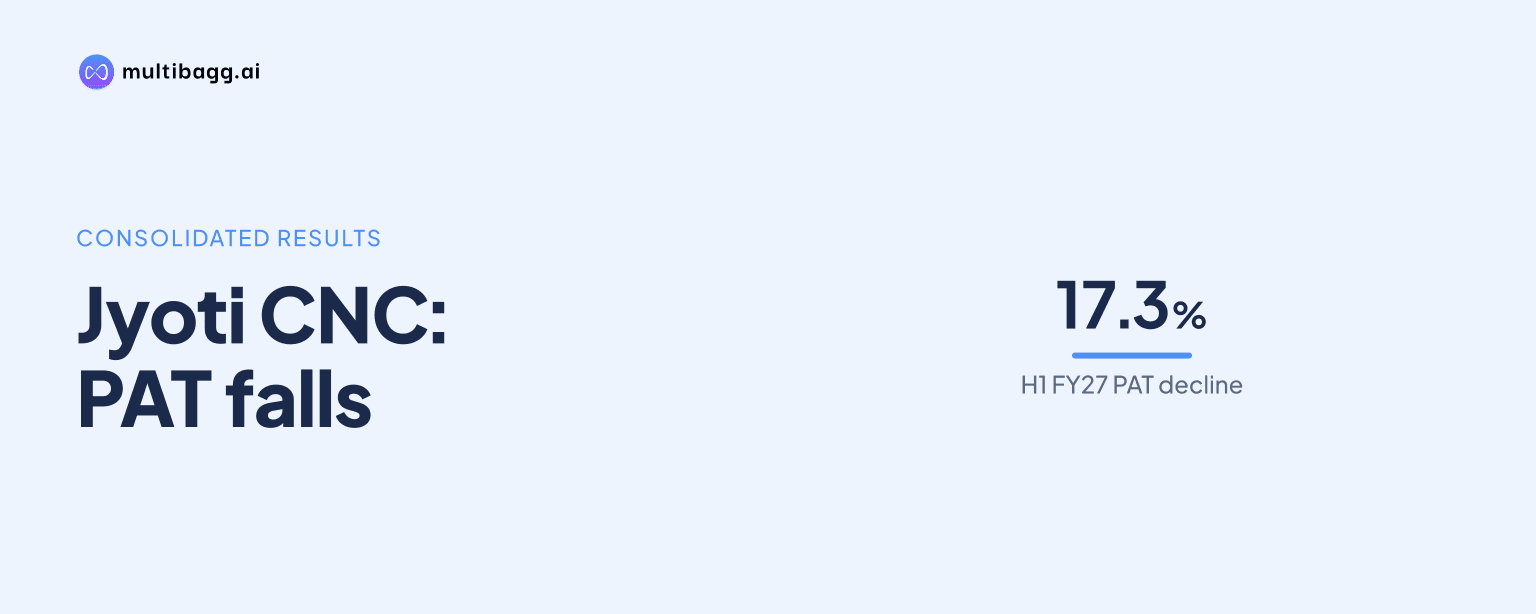
Jyoti CNC reported consolidated profit after tax (PAT) of Rs 129.7 crore in H1FY27, down 17.3% year on year, although revenue from operations rose 21.0% to Rs 1,110.5 crore and gross profit margin increased to 57.7% from 56.0%. Higher operating expenses, depreciation, finance costs and lower other income reduced earnings below the gross-profit line.
Know Jyoti CNC Automation inside out
Results, valuation, peers and who's buying, in one view.
Why did Jyoti CNC's consolidated PAT fall in H1FY27?
Jyoti CNC's consolidated PAT fell because growth in gross profit did not translate into comparable growth in earnings before interest, tax, depreciation and amortisation (EBITDA), while expenses after EBITDA also moved adversely. Revenue increased by Rs 192.4 crore from Rs 918.1 crore in H1FY26 to Rs 1,110.5 crore in H1FY27. Gross profit rose Rs 126.9 crore to Rs 640.9 crore, a 24.7% increase that exceeded the 21.0% revenue increase, lifting gross margin by 170 basis points, where one basis point equals one-hundredth of a percentage point.
However, EBITDA rose only 6.8% to Rs 240.2 crore from Rs 224.8 crore, and its margin declined 290 basis points to 21.6% from 24.5%. Depreciation increased to Rs 31.0 crore from Rs 22.7 crore, other income fell to Rs 6.3 crore from Rs 29.6 crore, and finance cost rose to Rs 38.3 crore from Rs 26.4 crore. As a result, profit before tax declined 13.7% to Rs 177.1 crore and PAT margin fell 540 basis points to 11.7% from 17.1%.
How did expenses affect Jyoti CNC's consolidated margins?
Jyoti CNC's employee and other expenses absorbed much of the Rs 126.9 crore rise in H1 gross profit. Employee cost increased Rs 41.0 crore to Rs 200.0 crore from Rs 159.0 crore, while other expenses increased Rs 70.5 crore to Rs 200.7 crore from Rs 130.2 crore. Together, these two expense lines rose Rs 111.5 crore, compared with the Rs 15.4 crore increase in EBITDA.
The margin pattern was also evident in the second quarter. Q2FY27 consolidated gross profit margin was 57.3%, up from 56.0% in Q2FY26, but EBITDA margin decreased to 21.8% from 24.5%. Q2 PAT was Rs 72.6 crore, down 15.1% from Rs 85.5 crore, and PAT margin decreased to 12.1% from 16.8%. The presentation provides the reported cost lines but does not identify the specific business or accounting reasons for their increases.
How different were Jyoti CNC's standalone results?
Jyoti CNC's standalone results showed profit growth, unlike the consolidated accounts. Standalone H1FY27 revenue rose 33.6% to Rs 1,096.6 crore, EBITDA increased 44.7% to Rs 302.5 crore, and PAT increased 34.0% to Rs 202.3 crore. Standalone EBITDA margin rose to 27.6% from 25.5%, while PAT margin was 18.5%, marginally above 18.4% in H1FY26.
The divergence is substantial in the reported H1FY27 profit figures: consolidated PAT was Rs 129.7 crore while standalone PAT was Rs 202.3 crore. Consolidated EBITDA was Rs 240.2 crore, compared with standalone EBITDA of Rs 302.5 crore, despite consolidated revenue of Rs 1,110.5 crore being slightly above standalone revenue of Rs 1,096.6 crore. The presentation reports both sets of accounts but does not provide a reconciliation explaining the differences between them.
Got a follow-up? Ask IRIS
What changed in Jyoti CNC's revenue mix and order book?
Jyoti CNC's consolidated H1FY27 revenue mix shifted toward auto and auto components, which accounted for 36% of Rs 1,110 crore revenue, compared with 31% of Rs 918 crore in H1FY26. Aerospace and defence represented 28%, down from 34%, while general engineering held at 23%. Electronics manufacturing services, or EMS, increased to 6% from 3%, and die and moulds declined to 1% from 2%.
The order book increased to Rs 5,082 crore at 30 September 2026 from Rs 4,848 crore at 30 June 2026. Jyoti CNC recorded Rs 809 crore of order intake and executed Rs 575 crore during Q2FY27. Aerospace and defence comprised 36% of the closing order book, followed by auto and auto components at 22%, general engineering at 21%, and EMS at 12%; Q2 intake was led by auto and auto components at 50%.
What do cash flow and the balance sheet show for Jyoti CNC?
Jyoti CNC generated net cash from operating activities of Rs 111.7 crore in the period to September 2026, compared with Rs 13.2 crore a year earlier. The presentation reported operating cash flow, or OCF, to EBITDA conversion of 47% in H1FY27 versus 6% in H1FY26. Cash generated from operations before taxes was Rs 149.0 crore, while working-capital changes used Rs 108.7 crore.
Investment cash outflow was Rs 193.5 crore in the period to September 2026, compared with Rs 144.7 crore in the prior-year period, and cash and cash equivalents ended at Rs 26.7 crore versus Rs 83.4 crore. On the consolidated balance sheet, inventories rose to Rs 1,440.5 crore in September 2026 from Rs 1,166.0 crore in March 2026. Non-current borrowings increased to Rs 511.9 crore from Rs 410.2 crore, while current borrowings declined to Rs 431.0 crore from Rs 439.5 crore.
Conclusion
Jyoti CNC's consolidated H1FY27 figures show that a 21.0% increase in revenue and a 170-basis-point improvement in gross margin were offset by higher employee costs, other expenses and depreciation, alongside lower other income and higher finance costs. This left EBITDA up 6.8% at Rs 240.2 crore but reduced PAT by 17.3% to Rs 129.7 crore, in contrast with the 34.0% standalone PAT increase to Rs 202.3 crore.
The next disclosed operating indicators are delivery against the Rs 5,082 crore order book at 30 September 2026 and the cash conversion trend, after H1FY27 OCF-to-EBITDA conversion reached 47%. Management also disclosed approval for Rs 1,020.65 crore of investment over five years at its Rajkot facility under the ECMS, with eligibility for up to a 25% capital subsidy and an application for a matching Gujarat government subsidy.