










Jyoti says controller delays doubled but inventory protects plan
Key highlights
- Jyoti says global CNC controller delivery times have more than doubled as supplier capacity is fully booked.
- Inventory days improved from 203 in March to close to 190 at the six-month point.
- Jyoti continues to target more than 8,000 machine deliveries in FY27 after 5,600 in the prior full year.
- Jyoti plans Rs 1,020 crore of investment in controller and electronics development over four to five years.
powered by IRIS
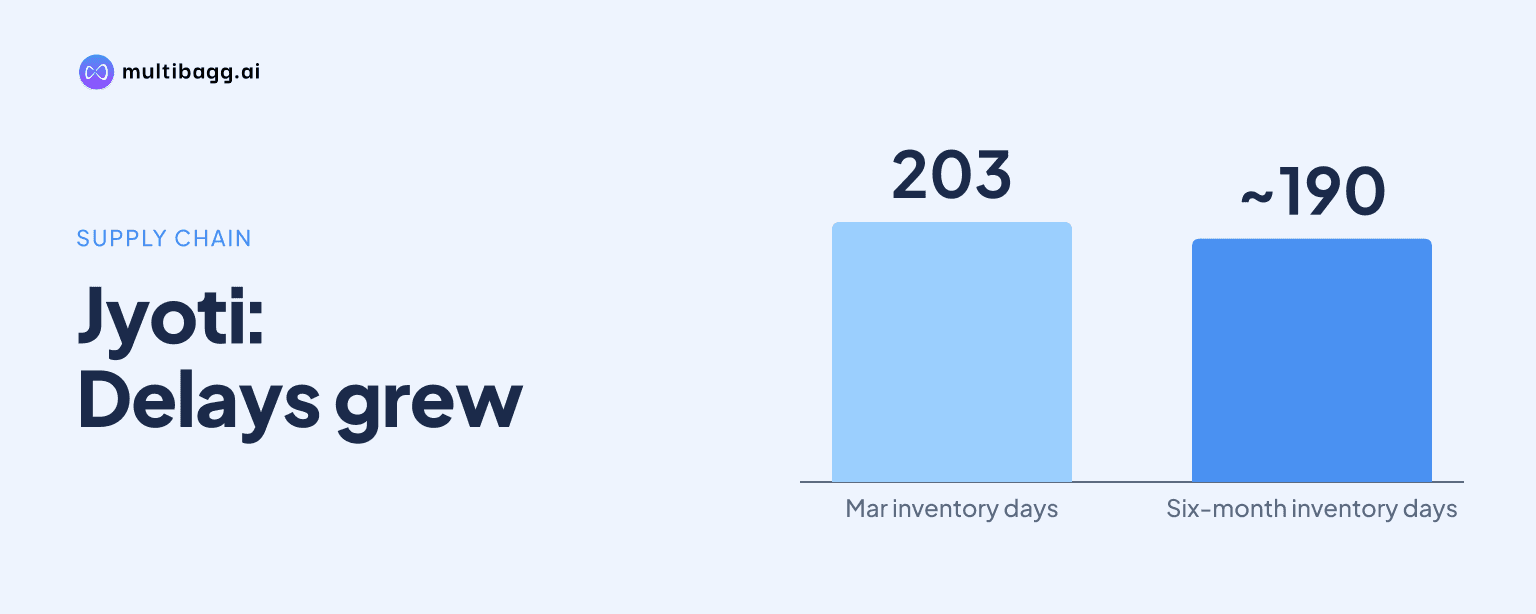
Jyoti says global computer numerical control (CNC) controller delivery times more than doubled as worldwide machine-tool demand filled supplier capacity, but safety inventories support its FY27 plan to exceed 8,000 machine deliveries. Management said inventory days had improved from 203 in March to close to 190 at the six-month point.
Know Jyoti CNC Automation inside out
Results, valuation, peers and who's buying, in one view.
Why have CNC controller delivery times risen for Jyoti?
Jyoti says controller delivery times have more than doubled because global machine-tool order intake has increased and suppliers are fully booked. Management linked the pressure to artificial intelligence and data-centre-related capacity additions, which it said have absorbed supplier capacity that previously served machine-tool makers. It did not disclose controller lead times in days or months.
Management identified Japan, Germany, Italy and the US as markets with higher machine-tool demand. It said Japan’s order-book intake had risen by more than 60% month on month during the prior six months, without providing an absolute order value or precise reporting months. CNC controllers are a critical component for Jyoti’s entry-level, mid-level and high-end machine ranges.
The constraint is a supply-side issue rather than a reported decline in customer demand. Management described the position as challenging but said it had planned capacity additions, inventory and safety factors in advance. Jyoti therefore retained its FY27 target to exceed 8,000 machines, compared with 5,600 machines in the preceding full year.
How is Jyoti protecting its FY27 production plan?
Jyoti says advance inventory planning has protected its near-term production ramp despite longer controller deliveries. Management said its safety inventories and capacity preparations allowed production growth to continue rather than being reduced by component availability. It did not disclose the number of controllers in stock or the duration of coverage.
Inventory days improved from 203 in March to close to 190 at the six-month point, according to management. It expects the measure to decline further by the end of FY27 while retaining stock for long-lead components. That outlook depends on material consumption and execution continuing to exceed any additional inventory build.
Capacity additions are also part of the response. Management said Jyoti had a capacity of 1,500 machines but executed 1,900 machines, indicating that new capacity was already being used. It said 3,317 machines had been completed by the call and projected close to 4,700-plus machines in the next two quarters, supporting the full-year target above 8,000 machines.
Will licensing delays or Huron affect Jyoti’s execution?
Jyoti says French end-user certificate and dual-use licence approvals are taking longer, but the issue is not directly connected to the CNC controller supply constraint. Management attributed slower approvals to the war-related environment in France and said it was not facing comparable challenges for machines made in India. It also said there had been no communication after its response to a Huron notice received in the first week of April.
An analyst proposed Rs 80 crore to Rs 100 crore of Huron dispatches in Q3 within a Rs 300 crore guidance framework, followed by a further Q4 ramp-up, and management agreed with that understanding. Management said approvals had started arriving, enabling dispatches during the quarter. The figures are an analyst framing endorsed by management, not reported Q3 dispatches.
An analyst also said Rs 60 crore of Huron revenue had not been recognised in the first half, and management said it would be covered in H2. The analyst estimated that recognising this revenue could increase consolidated earnings before interest, tax, depreciation and amortisation (EBITDA) margin by 3% to 4%, which management said was correct. This outcome remains dependent on H2 recognition and dispatch execution.
Got a follow-up? Ask IRIS
Can Jyoti reduce dependence on outside controller suppliers?
Jyoti plans to develop controllers, drives and related electronics internally over the next two years as it seeks to become a mechatronics company rather than only a mechanical company. Management said margin gains and operating leverage would be invested in research and development, followed by industrial automation, with robotics the first priority. This is a development plan, not evidence of commercial production of internally developed controllers.
The programme has a planned investment of Rs 1,020 crore over four to five years. Management said it had received close to Rs 255 crore of central-government subsidy and expects a matching Gujarat government grant, including possible research and development support, to bring subsidies above 50% of planned investment. The Gujarat grant had not been sanctioned at the time of the call.
Jyoti said more than 110 people had worked in its controller research and development centre after about 1.5 years of development. Management expects to add 40 to 50 engineers over the next six months, taking the team beyond 150 people. It acknowledged customer acceptance as a challenge but cited a customer base of more than 15,000, with about one-third described by management as highly loyal customers able to test products.
What could change Jyoti’s supply-chain outlook?
Jyoti’s output plan depends on its inventory buffer lasting through the planned ramp-up while external controller lead times remain extended. Management said machine assembly and sheet-metal operations at the new plant were already in use, while the foundry was at its last-mile stage. It said there was no production bottleneck against the FY27 output target at the time of the call.
The company added close to 950 people during the prior six months, with the associated costs already booked before corresponding revenue fully arrives. Management expects operating leverage as volumes increase and continues to target a 25% EBITDA margin by the end of FY27. That target is management guidance and depends on volume execution, Huron dispatches and component availability.
Conclusion
Jyoti’s supply-chain position is defined by a clear near-term trade-off: global machine-tool demand has extended CNC controller deliveries, while its planned inventories and newly used capacity have so far protected production. Inventory days fell from 203 in March to close to 190 at the six-month point, and management maintained its FY27 target to exceed 8,000 machines.
The next disclosed markers are completion of the foundry’s final stage, delivery of close to 4,700-plus machines over the next two quarters and progress in controller availability. Management also expects the Gujarat subsidy decision, the addition of 40 to 50 controller engineers within six months and Huron dispatches in Q3 to shape execution through FY27.