










Solex Energy targets 10 GW module capacity by FY30 roadmap
Key highlights
- Solex Energy reached 4 GW of module capacity in November 2025.
- Solex Energy targets 10 GW of module capacity by FY30.
- Solex Energy plans to commission a 2.2 GW N-Type TOPCon cell line in 2027.
- Solex Energy reported order-book visibility above Rs 4,000 crore as of September 30, 2026.
powered by IRIS
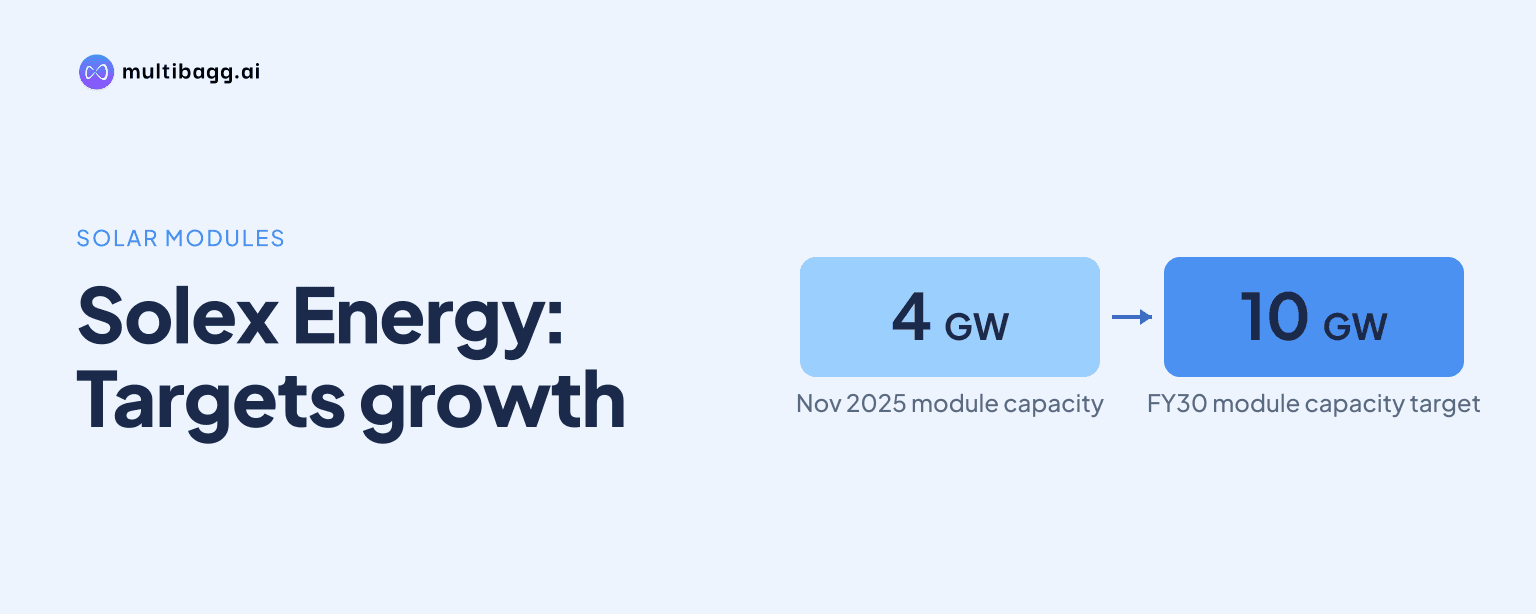
Solex Energy Ltd. targets 10 GW of solar-module capacity by FY30, up from 4 GW achieved in November 2025, while planning an integrated platform spanning solar cells, ingot and wafer, and battery energy storage systems. The supplied presentation does not disclose a $1.5 billion capital-expenditure budget.
Know Solex Energy inside out
Results, valuation, peers and who's buying, in one view.
What capacity is Solex Energy targeting by FY30?
Solex Energy is targeting 10 GW of module capacity by FY30, which would add 6 GW to the 4 GW platform it says was achieved in November 2025. Modules remain the company’s core business, with the Tapi-R, Tapi Trans, Tapi, Tapi Black and Tapi RC product lines listed in its presentation.
The FY30 module roadmap includes rear-contact and heterojunction, or HJT, technologies, alongside the current P-Type Mono PERC and N-Type tunnel oxide passivated contact, or TOPCon, offerings. Solex Energy also says its manufacturing facility uses automated high-speed production lines, artificial intelligence and automated optical inspection, or AOI, for quality control.
The 10 GW module target is the clearest dated capacity objective in the presentation. Solex Energy expects utilisation above 80% in H2 FY27, after the pause in fresh inventory procurement from the end of May reduced machine utilisation while fixed costs continued during H1 FY27.
How will Solex Energy sequence cell, wafer and BESS manufacturing?
Solex Energy plans to commission a 2.2 GW N-Type TOPCon solar-cell line in 2027 as its first stated backward-integration step. The company identifies solar cells and battery energy storage systems, or BESS, as its next growth engine, alongside a planned 2 GW ingot-and-wafer operation.
Its dated roadmap lists 5 GW of BESS in 2028, an additional 3 GW of cell capacity in 2029, and expansion to 10 GW of module capacity in 2030. The same 2030 entry also refers to 10 GW of cell capacity, a 2 GW ingot-and-wafer foray and 5 GW of BESS manufacturing.
The presentation gives different timing for the cell target. Its platform overview says solar-cell capacity would move from an initial 2.2 GW to 10 GW by FY31, whereas the 2030 timeline says cell capacity would reach 10 GW in 2030. Solex Energy does not reconcile the FY30 and FY31 dates in the supplied material.
The BESS schedule is similarly not fully defined. The platform overview calls for 10 GW of planned BESS capacity, while the dated roadmap names 5 GW in 2028 and another 5 GW of manufacturing in 2030. The presentation does not state whether those two 5 GW milestones are incremental, cumulative or separate phases.
Got a follow-up? Ask IRIS
What manufacturing and operating base does Solex Energy have today?
Solex Energy operates a 4 GW module manufacturing platform and says it has a manufacturing execution system, or MES, linking raw-material, cell, process and quality data for each module. The system is presented as a mechanism for end-to-end traceability, production scheduling, data integration and regulatory or customer compliance.
The company states that its module facility is close to the Hazira, Mundra and Nhava Sheva ports, and that its modular design enables phased capacity additions. Its manufacturing formats include TOPCon, bifacial modules and M10R/G12R formats, while the company says the facility is compliant with the Approved List of Models and Manufacturers, or ALMM, and Bureau of Indian Standards requirements.
Beyond manufacturing, Solex Energy delivered more than 200 engineering, procurement and construction, or EPC, projects in FY26. Its EPC scope includes project development, design and engineering, installation, and operations and maintenance for corporates, public-sector undertakings, government bodies and institutions.
Solex Energy reports cumulative shipments of more than 3 million modules and execution of more than 10,000 projects, although it does not give dates for those cumulative totals. Its presentation also cites export presence in seven countries across Europe, North America and Africa, and operations across more than 22 Indian states and international markets.
What commercial and technology evidence supports the expansion plan?
Solex Energy reported order-book visibility of more than Rs 4,000 crore as of September 30, 2026. Management said approximately Rs 1,050 crore comprised confirmed orders backed by advance payments, while about Rs 3,000 crore was at the final stage of closure after factory audits.
The approximately Rs 3,000 crore portion was not described as confirmed business because pricing and production schedules were still being finalised. In Q2 FY27, the company reported total income of Rs 27.43 crore, earnings before interest, tax, depreciation and amortisation, or EBITDA, of Rs 2.84 crore, and profit after tax of Rs 39 lakh.
Solex Energy cites original equipment manufacturer work for Tata, Adani, Jinko Solar and LONGi during 2022 to 2025. It says more than 200 MW of modules were supplied to Welspun and Zelestra under a LONGi-linked arrangement in which LONGi specified the cells and bill of materials.
The presentation also says a third Chinese solar brand audited and cleared Solex Energy’s facility, with potential demand of about 2 GW of modules. That demand remains potential rather than booked, while the company says commercial production of TAPI RQ and TAPI Rear Contact products is planned by 2027 through its technology and research-and-development collaboration with ISC Konstanz in Germany.
Conclusion
Solex Energy’s disclosed strategy is to move from a 4 GW module manufacturer into a broader solar-and-storage platform covering modules, cells, ingot and wafer, EPC and planned BESS manufacturing. The stated 10 GW module target by FY30 is supported by a 2.2 GW cell-line commissioning plan for 2027, but the presentation does not disclose a $1.5 billion budget or any total capital-expenditure figure.
The next disclosed milestones are the 2.2 GW N-Type TOPCon cell line in 2027, the 5 GW BESS milestone listed for 2028 and the additional 3 GW cell capacity listed for 2029. Investors will need to watch for clarification on whether the 10 GW cell target falls in 2030 or FY31, how the two 5 GW BESS references combine, and the funding required for the expansion.